

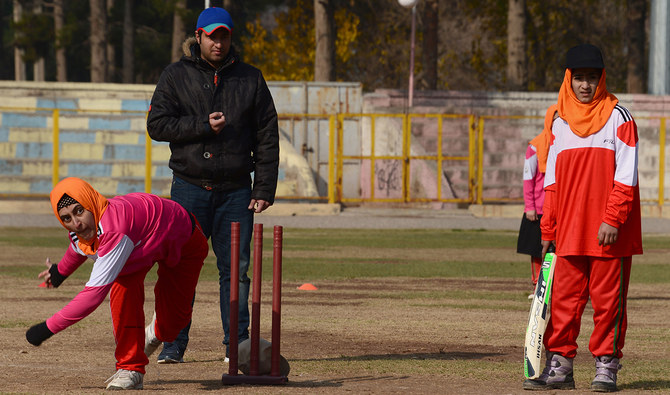

BRISBANE: Just over two years ago, Firooza Amiri was an 18-year-old batter for the Afghanistan women’s cricket team, ready to take on the world if given the chance.
But just like that, her world and that of millions of others in her country changed forever.
Forced to flee with her family when the Taliban retook power in Afghanistan on Aug. 15, 2021, Amiri and her family first traveled to Pakistan and then were evacuated to Australia. She still lives in Australia, along with most of her 25 teammates.
Now, looking for their place in international competition, they are pleading with the International Cricket Council and the Afghanistan cricket authorities to give them a place to play, despite the Taliban’s ban on women in sport and education.
“Yeah, unfortunately two weeks ago was the two-year anniversary of the Taliban and our BLACK DAY,” Amiri said in a message to The Associated Press, accentuating two words in capital letters.
Amiri and her family were from the oasis city of Herat, then the third-largest city in Afghanistan with an estimated population of about 500,000.
“It was a black day for me and all the girls of Afghanistan, the day our dreams were destroyed and all the efforts of many years of each of us were destroyed,” Amiri told the AP. “When Herat fell, we decided to go to Kabul and reach one of the foreign embassies. When we arrived in Kabul, we saw that Afghanistan had fallen completely to the Taliban and all the people were going to the airport to be able to leave the country, we did the same.”
From that point, the situation deteriorated.
“It was very painful for me when I saw that all the girls, journalists, and politicians of Afghanistan were going to the airport and were leaving their country,” Amiri said. “For me, the most terrifying moment of my life was when I saw that there was shooting everywhere, people were screaming and crying, and even a young man had been shot five times . . . that was the moment when we stopped going to the airport and I and my teammates went to a safe house.”
Another of Amiri’s teammates in Australia, Friba Hotack, was afraid her family would be targeted.
“Because my life was in danger, I separated from my family. I was in Pakistan for a month. I was afraid. I was very scared,” she told Australian Broadcasting Corp. radio earlier this year.
“Our dreams were shattered from the day the Taliban came. Everything — bat, cricket equipment, we burned everything because of the fear. The day we came to Australia, those dreams became alive again. We started to want to play again. We wanted to have a team here, to play cricket here.”
Amiri and some of her former teammates are doing just that, playing in a suburban league in Melbourne. But that’s a long way from the level they’re determined to be competing on. The Afghan men’s team travels the world and plays at the elite level. The women’s team wants a chance to do the same.
So Amiri and her teammates sent an email to the sport’s world governing body in December.
“Could you please advise what the official stance is on our national playing contracts and future playing opportunities, noting that we are no longer living in Afghanistan?” they wrote.
“The funding provided by the ICC to the ACB for the women’s program — where has this money gone? And can it be redirected to an organization in Australia to invest in our development ... so we can still represent our country on the international stage?”
Amiri added “we mentioned that we had been safely moved to Australia and that we know the situation in Afghanistan but with your help and support . . . our hopes of representing our country remains alive. We are waiting for your leadership and your right decision.”
Amiri says no one from the Afghanistan Cricket Board or ICC has contacted them.
“We did not receive any help or even any hope from them, even though since 2017 they used the budget of men and women only for men and never supported the women’s team,” Amiri said.
The ICC, in an emailed statement to the AP, said the Afghanistan Cricket Board operates autonomously and it cannot interfere.
“The ICC board remains committed to supporting the Afghanistan Cricket Board and are not penalizing the ACB, or their players for abiding by the laws set by the government of their country,” the ICC said.
“The relationship with players in any of the ICC’s member countries is managed by the board in that country, the ICC does not get involved. Similarly, the authority to field men’s and women’s national teams lies solely with the member board in any country, not with the ICC.”
Amiri said the Afghan women’s team took heart from Australia’s decision in January to cancel a limited-overs series against Afghanistan scheduled to be played in the United Arab Emirates, where the men’s team is based. Cricket Australia cited recent heavier restrictions on women’s rights by the Taliban government for not playing the three games in March.
The cancelation was evidence, Amiri said, that some countries were serious about the rights of women to represent Afghanistan in the international sports arena.
But she and some of her teammates don’t want the Afghan men’s team, which will play in the Cricket World Cup in India next month, to be banned from international cricket.
“In my opinion, banning the men’s team is not a good way to create a team for us,” Amiri said. “Because the people of Afghanistan are fans of cricket, and by banning the men’s team, in addition to the fact that the people of Afghanistan will be saddened by the women’s team, our effort is to be able to get the support of the Afghan people.”
Unfortunately, she said, players on the national men’s team have “refused to stand with us.”
“Their only answer to us was that we are endangering our families by doing this,” Amiri said. “The Afghanistan Cricket Board has not done anything for the development of women’s cricket for years.”
With a second anniversary of the Taliban takeover just passed, Amiri can’t forget the turmoil.
“For me, every year this day is a reminder of all the moments that I experienced when I was 18, the age when we all (should) study and pursue our dreams,” she said. The entire world can see, she added, “That the girls in Afghanistan don’t have the basic right of society, which is education.
“It’s painful for me to imagine that if I was in Afghanistan, would I be alive or not?”
Afghanistan’s female athletes are receiving support from one of the country’s first female Olympians — Friba Rezayee, a judo competitor at the 2004 Athens Games. Rezayee has started a petition asking the International Olympic Committee to “recognize the Afghan female athletes independently, not the Taliban NOC (National Olympic Committee).”
The Afghan women’s team hasn’t had a chance to play international cricket, yet. Amiri remains optimistic.
“I would like to say thanks to Australia and all the people who have helped us to live safely,” she says. “We believe that magic will happen one day and we will represent our country on an international ground in the world.”
To further illustrate her point, the slogan on one of Amiri’s messaging apps says: “Gonna take more than a human to stop me from where I am meant to be,” and includes a muscle-flexing arm, a cricket bat and ball, and a flag of Afghanistan.


