Pakistan ‘working closely’ with Saudi, Middle East markets on IT investments — minister

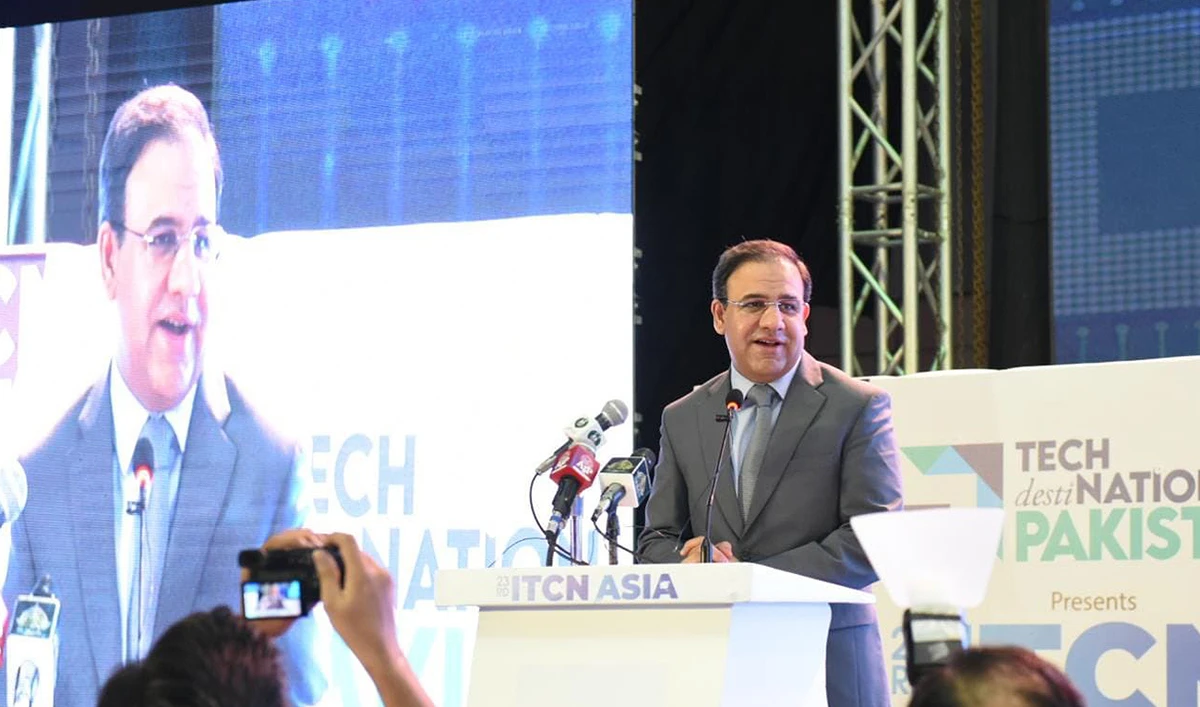
Caretaker Federal Minister for IT & Telecom, Dr. Umar Saif, speaks at ITCN Asia 23, the International IT & Telecom show at Expo Center Karachi, Pakistan, on August 31, 2023. (Photo courtesy: @umarsaif/Twitter)
Short Url
Updated 01 September 2023
Follow

Pakistan ‘working closely’ with Saudi, Middle East markets on IT investments — minister

  • IT minister says with strategic interventions, IT exports in short term can be increased from $2.6 billion to about $10 billion 
  • Urges Pakistani IT companies to bring export proceeds back to the country instead of maintaining offshore offices 

KARACHI: Pakistan is eyeing investment opportunities in the Saudi and Middle Eastern markets in the Information Technology sector, caretaker minister for IT Dr. Umar Saif said on Thursday, hoping the sector’s exports could swell to about $10 billion in the short term. 

The minister was speaking at a three-day exhibition titled ‘Declaring Pakistan the Regional ICT Hub’ at Karachi’s Expo Center where he spoke of Pakistan’s immense potential in the domestic and international IT market, saying that its population comprised educated and tech savvy youth. 

“At this point, my highest priority is to make sure that our youth gets better skills, that they’re able to contribute to the domestic economy, and to the emerging investments and opportunities in the Middle Eastern market,” Saif told Arab News at the sidelines of the event. 

“We are working closely with the Saudi market, we’re working closely with the Middle Eastern market,” he said, adding that Pakistan was also eyeing markets in Africa. 

“What we do here in terms of software production, in terms of handset manufacturing, in terms of competitiveness for telecom operators, will have huge implications for the growth of the local economy as well as our export potential.” 

Saif said Pakistan’s current IT exports did not reflect its real exports as many companies were not bringing export proceeds to the country.

“Currently, the IT industry employs about 150,000 people and has an export of about $2.6 billion,” he said. “I think the actual export is more than this because a lot of It companies— because these are service companies— park their money outside of Pakistan because they find it difficult to bring it to Pakistan.”

Saif said by addressing IT-related issues, the government can encourage Pakistani IT companies to bring export proceeds back to the country instead of maintaining offshore offices. He said Pakistan’s annual IT exports could be increased to $3.5 billion through these measures. 

The minister said Pakistan can boost its exports from $2.6 billion to about $10 billion in the short term by undertaking strategic interventions in the IT industry and online freelancing, to make sure the youth are upskilled and contributing to the IT sector. 

Speaking at the event earlier, Saif said Pakistan’s IT ministry will train 100,000 software developers through a partnership program with a private company, adding that the trainings would help enhance exports by $2 billion per annum. 

To achieve this, he said various programs and boot camps would be organized to enhance the capacity of university graduates in accordance with skills that were required by the IT industry. 

Saif said introduction of a de-risking mechanism for venture capital could bring back the investment trend in the country’s startup culture. “The ministry is planning to launch a fund of funds with 30 percent equity of the government,” he said. 

Over 400 brands, including a Saudi-based multinational Unifonic showcased their products at the exhibition. Unifonic is involved in managing conversation platforms and AI-based voice chatbot solutions. 

“We have started our operations and we see Pakistan as a big market because it’s a country with 225 million people, a very vibrant and upcoming ecommerce scenario from our perspective,” Khurram Rahat, senior country director of Unifonic, told Arab News. 

The organizers of the exhibition expect over 35,000 visitors to attend the event during the three days. 

Islamabad offers skilled manpower to help Iraq in reconstruction, development efforts

Updated 10 sec ago
Follow

Islamabad offers skilled manpower to help Iraq in reconstruction, development efforts

  • The development comes during Pakistan President Asif Ali Zardari’s four-day visit to Iraq to strengthen bilateral cooperation
  • Zardari says current levels of bilateral trade do not reflect true potential of Pakistan-Iraq ties, highlights opportunities

ISLAMABAD: Pakistan has offered to provide skilled manpower to support Iraq’s reconstruction and development efforts, the Pakistani government said on Sunday, signaling Islamabad’s willingness to deepen cooperation with Baghdad in sectors including infrastructure, technical services and human resource development.

The development comes during Pakistan President Asif Ali Zardari’s four-day visit to Iraq to strengthen cooperation in trade, investment, religious tourism, energy and other sectors.

Zardari held a one-on-one meeting with his Iraqi counterpart, Dr. Abdul Latif Jamal Rashid, at Baghdad Palace, which was followed by delegation-level talks to review the state of bilateral relations.

“President Zardari reiterated Pakistan’s willingness to support Iraq’s reconstruction and development efforts through the provision of skilled and semi-skilled manpower under the existing Memorandum of Understanding on manpower transmission,” Pakistan’s Press Information Department (PID) said in a statement.

“He also highlighted Pakistan’s capacity in medical services, financial expertise and digital governance, and expressed readiness to share technical experience, including in secure data management, to support institutional capacity-building in Iraq.”

Iraq has been working to rebuild its economy and infrastructure after decades of conflict, including the 2003 US-led invasion and years of instability caused by sectarian violence and the fight against Daesh group. Although security conditions have improved in recent years, large parts of the country still face damaged roads, power plants, hospitals and housing, requiring large-scale reconstruction and public service delivery.

During Sunday’s meeting, Zardari noted that the current levels of bilateral trade do not reflect the true potential of Pakistan-Iraq economic, cultural and security relations, highlighting opportunities in agriculture, defense production, information technology, construction, pharmaceuticals and other sectors. He underscored the importance of business-to-business engagement and the establishment of direct banking channels to facilitate trade and commercial activity, according to the PID.

Zardari also requested improved facilitation for Pakistani pilgrims visiting Iraq and expressed hope for early finalization and implementation of a proposed Memorandum of Understanding on Zaireen (pilgrims) Management, aimed at ensuring orderly travel. He expressed his firm resolve to work with the Iraqi government to stop illegal entry and overstay of those Pakistanis who violate Iraqi law.

“Both Presidents expressed their resolve to fight extremism, terrorism and narco trade and enhance bilateral cooperation,” the PID said. “The two leaders reaffirmed their commitment to further deepening bilateral cooperation across political, economic and social domains.”

Pakistan and Iraq established diplomatic relations in 1947 and have traditionally maintained cordial ties, though commercial links remain modest. The volume of trade between both countries stood at $268 million in 2023.

Pakistan’s major exports to Iraq include machinery and mechanical appliances, pharmaceutical products, fish, cereals, essential oils and resinoids. Islamabad’s imports from Iraq include mineral fuels, mineral, organic chemicals, edible fruit and nuts.