

Suicide bomber attacks security convoy in northwestern Pakistan, killing 9 soldiers — officials

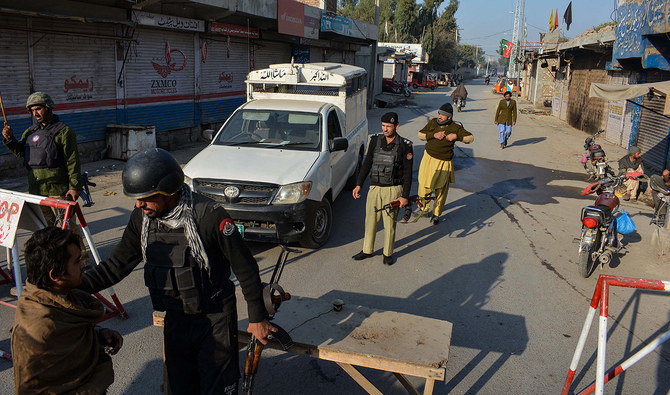
In this photo taken on December 19, 2022, police stand guard along a road they blocked after Taliban militants seized a police station in Bannu. (AFP/File)
Short Url
Updated 31 August 2023
Follow

Suicide bomber attacks security convoy in northwestern Pakistan, killing 9 soldiers — officials

  • Attack takes place in Bannu district in northwestern Pakistan bordering Afghanistan
  • No group has yet claimed responsibility for the attack that has also injured 20 people

PESHAWAR: A suicide bomber riding on a motorcycle targeted a security convoy in northwest Pakistan on Thursday, killing at least nine soldiers and wounding 20 others, three security officials said, a sign of increasing militant violence.

The attack happened in Bannu, a district of Khyber Pakhtunkhwa province bordering Afghanistan, the officials said. They spoke on condition of anonymity because they were not authorized to speak to the media on the record.

There was no immediate claim from any group, but the suspicion is likely to fall on the Pakistani Taliban, who have stepped up attacks on security forces since 2022. Authorities say the insurgents have found sanctuaries and have even been living openly in Afghanistan since the Taliban takeover, which also emboldened them,

There was no immediate comment from the army.

Bannu is located near the former militant stronghold of North Waziristan, which served as a base for insurgents until the army years ago announced that it had cleared the region of local and foreign militants. Occasional attacks have continued, however, raising concerns that the local Taliban, known as Tehrik-e-Taliban Pakistan, are regrouping in the area.

The Pakistani Taliban are a separate group but allies of the Afghan Taliban, who seized power in Afghanistan in 2021 as the U.S. and NATO troops were in the final stages of their pullout.


Pakistan urges developed nations, global institutions to expand role in climate financing

Updated 4 sec ago
Follow

Pakistan urges developed nations, global institutions to expand role in climate financing

  • Pakistan is recognized among countries worldwide most affected by climate-induced disasters
  • Planning minister stresses redesigning global financial system on principles of responsibility, equity

ISLAMABAD: Pakistan’s Planning Minister Ahsan Iqbal this week called on developed nations and international financial institutions to play a greater role in helping developing countries adopt green technologies at lower costs, state-run media reported. 

Pakistan has suffered frequent climate change-induced disasters over the past couple of years, ranging from floods, droughts, heatwaves, cyclones and other irregular weather patterns. 

This year the South Asian country reported over 1,000 deaths from floods and landslides triggered by heavy rains and the melting of glaciers. 

“He [Iqbal] said Pakistan has urged developed countries and international financial institutions to expand their role in climate financing to enable developing nations to adopt green technologies at lower costs,” state-run Associated Press of Pakistan (APP) reported on Saturday. 

The minister was speaking at the Second Asia Energy Transition Summit held at Pakistani university LUMS on Saturday. 

Iqbal warned that climate change is intensifying emergencies and increasing economic burdens on vulnerable countries, adding that financial incentives and concessional financing have become indispensable for sustainable climate action.

“He further emphasized the need to redesign the global financial system based on the principles of collective responsibility and equity,” APP said. 

The minister noted that Pakistan has been introducing comprehensive reforms in its development agenda to promote renewable energy, solar power and green technological solutions. 

The country, he said, possesses “strong solar potential,” a robust renewable energy market, a wide talent pool in engineering and science and an enabling environment for green innovation.

Pakistan has regularly urged developed countries to fulfill past pledges and provide easy access to climate funding without attaching conditions, especially at Conference of Parties (COP30) climate summits. 

Islamabad was instrumental in getting the Fund for Responding to Loss and Damage (FRLD) established at the COP27 climate summit in Egypt in 2022. The Loss and Damage Fund aims to help developing and least developed countries cope with both economic and non-economic impacts of climate change, such as extreme weather events and slow-onset crises like sea-level rise and droughts.