Pakistan seeks IMF approval to allow customers to pay electricity bills in installments

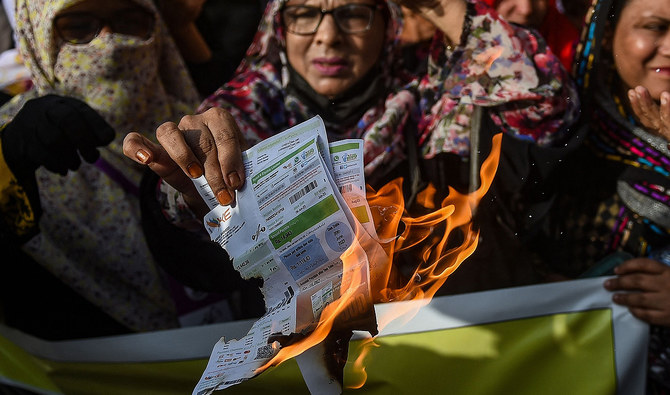
Women activists of Pakistan's Jamat-e-Islami party set electricity bills on fire during a protest against the surge in electricity prices along a street in Karachi on August 31, 2023. (AFP)
Short Url
Updated 31 August 2023
Follow

Pakistan seeks IMF approval to allow customers to pay electricity bills in installments

  • If approved, consumers will be allowed to deposit bills in installments and increase in tariff will be applied in phases
  • Price hike was agreed with IMF earlier this year when it approved short-term $3 billion bailout package for Pakistan

ISLAMABAD: The Pakistan government has shared a proposal with the International Monetary Fund (IMF) seeking approval for domestic customers to be able to pay electricity bills in installments, a senior official of the finance ministry told Arab News on Thursday, as protests continued for a second week against electricity bills.

An electricity price hike was agreed with the IMF earlier this year when the international lender approved a short-term $3 billion bailout package for Pakistan. Protests against steep bills began in Karachi on August 17 and have since spread across the country.

A Rs7 increase in basic tariff was approved last month to be levied from September, while last week the National Electric Power Regulatory Authority approved a further hike of Rs4.96 per unit, whose notification has been delayed due to ongoing protests.

“We have shared a detailed plan with the IMF seeking approval for relief to electricity consumers of up to 400 units and that the increase of Rs7 per unit be applied in phases,” the official, who declined to be named, said.

It could take a “day or two” to get approval from the IMF, after which the measures would be made public:

“If the IMF grants the approval, the ministry will allow collection of August and September electricity bills in installments.”

The government also planned to collect at least Rs250 billion by curbing electricity theft, the official said.

To a question about multiple taxes added in bills, he said the government could not reduce or abolish taxes in bills as long as Pakistan was part of an IMF program.

IMF resident representative Esther Perez Ruiz did not respond to questions seeking comment for the story. Director General Media for the finance ministry, Biraj Lal Dosani, declined to comment on the issue.

The previous government of former Prime Minister Shehbaz Sharif had agreed with the IMF to raise taxes and power prices to secure a bailout deal that helped the nation avert a sovereign debt default.

The official said the Sharif government had agreed with the IMF to keep power sector circular debt below Rs2.3 trillion and thus Pakistan was not in a position to extend any relief to the public without prior approval of the fund.

Samiullah Tariq, Director Research at Pakistan Kuwait Investment Company, said the government did not have the fiscal space to extend relief to electricity consumers as power prices and the formula were predetermined.

“The government can allow the consumers to deposit their bills in instalments, but this was also not the solution as the electricity would cost the public more next month,” he told Arab News.

Tariq said the government would have to pass on the burden to consumers with a change in currency parity as the rupee was rapidly depreciating on a daily basis against the US dollar.

“The authorities are caught in a vicious cycle now,” Tariq said, “where we can all only pray for the better.”


IMF Executive Board to review $1.2 billion loan disbursement for Pakistan today

Updated 4 sec ago
Follow

IMF Executive Board to review $1.2 billion loan disbursement for Pakistan today

  • Pakistan, IMF reached a Staff-Level Agreement in October for second review of $7 billion Extended Fund, climate fund program
  • Economists view IMF bailout packages as essential for cash-strapped Pakistan grappling with a prolonged macroeconomic crisis

ISLAMABAD: The Executive Board of the International Monetary Fund (IMF) is set to meet in Washington today to review a $1.2 billion loan disbursement for Pakistan, state media reported on Monday.

Pakistan and the IMF reached a Staff-Level Agreement (SLA) in October for the second review of a $7 billion Extended Fund Facility (EFF) and the first review of its $1.4 billion Resilience and Sustainability Facility (RSF). 

The agreement between the two sides took place after an IMF mission, led by the international lender’s representative Iva Petrova, held discussions with Pakistani authorities during a Sept. 24–Oct. 8 visit to Karachi, Islamabad and Washington D.C.

“The International Monetary Fund’s (IMF) Executive Board is set to meet in Washington today to review and approve $1.2 billion in loan for Pakistan,” state broadcaster Pakistan TV reported. 

Pakistan has been grappling with a prolonged macroeconomic crisis that has drained its financial resources and triggered a balance of payments crisis for the past couple of years. Islamabad, however, has reported some financial gains since 2022, which include recording a surplus in its current account and bringing inflation down considerably.

Economists view the IMF’s bailout packages as crucial for cash-strapped Pakistan, which has relied heavily on financing from bilateral partners such as Saudi Arabia, China and the United Arab Emirates, as well as multilateral lenders including the IMF, World Bank, Asian Development Bank and Islamic Development Bank. 

Speaking to Arab News last month, Pakistan’s former finance adviser Khaqan Najeeb said the $1.2 billion disbursement will further stabilize Pakistan’s near-term external position and unlock additional official inflows.

“Continued engagement also reinforces macro stability, as reflected in recent improvements in inflation, the current account, and reserve buffers,” Najeeb said.

Pakistan came close to sovereign default in mid-2023, when foreign exchange reserves fell below three weeks of import cover, inflation surged to a record 38% in May, and the country struggled to secure external financing after delays in its IMF program. Fuel shortages, import restrictions, and a rapidly depreciating rupee added to the pressure, while ratings agencies downgraded Pakistan’s debt and warned of heightened default risk.

The crisis eased only after Pakistan reached a last-minute Stand-By Arrangement with the IMF in June 2023, unlocking emergency support and preventing an immediate default.