

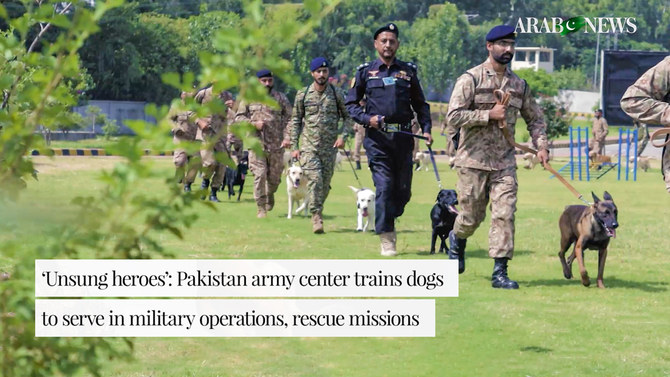
‘Unsung heroes’: Pakistan army center trains dogs to serve in military operations, rescue missions

Pakistani army soldiers train a dog for specialized reconnaissance missions at the Army Canine Centre in Rawalpindi on August 29, 2023. (AN photo)
Short Url
Updated 31 August 2023
Follow

‘Unsung heroes’: Pakistan army center trains dogs to serve in military operations, rescue missions

  • Army’s canine center in Rawalpindi has been training dogs for specialized military and other tasks since 1952
  • Training and deployment of dogs in war zones has decreased IED attacks by about 90 percent, commandant says

ISLAMABAD: Over the past seven decades, the Pakistan military’s canine center has trained hundreds of dogs that have not only taken part in local military and anti-narcotics operations but also been deployed in search and rescue missions worldwide, the Commandant of the Army Canine Centre said this week.

The center was established in the garrison city of Rawalpindi in 1952 to breed, nurture, and train dogs for deployment in various military units and formations. To date, instructors at the facility have trained thousands of dogs to take part in military operations, anti-narcotics efforts, and post-disaster rescue missions.

“Nine courses are being run at this canine centre and we receive students from army, from air force and navy, as well as from the civilian armed forces and law enforcement agencies,” Colonel Muhammad Hasan, Commandant Army Canine Centre, told Arab News in an interview on Tuesday.

The center’s commandant said the dogs underwent puppy training before being put into specialized training for six to eight months.

“For each course, we require different attributes from the dog,” Hasan said. “Like in guard dogs, we require aggression, and for sniffers, we require agility plus nose work. So, our master trainer picks these dogs and starts training them.”

Hasan said the center preferred three breeds – German Shepherds, Belgian Malinois, and Labrador Retrievers – and trained them according to their distinct characteristics.

The trained dogs had been an “integral part” of all military operations in the country, particularly to sniff out IEDs and arms and explosives, and perform tracking duties, the commandant said.

“Since 2012 when these dogs were deployed in operational areas [to fight militants], the number of IEDs has reduced by about 90 percent, and the number of incidents decreased drastically,” Hasan said.

In one incident, a chocolate coloured Labrador named Proton, deployed in Khyber tribal district in Pakistan’s northwest, was ambushed and killed by militants after recovering over 100 IEDs and large quantities of ammunition in dozens of operations in 2014.

“To recognize him, the chief of the army staff [Gen Raheel Sharif], on the recommendation of our directorate, suggested a medal for these unsung heroes, and the Proton medal has since been awarded to five dogs in various categories so far,” Hasan said.

The centre had also trained students from foreign countries:

“Mostly they come from the Arab countries and we train them in the art and science of dog handling as well as canine training,” the commandant said. 

During last year’s FIFA World Cup, 40 Pakistani dog handlers were sent to Doha with a military contingent to perform security and protection responsibilities.

Dogs from the training center have also performed international assignments, including rescue work in Nepal and Turkey after earthquakes, the colonel said. 

“Our urban search and rescue dogs participated in the rescue missions in Nepal in 2022 and 2023 in Turkey,” Hasan said, “where they recovered dead bodies and live humans and animals.”


Imran Khan not a ‘national security threat,’ ex-PM’s party responds to Pakistan military

Updated 06 December 2025
Follow

Imran Khan not a ‘national security threat,’ ex-PM’s party responds to Pakistan military

  • Pakistan’s military spokesperson on Friday described Khan’s anti-army narrative as a “national security threat”
  • PTI Chairman Gohar Ali Khan says words used by military spokesperson for Khan were “not appropriate”

ISLAMABAD: Former prime minister Imran Khan’s Pakistan Tehreek-e-Insaf (PTI) party on Saturday responded to allegations by Pakistan military spokesperson Lt. Gen. Ahmed Sharif Chaudhry from a day earlier, saying that he was not a “national security threat.”

Chaudhry, who heads the military’s media wing as director general of the Inter-Services Public Relations (ISPR), spoke to journalists on Friday, in which he referred to Khan as a “mentally ill” person several times during the press interaction. Chaudhry described Khan’s anti-army narrative as a “national security threat.”

The military spokesperson was responding to Khan’s social media post this week in which he accused Chief of Defense Forces Field Marshal Asim Munir of being responsible for “the complete collapse of the constitution and rule of law in Pakistan.” 

“The people of Pakistan stand with Imran Khan, they stand with PTI,” the party’s secretary-general, Salman Akram Raja, told reporters during a news conference. 

“Imran Khan is not a national security threat. Imran Khan has kept the people of this country united.”

Raja said there were several narratives in the country, including those that created tensions along ethnic and sectarian lines, but Khan had rejected all of them and stood with one that the people of Pakistan supported. 

PTI Chairman Gohar Ali Khan, flanked by Raja, criticized the military spokesperson as well, saying his press talk on Thursday had “severely disappointed” him. 

“The words that were used [by the military spokesperson] were not appropriate,” Gohar said. “Those words were wrong.”

NATURAL OUTCOME’

Speaking to reporters earlier on Saturday, Pakistan’s Defense Minister Khawaja Asif defended the military spokesperson’s remarks against Khan.

“When this kind of language is used for individuals as well as for institutions, then a reaction is a natural outcome,” he said. 

“The same thing is happening on the Twitter accounts being run in his [Khan’s] name. If the DG ISPR has given any reaction to it, then I believe it was a very measured reaction.”

Khan, who was ousted after a parliamentary vote of confidence in April 2022, blames the country’s powerful military for removing him from power by colluding with his political opponents. Both deny the allegations. 

The former prime minister, who has been in prison since August 2023 on a slew of charges he says are politically motivated, also alleges his party was denied victory by the army and his political rivals in the 2024 general election through rigging. 

The army and the government both deny his allegations.