

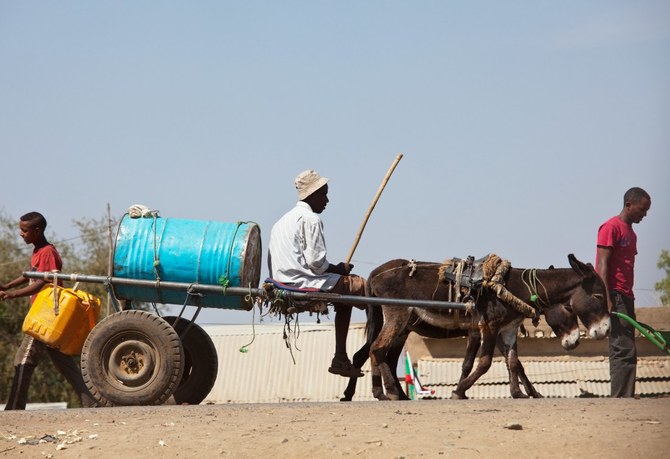

WASHINGTON: In the coming decades, people living in the Middle East will be threatened by extended heatwaves, rises in average temperatures and water scarcity, complicated by the possible instigation of regional conflicts over dwindling resources, unless serious efforts are made to mitigate these conditions, say experts.
The Middle East has already seen a 1.5 C increase in average temperatures since the 1990s, but the worst is not over, according to climate and water experts during a session hosted by the Washington-based Middle East Institute on Tuesday.
They said countries including Syria, Iraq, Yemen and Sudan are prime examples of the impact of internal conflicts and extreme climate conditions, and half of the region’s people are living in water-stressed areas.
These serious conditions should present opportunities for governments in the region to cooperate with each other and international organizations to find solutions and take action, they added.
Mohammed Mahmoud, a senior fellow and director of the Climate and Water Program at the MEI, said the region is facing severe challenges because of climate change.
“Even without climate change, the region is prone to drought and dry weather. But when adding climate change, the issue becomes more serious,” he added.
Mahmoud said Sudan, wracked by conflict between government forces and the paramilitary Rapid Support Forces, is now seeing people lack access to water and food.
It is highly likely that there will be armed conflict over water resources in the future, he added.
Hayder Alabdali, a climate and environment officer at the International Committee of the Red Cross in Baghdad, said Iraq, a country with a historic abundance of water resources and deep agricultural heritage, is facing water shortages, with the rise in temperatures impacting agriculture and the population’s well-being.
Clare Dalton, the ICRC’s head of mission in the UAE, said an added difficulty is air pollution. Iraq is the fifth-most vulnerable country in the world in terms of extreme temperatures, water scarcity and food shortages, she added.
Alabdali said the Iraqi government lacks clear long-term strategies and solutions to its water crisis and the impact of climate change. The problem is exacerbated by the impact of dams built upstream in Turkiye and Syria, he added.
“We’re particularly concerned over these issues (which are) making the humanitarian impact more difficult,” he said.
Alabdali added that Iraq’s government only has “short-term solutions,” especially when allowing the population to drill boreholes for farming, which is threatening underground water aquifers.
Megan Ferrando, a non-resident scholar of the Climate and Water Program at the MEI, said drought and floods have created water shortages across Syria, and people there have been experiencing a cholera epidemic, which is another example of how armed conflict can exacerbate existing living conditions.


