

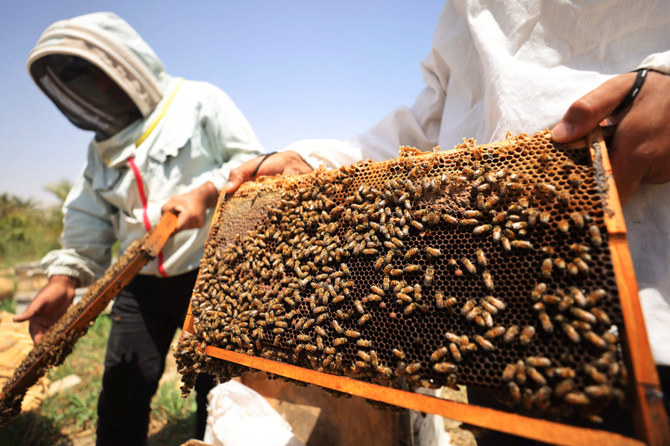


AL-REGHILA, Iraq: An oppressive heat beats down on the central Iraqi province of Babylon, where drought and rising temperatures are hitting bees and honey production hard.
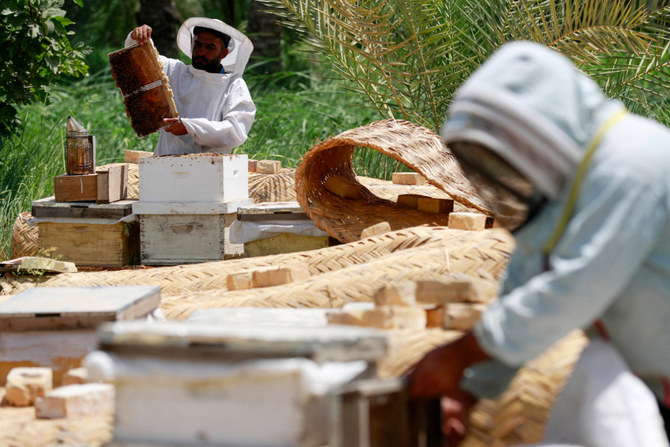
Beekeeper Mohamed Aliawi knows it all too well as he checks on dozens of hive boxes placed at the feet of tall palm trees in the fields of Al-Reghila village.
“There is no water and therefore no (flowering) plants to keep the bees satisfied,” Aliawi, the deputy director of a local apiarist association, told AFP.
The earth is cracked, and growing melons and watermelons proves difficult due to a lingering drought and intense July temperatures often reaching around 50 degrees Celsius (122 Fahrenheit) — which take their toll on bees too.
A bee needs to constantly forage for the pollen and nectar necessary for honey production. It is in constant movement, usually traveling hundreds of meters (yards) to find its bounty, said Aliawi.
But the drought is forcing bees to travel longer — up to five kilometers (three miles) — to pollinate.
“This impacts the lifespan of the worker bee,” the female bee that gathers pollen and nectar, Aliawi explained.
“Under optimal circumstances, the worker bee can live up to 60 days, but in this current situation it only lives 20 days.”
In addition, bees thrive in temperatures of around 30-35 degrees Celsius, not in searing heat, when the thermometer climbs to 50, said Aliawi, the manager of a private honey producer.
He has moved dozens of bee hive boxes from central Iraq to seven sites scattered across the mountains of the northern autonomous Kurdistan region, where the air is cooler and the land greener.
“If we don’t move the bees they suffer,” he said.
On a hot July day, Aliawi and his team wore protective headgear before inspecting the bee hive boxes and the honeycombs inside.
They wafted smoke over the hives with a bee smoker, a procedure known to calm the insects.
In the early 2000s, each bee hive yielded about 20 to 25 kilograms (44-55 pounds) of honey per year, whereas now the quantity has plunged to merely five kilograms, Aliawi said.
According to the United Nations, Iraq is one of the five countries in the world most impacted by some effects of climate change.
Authorities say Iraq is going through its fourth-straight year of drought.
The country has been plagued by scorching summers, declining rainfall and frequent sand storms, while upstream dams have reduced the flow of the Tigris and Euphrates rivers that run across Iraq.
Despite these woes, the head of the apiarist department at the agriculture ministry, Hashem Al-Zeheiri, remains optimistic.
Honey production is “increasing year on year,” he said.
In 2022, honey produced in parts of Iraq controlled by the Baghdad federal authorities reached 870 tons, while in Kurdistan 850 tons were produced — up from about 700 tons in each territory the previous year.
Zeheiri said he has prepared a study on the benefits of moving bee hives from southern and central Iraq to Kurdistan, and vice-versa “according to needs,” in order to improve yields.
The United Nations Development Programme said in a 2020 report that “beekeeping has existed in Iraq... for an estimated 8,000 years,” with “recipes that use honey for medicinal purposes” inscribed on ancient Sumerian tablets.
In modern times, beekeeping in Iraq is dominated by men, but that has not stopped Zeinab Al-Maamuri.
She developed a passion after discovering beekeeping through her late husband, who had taken it up as a hobby.
Three decades on and now in her early 50s, Maamuri has 250 bee hives in the province of Babylon, dozens of which she keeps in the courtyard of the family house.
She lamented the effects of a warming planet on her bees.
“The rise in temperatures affects bees... the queen stops laying eggs” when it is too hot, Maamuri said.
And during the frequent sand storms that buffet the country, “if the bees are out, half will not return.”


