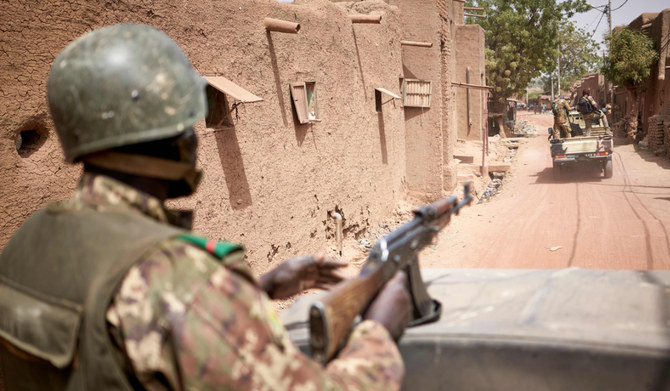

UNITED NATIONS: The United Nations is in the throes of what Secretary-General António Guterres calls an “unprecedented” six-month exit from Mali on orders of the West African nation’s military junta, which has brought in mercenaries from Russia’s Wagner Group to help fight an Islamic insurgency.
The UN special envoy for Mali, El-Ghassim Wane, laid out the scale of the operation to the UN Security Council on Monday: All 12,947 UN peacekeepers and police must be sent home, their 12 camps and one temporary base handed over to the government, and 1,786 civilian staff terminated by the Dec. 31 deadline.
Mali’s UN Ambassador Issa Konfourou said the government is cooperating with the UN peacekeeping mission, known as MINUSMA, but it will not extend the deadline.
The United Nations also needs to move out approximately 5,500 sea containers of equipment and 4,000 vehicles that belong to the UN and the countries that contributed personnel to MINUSMA, the fourth largest of the UN’s dozen peacekeeping operations, Wane said.
That process has begun but will continue during a “liquidation” period that will begin on Jan. 1, 2024 and last for 18 months, with the UN keeping police in the three hubs in the capital, Bamako, Gao and Timbuktu where the equipment is being gathered.
Mali has been in turmoil since a 2012 military coup which was followed by rebels in the north forming a Daesh two months later.
The extremist rebels were forced from power in the north with the help of a French-led military operation, but they moved from the arid north to more populated central Mali in 2015 and remain active.
In August 2020, Mali’s president was overthrown in a coup that included an army colonel who carried out a second coup and was sworn in as president in June 2021. He developed ties to Russia’s military and the Wagner group whose head, Yevgeny Prigozhin, was reportedly killed in a plane crash on a flight from Moscow last week.
The UN deployed peacekeepers in 2013 and MINUSMA has become the most dangerous UN mission in the world, with more than 300 personnel killed.
In a 13-page letter to Security Council members circulated Monday, Guterres said “the timeline, scope and complexity of the mission’s withdrawal are unprecedented.”
He said the landlocked country’s “vast terrain, the hostile operating environment in certain regions and its climates render the mission’s withdrawal within a six-month time frame extremely challenging.”
Guterres said the logistics of moving troops and equipment is further constrained by the presence of “terrorist armed groups” and the recent military takeover of Niger, a key transit country.
UN experts said in a report last week that Islamic State extremists have almost doubled the territory they control in Mali in less than a year, and that their Al-Qaeda-linked rivals are also capitalizing on the deadlock and perceived weakness of armed groups that signed a 2015 peace agreement.
UN envoy Wane told the Security Council that the first phase of the withdrawal focused on closing the smallest and furthest outposts – Menaka, Ber, Goundam and the temporary base in Ogossagou — which was completed on Aug. 25.
The withdrawal from Ber took place two days early because of clashes at the camp, and UN convoys leaving the camp were attacked, with no casualties.
Mali’s Konfourou said “armed terrorist groups took hostile action to prevent the Malian security and armed forces from occupying the camp” at Ber.
France’s deputy UN ambassador Nathalie Broadhurst told the council the clashes in Ber occurred “with the participation of Wagner mercenaries” and were a serious violation of a cease-fire and the 2015 peace agreement.
US Ambassador Linda Thomas-Greenfield also expressed alarm at the resumption of hostilities in northern Mali, including at Ber.
“Additionally, MINUSMA’s withdrawal limits the ability of the international community to protect civilians from the predations of Wagner, whose activities contribute to greater insecurity in the country,” she said.
Russia’s deputy UN ambassador Dmitry Polyansky made no mention of Wagner but said, “Russia will continue to provide Mali and other interested African partners with comprehensive assistance on a bilateral, equal and mutually respectful basis.”
UN envoy Wane said the second and final phase of the troop withdrawal starting Sept.1 “will be incredibly difficult” because of the long distances that convoys evacuating troops and equipment need to travel, including through hostile areas — 563 kilometers in the case of the Tessalit camp.
Wane stressed that the withdrawal is taking place as the 2015 peace agreement between the government, a pro-government militia and a coalition of groups seeking autonomy in Mali’s north is paralyzed.
“That agreement is the cornerstone of Mali’s long-term stabilization,” he said.