Pope Francis laments ‘reactionary,’ politicized, US Catholic Church

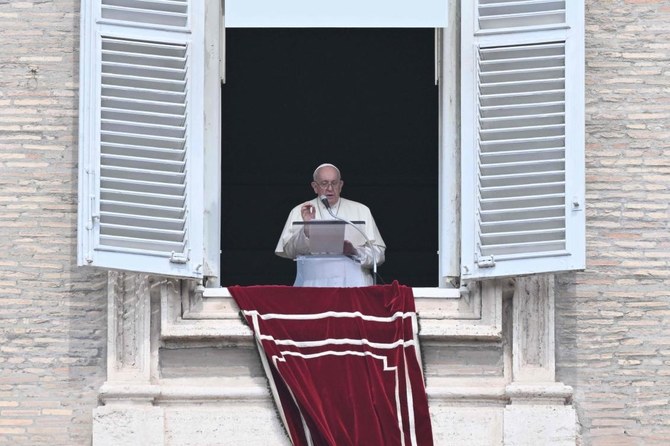
Pope Francis says his critics should understand that ‘there is an appropriate evolution in the understanding of matters of faith and morals.’ (AFP)
Short Url
Updated 28 August 2023
Follow

Pope Francis laments ‘reactionary,’ politicized, US Catholic Church

  • Pope Francis has been criticized by conservative sectors of the US Church who are opposed to reforms
  • Francis says his critics should understand that ‘there is an appropriate evolution in the understanding of matters of faith and morals’

VATICAN CITY: Pope Francis has lamented what he called a “reactionary” Catholic Church in the United States, where he said political ideology has replaced faith in some cases.
In the 10 years since his election, Francis has been criticized by conservative sectors of the US Church who are opposed to reforms such as giving women and lay Catholics more roles and making the Church more welcoming and less judgmental toward some, including LGBT people.
Francis made his comments on Aug. 5 in a private meeting in Lisbon with members of the Jesuit order, of which he is a member, during his trip for World Youth Day. They were published on Monday by the Jesuit journal Civilta Cattolica.
In a question-and-answer session, a Portuguese Jesuit said that during a sabbatical in the United States, he was saddened that many Catholics, including some bishops, were hostile to the pope’s leadership.
“You have seen that in the United States the situation is not easy: there is a very strong reactionary attitude. It is organized and shapes the way people belong, even emotionally,” the pope responded.
Religious conservatives in the United States often have aligned with politically conservative media outlets to criticize the pope over a host of issues such as climate change, immigration, social justice, his calls for gun control and his opposition to the death penalty.
“You have been to the United States and you say you have felt a climate of closure. Yes, this climate can be experienced in some situations,” Francis said.
“And there, one can lose the true tradition and turn to ideologies for support. In other words, ideology replaces faith, membership in a sector of the Church replaces membership in the Church,” he said.
Francis said his critics should understand that “there is an appropriate evolution in the understanding of matters of faith and morals” and that being backward-looking is “useless.”
As an example, he said some pontiffs centuries ago were tolerant of slavery but the Church evolved.
One of the pope’s fiercest American critics, Rome-based Cardinal Raymond Burke, wrote in an introduction for a recent book that a meeting of bishops called by Francis for this October to help chart the future of the Church risked sowing “confusion and error and division.”


India’s prime minister says it has reached a free trade deal with the EU

Updated 4 sec ago
Follow

India’s prime minister says it has reached a free trade deal with the EU

  • It touches a whopping 2 billion people and is one of the biggest bilateral engagements on commerce
  • The timing comes as Washington targets both India and the EU with steep import tariffs
NEW DELHI: Prime Minister Narendra Modi said Tuesday that India and the European Union have reached a free trade agreement to deepen their economic and strategic ties.
The accord, which touches a whopping 2 billion people, was concluded after nearly two decades of negotiations. It was dubbed the “mother of all deals” by both sides.
It is one of the biggest bilateral engagements on commerce. The timing comes as Washington targets both India and the EU with steep import tariffs.
“This agreement will bring major opportunities for the people of India and Europe. It represents 25 percent of the global GDP and one-third of global trade,” Modi said while virtually addressing an energy conference.
The deal comes at a time when Washington is targeting both India and the EU with steep tariffs, disrupting established trade flows and pushing major economies to seek alternate partnerships.
Modi was scheduled to meet with European Commission President Ursula von der Leyen later Tuesday to jointly announce the agreement.
India has stepped up efforts to diversify its export destinations as part of a broader strategy to offset the impact of higher US tariffs.
The tariffs include an extra 25 percent levy on Indian goods for its unabated purchases of discounted Russian oil, bringing the combined tariffs imposed by the United States on its ally to 50 percent.
The deal gives the EU expanded access to one of the world’s fastest-growing major economies, helping European exporters and investors to reduce their reliance on more volatile markets.
Bilateral trade between India and EU stood at $136.5 billion in 2024-25. The two sides hope to increase that to about $200 billion by 2030, India’s Trade Ministry officials said.
“Ultimately, the agreement is about creating a stable commercial corridor between two major markets at a time the global trading system is fragmenting,” said Indian trade analyst Ajay Srivastava.
The EU is still reeling from the aggressive approach of its once-stalwart ally across the Atlantic. There’s a widespread sense of betrayal across the 27-nation bloc from US President Donald Trump’s onslaught of higher tariffs, embrace of far-right parties, and belligerence over Greenland.
Brussels has accelerated its outreach to markets around the world: Over the past year, von der Leyen has signed deals with Japan, Indonesia, Mexico, and South America under the catchphrase “strategic autonomy,” which in practice is akin to decoupling from a US seen by most European leaders as erratic.
“We are showing a fractured world that another way is possible,” she posted on X after arriving in India on Sunday.