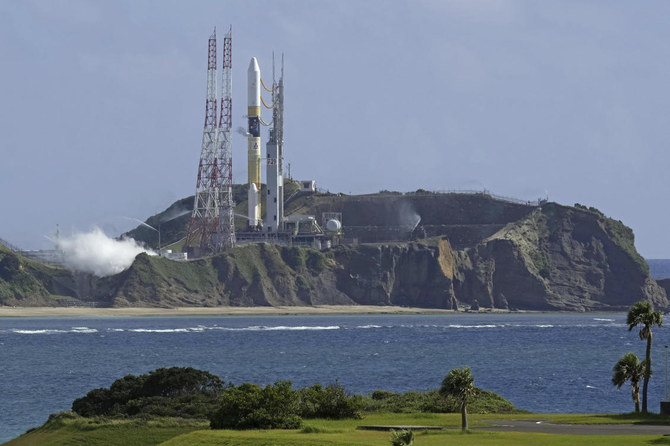
TOKYO: Japan’s space agency on Monday postponed for the third time the launch of its “Moon Sniper” lunar mission due to strong winds just half an hour before launch.
The Japan Aerospace Exploration Agency (JAXA) gave no new date for the launch, which comes after India successfully landed a probe on the Moon last week.
The rocket, set for launch from the southern island of Tanegashima, will also carry a research satellite developed by JAXA, NASA and the European Space Agency.
Tatsuru Tokunaga, a Mitsubishi Heavy Industries official in charge of the launch, told reporters the mission was postponed as “upper winds did not meet the launch conditions” and that it would take “at least three days” to prepare for another attempt.
The firm said the launch needs to happen before the current window expires on September 15.
Last week, India landed a craft near the Moon’s south pole in a historic triumph.
Previously, only the United States, Russia and China had managed to put a spacecraft on the lunar surface, and none on the south pole.
India’s success came days after a Russian probe crashed in the same region, and four years after a previous Indian attempt failed at the last moment.
Japan has also tried before, attempting last year to land a lunar probe named Omotenashi, carried on NASA’s Artemis 1 mission, but the mission went wrong and communications were lost with the craft.
In April, Japanese start-up ispace failed in an ambitious attempt to become the first private company to land on the Moon, losing communication with its craft after what the firm called a “hard landing.”
The “Moon Sniper” is so called because JAXA is aiming to land its lightweight “Smart Lander for Investigating Moon” (SLIM) within 100 meters of a specific target on the Moon.
This is far less than the usual range of several kilometers.
Using a palm-sized mini rover developed with a toy company, SLIM aims to investigate how the Moon was formed by examining exposed pieces of the lunar mantle.
Japan has also had problems with launch rockets, with failures after liftoff of the next-generation H3 model in March and the normally reliable solid-fuel Epsilon the previous October.
Last month, the test of an Epsilon S rocket, an improved version of the Epsilon, ended in an explosion 50 seconds after ignition.


![]()

Japan postpones ‘Moon Sniper’ launch for third time
Short Url
https://arab.news/v2b6s
Japan postpones ‘Moon Sniper’ launch for third time
- Launch needs to happen before the current window expires on September 15
- Last week, India landed a craft near the Moon’s south pole in a historic triumph


Latest updates


© 2026 SAUDI RESEARCH & PUBLISHING COMPANY, All Rights Reserved And subject to Terms of Use Agreement.