

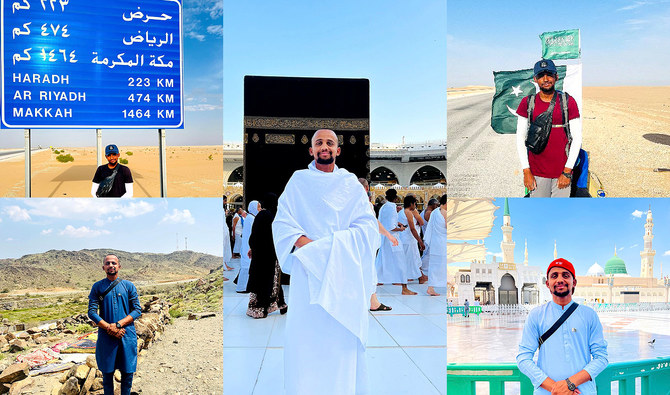

ISLAMABAD: With a small backpack slung over his shoulders, an umbrella in hand, and a pair of trekking shoes on his feet, Pakistani student Usman Arshad set out from his hometown of Okara in eastern Pakistan in October 2022 on an ambitious journey on foot. Four months and 5,400 kilometers later, he arrived in Makkah in March 2023 passing through Pakistan, the United Arab Emirates, and Saudi Arabia to perform the annual Islamic spiritual pilgrimage, Hajj.
Saudi Arabia this year reinstated Pakistan’s pre-pandemic Hajj quota of 179,210 pilgrims and scrapped the upper age limit of 65 in January. More than 160,000 Pakistani pilgrims performed the pilgrimage this year which fell on June 26.
A travel enthusiast and student, Arshad, 25, documented his journey from Okara to Makkah through various vlogs on YouTube. “I entered Saudi Arabia on an Umrah visa well before the Hajj process commenced,” Arshad told Arab News on Sunday.
However, when his three-month Umrah visa neared its expiry date, Arshad said he acquired the Hajj visa by paying the required fee for it and re-entering the Kingdom with the help of the Pakistani Hajj Mission and the Saudi authorities.
“I paid the same Hajj dues in Pakistan that other Pakistani pilgrims had paid, which amounted to Rs1.175 million ($3,855), and received my Hajj visa online while I was in Saudi Arabia with support from the Pakistani Hajj Mission,” he said.
Arshad appreciated the Saudi government for allowing him to re-enter the Kingdom via a seamless process.
“The Saudi government provided considerable assistance throughout this process, as I traveled to the Saudi-Bahrain border where I exited on my Umrah visa and re-entered the Kingdom using the Hajj visa," Arshad explained.
"And unlike the usual requirement for travelers exiting the border to obtain a Bahrain visa for re-entry, I was allowed to remain at the Saudi side of the border."
He said that while usually, the process entails that the Hajj process for Pakistani pilgrims has to be conducted from Pakistan, Saudi authorities helped out with his "unique situation" by managing the formalities on his behalf and sending him the Hajj visa online.
Arshad's four-month stay in the Kingdom was a spiritually refreshing one, where he got the chance to visit some of Islam's most holy sites including the famous cave in Mount Hira near Makkah which was frequented by Prophet Muhammad (PBUH).
The Pakistani student also visited the Thawr cave, the Al-Qiblatain mosque built two years after the prophet arrived in Madinah, and the first mosque built ever, the Quba mosque. Arshad also visited many holy places in Madinah which serve as a customary spot for millions of Muslims during Hajj and Umrah season.
He was all praises for the arrangements made by the Saudi government.
“The accommodations provided, including the hotel, were of exceptional quality, and all other arrangements were equally well-executed,” Arshad shared.
He said the security staff sprayed cold water on pilgrims during the scorching heat to ensure they stayed cool during the harsh weather while transport and accommodation were also top-notch.
“The train and various other measures implemented by the government greatly aided Hajj pilgrims, boosting their confidence and streamlining their travel experience,” Arshad said.
The scorching heat and strong winds were the only challenges Arshad faced in makeshift tents.
“There were vast stretches without any human population for several kilometers which compelled me to camp and spend the nights alone,” he said.
Not once, though, did he question his decision to embark on the spiritual journey.
“Alhamdulillah, I successfully completed this journey with ease and with a lot of beauty,” he said.


