

Pakistani who performed Hajj on foot thanks Kingdom for ‘considerable assistance’ in visa process

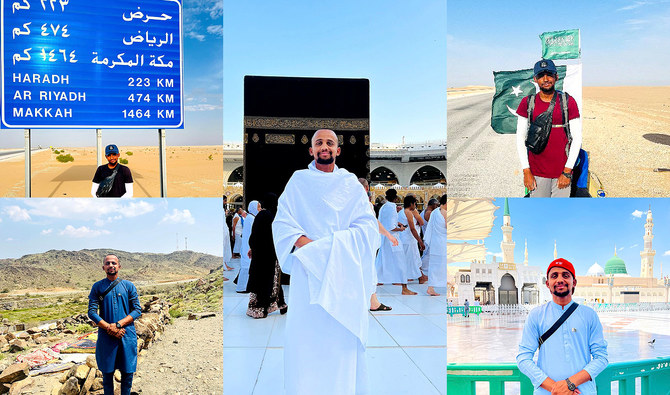
In this combination of photos, created on August 27, 2023, shows Pakistani student Usman Arshad who performed Hajj on foot in June this year. (Photos courtesy: Facebook/Usman Arshad)
Short Url
Updated 27 August 2023
Follow

Pakistani who performed Hajj on foot thanks Kingdom for ‘considerable assistance’ in visa process

  • Usman Arshad began journey on foot to perform Hajj from eastern Okara city in October 2022, arriving in Makkah by March 2023
  • Arshad acknowledges efforts by the Saudi government to ensure his seamless re-entry into Kingdom after expiry of his Umrah visa

ISLAMABAD: With a small backpack slung over his shoulders, an umbrella in hand, and a pair of trekking shoes on his feet, Pakistani student Usman Arshad set out from his hometown of Okara in eastern Pakistan in October 2022 on an ambitious journey on foot. Four months and 5,400 kilometers later, he arrived in Makkah in March 2023 passing through Pakistan, the United Arab Emirates, and Saudi Arabia to perform the annual Islamic spiritual pilgrimage, Hajj.

Saudi Arabia this year reinstated Pakistan’s pre-pandemic Hajj quota of 179,210 pilgrims and scrapped the upper age limit of 65 in January. More than 160,000 Pakistani pilgrims performed the pilgrimage this year which fell on June 26.

A travel enthusiast and student, Arshad, 25, documented his journey from Okara to Makkah through various vlogs on YouTube. “I entered Saudi Arabia on an Umrah visa well before the Hajj process commenced,” Arshad told Arab News on Sunday.

However, when his three-month Umrah visa neared its expiry date, Arshad said he acquired the Hajj visa by paying the required fee for it and re-entering the Kingdom with the help of the Pakistani Hajj Mission and the Saudi authorities.

“I paid the same Hajj dues in Pakistan that other Pakistani pilgrims had paid, which amounted to Rs1.175 million ($3,855), and received my Hajj visa online while I was in Saudi Arabia with support from the Pakistani Hajj Mission,” he said.

Arshad appreciated the Saudi government for allowing him to re-enter the Kingdom via a seamless process.

“The Saudi government provided considerable assistance throughout this process, as I traveled to the Saudi-Bahrain border where I exited on my Umrah visa and re-entered the Kingdom using the Hajj visa," Arshad explained.

"And unlike the usual requirement for travelers exiting the border to obtain a Bahrain visa for re-entry, I was allowed to remain at the Saudi side of the border."

He said that while usually, the process entails that the Hajj process for Pakistani pilgrims has to be conducted from Pakistan, Saudi authorities helped out with his "unique situation" by managing the formalities on his behalf and sending him the Hajj visa online.

Arshad's four-month stay in the Kingdom was a spiritually refreshing one, where he got the chance to visit some of Islam's most holy sites including the famous cave in Mount Hira near Makkah which was frequented by Prophet Muhammad (PBUH).

The Pakistani student also visited the Thawr cave, the Al-Qiblatain mosque built two years after the prophet arrived in Madinah, and the first mosque built ever, the Quba mosque. Arshad also visited many holy places in Madinah which serve as a customary spot for millions of Muslims during Hajj and Umrah season.

He was all praises for the arrangements made by the Saudi government.

“The accommodations provided, including the hotel, were of exceptional quality, and all other arrangements were equally well-executed,” Arshad shared.

He said the security staff sprayed cold water on pilgrims during the scorching heat to ensure they stayed cool during the harsh weather while transport and accommodation were also top-notch.

“The train and various other measures implemented by the government greatly aided Hajj pilgrims, boosting their confidence and streamlining their travel experience,” Arshad said.

The scorching heat and strong winds were the only challenges Arshad faced in makeshift tents.

“There were vast stretches without any human population for several kilometers which compelled me to camp and spend the nights alone,” he said.

Not once, though, did he question his decision to embark on the spiritual journey.

“Alhamdulillah, I successfully completed this journey with ease and with a lot of beauty,” he said.


IMF warns against policy slippage amid weak recovery as it clears $1.2 billion for Pakistan

Updated 11 December 2025
Follow

IMF warns against policy slippage amid weak recovery as it clears $1.2 billion for Pakistan

  • Pakistan rebuilt reserves, cut its deficit and slowed inflation sharply over the past one year
  • Fund says climate shocks, energy debt, stalled reforms threaten stability despite recent gains

ISLAMABAD: Pakistan’s economic recovery remains fragile despite a year of painful stabilization measures that helped pull the country back from the brink of default, the International Monetary Fund (IMF) warned on Thursday, after it approved a fresh $1.2 billion disbursement under its ongoing loan program.

The approval covers the second review of Pakistan’s Extended Fund Facility (EFF) and the first review of its climate-focused Resilience and Sustainability Facility (RSF), bringing total disbursements since last year to about $3.3 billion.

Pakistan entered the IMF program in September 2024 after years of weak revenues, soaring fiscal deficits, import controls, currency depletion and repeated climate shocks left the economy close to external default. A smaller stopgap arrangement earlier that year helped avert immediate default, but the current 37-month program was designed to restore macroeconomic stability through strict monetary tightening, currency adjustments, subsidy rationalization and aggressive revenue measures.

The IMF’s new review shows that Pakistan has delivered significant gains since then. Growth recovered to 3 percent last year after shrinking the year before. Inflation fell from over 23 percent to low single digits before rising again after this year’s floods. The current account posted its first surplus in 14 years, helped by stronger remittances and a sharp reduction in imports. And the government delivered a primary budget surplus of 1.3 percent of GDP, a key program requirement. Foreign exchange reserves, which had dropped dangerously low in 2023, rose from US$9.4 billion to US$14.5 billion by June.

“Pakistan’s reform implementation under the EFF arrangement has helped preserve macroeconomic stability in the face of several recent shocks,” IMF Deputy Managing Director Nigel Clarke said in a statement after the Board meeting.

But he warned that Islamabad must “maintain prudent policies” and accelerate reforms needed for private-sector-led and sustainable growth.

The Fund noted that the 2025 monsoon floods, affecting nearly seven million people, damaging housing, livestock and key crops, and displacing more than four million, have set back the recovery. The IMF now expects GDP growth in FY26 to be slightly lower and forecasts inflation to rise to 8–10 percent in the coming months as food prices adjust.

The review warns Pakistan against relaxing monetary or fiscal discipline prematurely. It urges the State Bank to keep policy “appropriately tight,” allow exchange-rate flexibility and improve communication. Islamabad must also continue raising revenues, broadening the tax base and protecting social spending, the Fund said.

Despite the progress, Pakistan’s structural weaknesses remain severe.

Power-sector circular debt stands at about $5.7 billion, and gas-sector arrears have climbed to $11.3 billion despite tariff adjustments. Reform of state-owned enterprises has slowed, including delays in privatizing loss-making electricity distributors and Pakistan International Airlines. Key governance and anti-corruption reforms have also been pushed back.

The IMF welcomed Pakistan’s expansion of its flagship Benazir Income Support Program, which raises cash transfers for low-income families and expands coverage, saying social protection is essential as climate shocks intensify. But it warned that high public debt, about 72 percent of GDP, thin external buffers and climate exposure leave the country vulnerable if reform momentum weakens.

The Fund said Pakistan’s challenge now is to convert short-term stabilization into sustained recovery after years of economic volatility, with its ability to maintain discipline, rather than the size of external financing alone, determining the durability of its gains.