

3 US Marines dead after aircraft crashes during drills in Australia

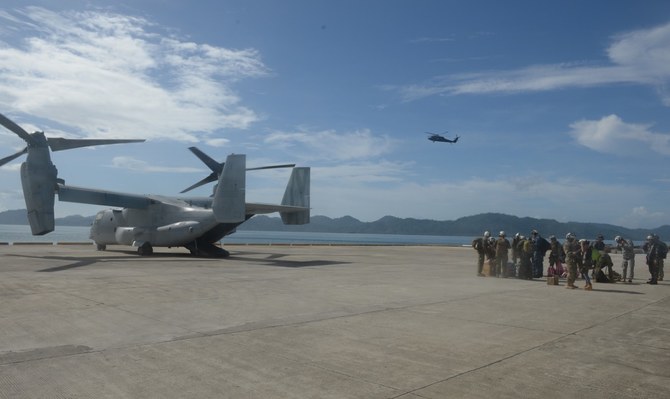
File photo of a v-22 Osprey helicopter (AFP)
Short Url
Updated 29 August 2023
Follow

3 US Marines dead after aircraft crashes during drills in Australia

  • Five Marines rescued from the crash site and flown to a hospital in Darwin in a ‘serious condition’
  • The Osprey was taking part in the Predators Run exercises

DARWIN, Australia: Three US Marines died Sunday after an Osprey aircraft crashed on a remote tropical island north of Australia during war games, US military officials said.

Five Marines had been rescued from the crash site and flown to a hospital in Darwin in a “serious condition,” the US officials said, while Australian police said they were triaging the rest of the injured crew at the scene.

“There were a total of 23 personnel on board,” US military officials said in a statement.

“Three have been confirmed deceased while five others were transported to Royal Darwin Hospital in a serious condition.”

Rescue efforts were complicated by the location of the crash — the remote and sparsely populated Melville Island about 60 kilometers (37 miles) north of the Australian mainland.

“Recovery efforts are ongoing,” US officials said, adding that an investigation into the cause of the incident had been launched.

Prime Minister Anthony Albanese described the incident as “tragic” and “regrettable” but stressed that authorities were still trying to piece together what happened.

“We want to make sure that any information that is provided is absolutely accurate,” he told reporters.

The Osprey — a mix between a helicopter and a plane — was taking part in the Predators Run exercises, a joint series of warfighting drills involving thousands of soldiers from the US and Australia, as well as other militaries such as Indonesia and the Philippines.

Northern Australia has become an increasingly important staging ground for the US military in recent years, as Washington and Canberra work together to counter China’s growing clout in the Asia-Pacific region.

The Osprey aircraft has a troubled history, blighted by a string of fatal crashes over the years.

Four US Marines were killed in Norway last year when their V-22B Osprey aircraft went down during NATO training exercises.

Three Marines were killed in 2017 when an Osprey crashed after clipping the back of a transport ship while trying to land at sea off Australia’s north coast.

And 19 Marines died in 2000 when their Osprey crashed during drills in Arizona.

The US Army earlier this year temporarily grounded all pilots who were not involved in critical missions, forcing them to complete further training after a series of safety incidents.

Ospreys are rapidly quick tilt-rotor aircraft that combine the features of both helicopters and turboprop planes, according to the US Air Force.

The hybrid aircraft has two swivelling engines positioned on fixed wingtips that allow it to land and take off vertically, but also travel much faster than a conventional helicopter.

Sunday’s incident follows a fatal training crash last month, in which four Australians died when their Taipan helicopter plunged into the sea during a series of multinational war games in Queensland.

The Taipan had been taking part in the large-scale Talisman Sabre exercise, which brought together 30,000 military personnel from Australia, the United States and several other nations.

It crashed near the Whitsunday Islands while taking part in a nighttime operation.


How a Syrian refugee chef met Britain’s King Charles

Imad Alarnab, a chef and restaurant owner who fled Syria in 2015, works at one of his restaurants in central London. (AFP)
Updated 02 March 2026
Follow

How a Syrian refugee chef met Britain’s King Charles

  • Alarnab, 48, said he had asked the king to come to the popular eatery when he met him at Buckingham Palace

LONDON: Pots clanged and oil sizzled inside the London kitchen of Syrian chef Imad Alarnab, as the former refugee who fled his country’s civil war recalled hosting King Charles III.
When the chef left his war-torn homeland in 2015, he never imagined that one day he would watch as cameras flashed and wide-eyed crowds greeted the monarch arriving at his Soho restaurant last year.
Alarnab, 48, said he had asked the king to come to the popular eatery when he met him at Buckingham Palace before an event honoring humanitarian work in 2023.
“I told him ‘I would love for you to visit our restaurant one day’ and he said: ‘I would love to’... I was over the Moon to be honest.”
The chef has come a long way since he arrived in London after an arduous journey from Damascus with virtually no money in his pocket.
Fearing for his life, he had escaped Syria after his family was uprooted again and again by fighting.
His culinary empire — restaurants, cafes, and juice bars peppered across the Syrian capital — had been destroyed by bombing in just six days in 2013.
Alarnab spent three months crisscrossing Europe in the back of lorries, aboard trains, on foot and even on a bicycle before he reached the UK.
“When I left, I left with nothing,” he told AFP, as waiters whirled past carrying steaming plates of traditional Syrian fare.
Starving and exhausted, he spent the last of his money on a train ticket to Doncaster where his sister lived.
“Love letter from Syria”
To make a living, Alarnab initially picked up any odd jobs, such as washing and selling cars, saving enough to bring his wife and three daughters over after seven months.
His love of cooking never left him though. In France, while he was sleeping on the steps of a church, Alarnab had often cooked for hundreds of other refugees.
“I always dreamed of going back to cooking,” he said.
So it wasn’t long before he found himself back in the kitchen, cooking up a storm across London with his sold-out supper clubs, bustling pop-up cafes, and crowded lunchtime falafel bars.
Alarnab’s friends gave him the initial boost for his first pop-up in 2017, and profits from his new catering business then covered the costs of later events.
He now runs two restaurants in the city — one in Soho’s buzzing Kingly Court and another nestled in a corner of the vibrant Somerset House arts center.
“I was looking for a city to love when I found London,” Alarnab said, adding it had offered him “space to innovate” and add his own modern twist to classic Syrian dishes.
Far from home, Alarnab said his word-of-mouth success had grown into a “love letter from Syria to the world” that needs no translation.
“You don’t really need to speak Arabic or Syrian to know that this is the best falafel ever,” he said, pointing to a row of colorful plates.
“There is hope”
For Alarnab, spices frying, dough rising and cheese melting inside a kitchen offered an unlikely escape from the real world.
“All my problems, I leave them outside the kitchen and walk in fresh.”
When he fled Syria, Alarnab thought going back to Damascus was forever off the table.
Yet he returned for the first time in October, almost a year to the day after longtime leader Bashar Assad was toppled in a lightning rebel offensive — ending almost 14 years of brutal civil war.
He walked the familiar streets of his old home, where his late mother taught him to cook many years ago.
“To return to Damascus and for her not to be there, that was extremely difficult.”
Torn between the two cities, Alarnab said he longed to one day rebuild his home in Damascus.
“I wish I could go back and live there. But at the same time, I feel like London is now a part of me. I don’t know if I could ever go back and just be in Syria,” he said.
Although Syrians still bear the scars of war, Alarnab said he had seen “hope in people’s eyes which was missing when I left in 2015.”
“The road ahead is still very long, and yes this is only the beginning — but there is hope.”