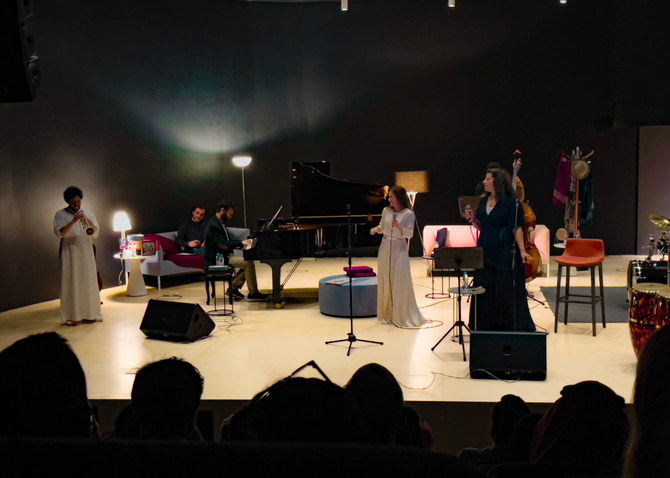

RIYADH: The Saudi Music Hub theater in Riyadh recently witnessed a lively, cheering crowd at “Jazzin About,” an evening dedicated to the genre that is seemingly gaining ground among local artists.
Paul Pacifico, CEO of the Music Commission, told Arab News at the event: “A lot of Arabic music has, at its heart, lots of improvisation, as does jazz. So jazz and Arabic music actually share a lot of commonalities. And in fact, if you look at the journey of music over the centuries, there’s a general drift from east to west.
“As I’ve come to Saudi Arabia and learn more and more about Saudi music, I can hear the influences of where a lot of music that has come from the peninsula across North Africa, into Spain, to flamenco, across the Atlantic into jazz, the influences are there.”
The stage was lit up with the smooth, jazzy sounds of Nourah Alammary and Magda on vocals, Mazen Lawand on piano, Karin Kotb on the double bass, Hasan on drums, and Mohammed Hakeem on trumpet.
Their set list included fun and fresh interpretations of old movie tracks including “My Favorite Things” and “My Funny Valentine,” as well as classics by jazz legends Duke Ellington and Nina Simone.
As I’ve come to Saudi Arabia and learn more and more about Saudi music, I can hear the influences of where a lot of music that has come from the peninsula across North Africa, into Spain, to flamenco, across the Atlantic into jazz, the influences are there.
Paul Pacifico, CEO of the Music Commission
Saudi singer Alammary believes Saudis have always had a thing for jazz. “We’ve had local artists who started out in jazz bands or have been involved in some way. The demand for jazz, whether it’s the classics or original tunes, has always been there,” she told Arab News.
Alammary’s childhood influences were also demonstrated on stage with her rendition of Disney soundtrack classics “I Wanna Be Like You (The Monkey Song)” from “The Jungle Book” and “Some Day My Prince Will Come” from “Snow White and the Seven Dwarfs.”
She told Arab News: “I just knew I was hooked. Then, when I was a teenager, I bought a CD with some classic jazz tunes from legends like Billie Holiday, Ella Fitzgerald, Bing Crosby and Etta James. That’s when it hit me that this was the kind of music that spoke to my soul.”
While teens opted for Britney and the Backstreet Boys, Alammary was in a “love affair” with timeless sounds. “We Saudis have rhythm in our blood, so it’s only natural for us to appreciate those soulful sounds,” she said. Her hope is to see Saudi music go global.
“The music scene here has exploded since 2019. That’s when we all came out to play, and it’s been a wild ride ever since. We’ve got new and old, talented local bands and artists, creating their own original music in all kinds of genres. We’ve got public and private entities supporting and building the infrastructure for this growth,” she said.
Like many other musicians in the Kingdom, pianist Lawand was initially self-taught, and had his first government-backed jazz performance with his band in 2017 at the King Fahad Cultural Center.
“People found jazz music to be an exotic thing and a very beautiful thing as well,” he told Arab News. “It was thought to be this beautiful music that was cool and chill and classy, which it is, but it’s also a very intense form of music. It’s not easy at all to pull off.”
They opened the first official Riyadh jazz festival, Groovz, in February 2018, followed by the Jeddah Jazz Fest in March at King Abdullah Economic City, the largest festival of its kind in the Kingdom at the time.
After gaining his music degree from Berklee College of Music in 2020, he now works at the Saudi Music Hub as an instructor for piano, guitar and music production. The “Jazzin About” event was his debut show as a curator.
Lamand said that Saudi Arabia has a rich history of music. “The Saudi music scene has been around forever. It’s been kicking, just underground … it was really because of people who taught themselves and because of passion and determination,” Lamand said.
With government support under the Vision 2030 goals, music and arts have been bolstered more than ever.
The Music Commission’s Pacifico said: “What is the voice of contemporary Saudi Arabia in global music? We don’t know yet. And that’s part of the journey of discovery that we’re on. Supporting the grassroots (initiatives), giving platforms to community groups who want to perform, explore, experiment, is a key step to building the foundations for the future of sustainable music.”