Pakistan, China launch first international road transport trade route

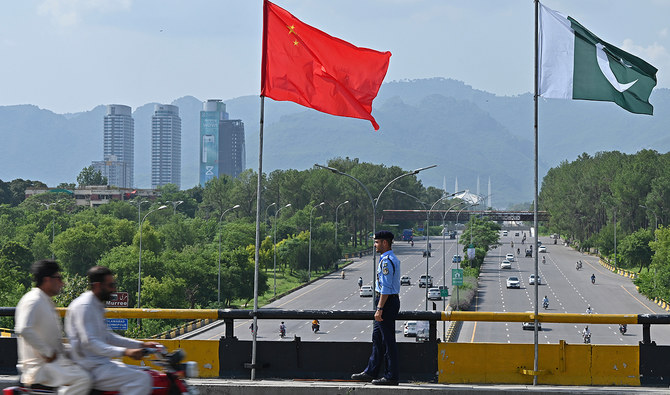
In this file photo, taken on July 30, 2023, a policeman stands guard under the national flags of China and Pakistan along a road, during the visit of Chinese Vice Premier He Lifeng last month, in Islamabad. (AFP/File)
Short Url
Updated 24 August 2023
Follow

Pakistan, China launch first international road transport trade route

  • First convoy of five trucks departed on Kashgar-Islamabad route this week
  • Sets precedent for future trade routes within China-Pakistan Economic Corridor

ISLAMABAD: An international road transport (TIR) route opened between China’s inland city of Kashgar and the Pakistani capital of Islamabad this week with the first convoy of five trucks departing at an inaugural ceremony, with an aim of enhancing cross-border trade.

Longtime ally Beijing, which has pledged over $65 billion in building infrastructure in Pakistan as part of a Belt and Road Initiative (BRI), has in recent months either rolled over or granted new loans worth around $5 billion to Islamabad to fulfill financing requirements of an International Monetary Fund (IMF) loan.

The total volume of trade between China and Pakistan is above $12.06 billion, up nearly 19 percent compared with 2021 when it stood at $10.14 billion due to Covid-19.

This is the first inaugural TIR trade route between China and Pakistan, “highlighting a fresh mode of cross-border transport for Xinjiang and potentially setting a precedent for future trade routes within the China-Pakistan Economic Corridor (CPEC),” state-run APP reported.

“The Kashgar-Islamabad TIR route is a collaborative endeavour involving Kashgar Customs, the Kashgar Municipal People’s Government, and spearheaded by CEVA Logistics [global logistics company] with support from the Shenzhen Cross-Border E-commerce Association. Kashgar is the first inland Chinese city to adopt TIR inland transport services following China’s ratification of the United Nations “TIR Convention” in 2016.”

Established in 1949, the international customs transit system TIR is characterised by streamlined, safe and economical procedures under which cargo remain sealed for the entirety of the transit, reducing potential delays at border crossings and minimizing the risk of cargo interference.

Additionally, the TIR’s unified international guarantee can potentially reduce additional customs expenses during cross-border transportation.


Pakistan mulls energy conservation measures as oil prices rise, Middle East conflict intensifies

Updated 6 sec ago
Follow

Pakistan mulls energy conservation measures as oil prices rise, Middle East conflict intensifies

  • Pakistan’s finance minister, petroleum minister meet Sindh chief minister, provincial officials to discuss energy crisis
  • Diplomatic contacts underway with Saudi Arabia, Oman, UAE for alternative fuel supplies, center tells Sindh government

ISLAMABAD: Pakistan’s Sindh government and the federal government discussed energy conservation measures amid a sharp rise in global oil prices on Sunday, the Sindh chief minister’s spokesperson said, as the conflict between Iran, Israel and the US intensifies. 

Fuel prices jumped more than 10 percent worldwide this week as oil rose above $90 a barrel, the highest in years. Pakistan on Friday increased petrol and diesel prices by Rs55 ($0.20) per liter each, as key energy shipping routes such as the Strait of Hormuz remain disrupted. 

Finance Minister Muhammad Aurangzeb and Petroleum Minister Ali Pervaiz Malik met Sindh Chief Minister Murad Ali Shah and other senior members of the Sindh government in Karachi. Participants reviewed the impact of escalating tensions in Iran on Pakistan’s energy supplies and the overall economic situation of the country. 

Information Minister Attaullah Tarar said on Saturday that the prime minister has asked his administration to formulate a strategy for fuel conservation and austerity in government affairs within 48 hours.

“The Sindh chief minister and federal ministers discussed emergency conservation measures to deal with a potential energy crisis,” the chief minister’s spokesperson said in a statement. 

As per the statement, the federal government informed the meeting that crude oil prices could reach as high as $120 per barrel if the Middle East conflict intensifies.
 
Aurangzeb said the federal government is closely monitoring global energy markets, adding that Islamabad is preparing alternative plans to manage the financial impact of rising oil prices.

The federal government informed participants of the meeting that three petrol cargo ships are expected to arrive in Pakistan by Monday. 

Malik revealed that Qatar’s move to declare force majeure on gas exports this week could disrupt LNG supplies. 

“Aurangzeb said Pakistan’s monthly oil import bill could rise to $600 million,” the statement said.

He said a joint dashboard is being developed with provinces to monitor fuel reserves, while both sides decided to increase coordination to prevent hoarding of petroleum products.

“Federal ministers said diplomatic contacts are underway with Saudi Arabia, Oman, and the UAE for alternative fuel supplies,” the statement said.

“Efforts are also being made to ensure oil supplies through routes other than the Strait of Hormuz, they added.”

Meanwhile, Malik said Pakistan will request relief from the International Monetary Fund regarding the petroleum levy, as it holds review talks over its External Fund Facility (EFF) program. 

The federal government’s delegation also included senior officials of the Oil and Gas Regulatory Authority, Sui Southern Gas Company and the Petroleum Division.