Fukushima wastewater released into ocean, China bans Japanese seafood

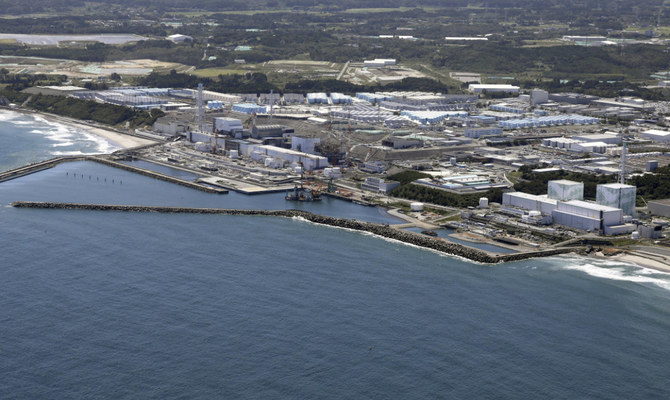
This aerial view shows the Fukushima Daiichi nuclear power plant in Fukushima, northern Japan, on Aug. 22, 2023. Japan will start releasing treated radioactive water from the wrecked Fukushima nuclear power plant into the Pacific Ocean on Thursday. (AP)
Short Url
Updated 24 August 2023
Follow

Fukushima wastewater released into ocean, China bans Japanese seafood

  • China criticizes action as ‘selfish and irresponsible’
  • Japan requests that China immediately lift its import ban on aquatic products

OKUMA: Japan started releasing treated radioactive water from the wrecked Fukushima nuclear power plant into the Pacific Ocean on Thursday, a polarizing move that prompted China to announce an immediate blanket ban on all aquatic products from Japan.
China is “highly concerned about the risk of radioactive contamination brought by... Japan’s food and agricultural products,” the customs bureau said in a statement.
The Japanese government signed off on the plan two years ago and it was given a green light by the UN nuclear watchdog last month. The discharge is a key step in decommissioning the Fukushima Daiichi plant after it was destroyed by a tsunami in 2011.
Plant operator Tokyo Electric Power (Tepco) said the release began at 1:03 p.m. local time (0403 GMT) and it had not identified any abnormalities.
However, China reiterated its firm opposition to the plan and said the Japanese government had not proved that the water discharged would be safe.
“The Japanese side should not cause secondary harm to the local people and even the people of the world out of its own selfish interests,” its foreign ministry said in a statement.
Tokyo has in turn criticized China for spreading “scientifically unfounded claims.”
It maintains the water release is safe, noting that the International Atomic Energy Agency (IAEA) has also concluded that the impact it would have on people and the environment was “negligible.”
Japan has requested that China immediately lift its import ban on aquatic products and seeks a discussion on the impact of the water release based on science, Prime Minister Fumio Kishida told reporters.
Japan exported about $600 million worth of aquatic products to China in 2022, making it the biggest market for Japanese exports, with Hong Kong second. Sales to China and Hong Kong accounted for 42 percent of all Japanese aquatic exports in 2022, according to government data.
China customs did not give details on the specific aquatic products impacted by the ban and did not immediately respond to a request for comment.
DECADES LONG PROCESS
The Fukushima Daiichi plant was destroyed in March 2011 after a massive 9.0 magnitude earthquake generated powerful tsunami waves causing meltdowns in three reactors.
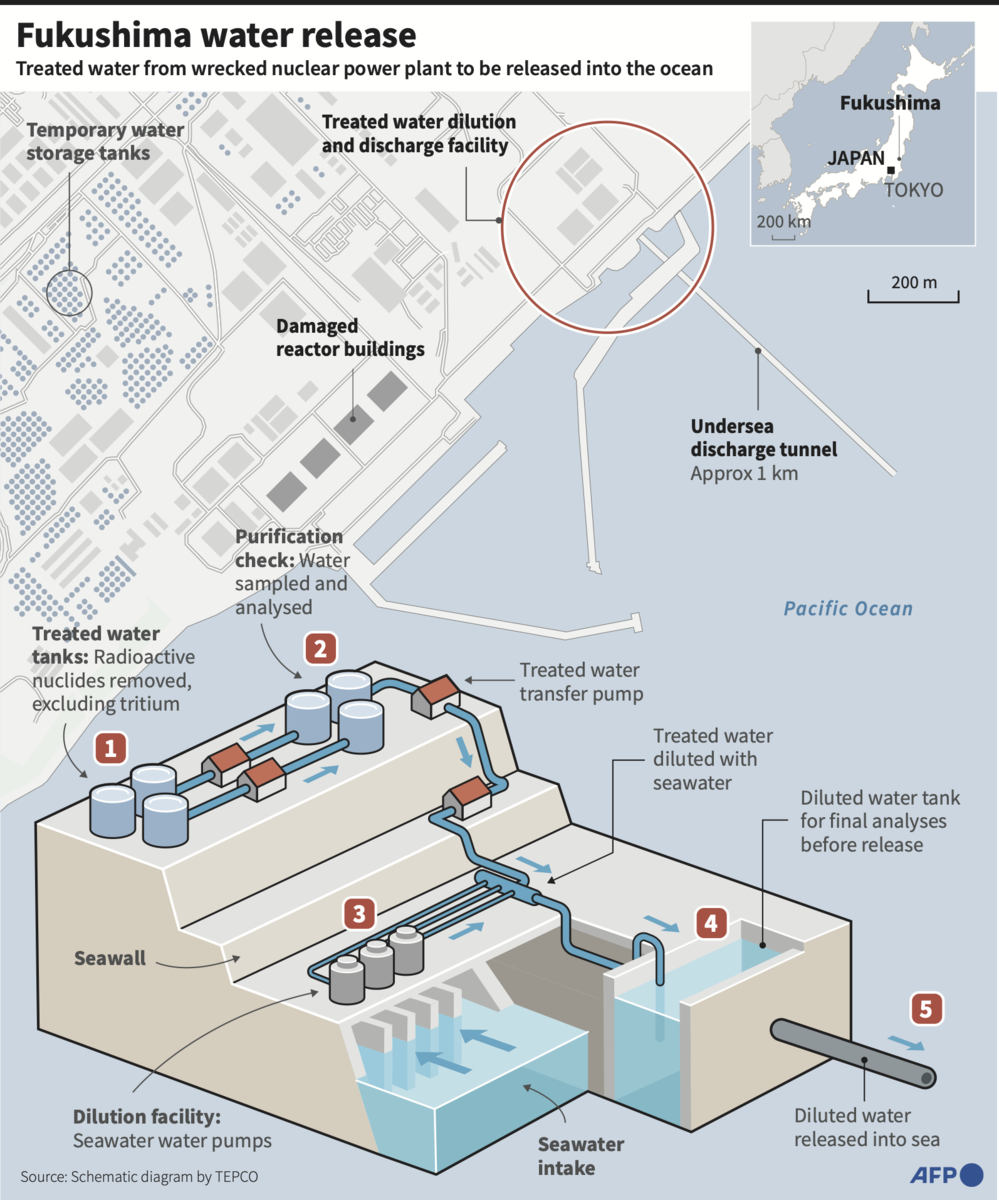
The first discharge totalling 7,800 cubic meters — the equivalent of about three Olympic swimming pools of water — will take place over about 17 days.
According to Tepco test results released on Thursday, that water contained about up to 63 becquerels of tritium per liter, below the World Health Organization drinking water limit of 10,000 becquerels per liter. A becquerel is a unit of radioactivity.
The IAEA also released a statement saying its independent on-site analysis had confirmed the tritium concentration was far below the limit.
“There are not going to be any health effects… There is no scientific reason to ban imports of Japanese food whatsoever,” said Geraldine Thomas, former professor of molecular pathology at London’s Imperial College.
But Japanese fishing groups, hit with years of reputational damage from radiation fears, still oppose the plan.
“All we want is to be able to continue fishing,” the head of the Japan Fisheries Co-operative said in a statement that touched on the “mounting anxiety” of the community.
Separately from China, Hong Kong and Macau have announced their own ban starting Thursday, which covers Japanese seafood imports from 10 regions.
South Korean Prime Minister Han Duck-soo said import bans on Fukushima fisheries and food products will stay in place until public concerns were eased.
Japan will conduct monitoring around the water release area and publish results weekly starting on Sunday, Japan’s environment minister said. The release is estimated to take about 30 years.

PROTESTS
In Hong Kong, Jacay Shum, a 73-year-old activist, held up a picture portraying IAEA head Rafael Grossi as the devil.
“Japan’s actions in discharging contaminated water are very irresponsible, illegal, and immoral,” said Shum, who was among a group of about 100 marchers. “No one can prove that the nuclear waste and materials are safe. They are completely unsafe.”
South Korean police arrested at least 16 protesters who entered the Japanese embassy in Seoul, although South Korea’s government has said its own assessment found no problems with the scientific and technical aspects of the release.
North Korea’s foreign ministry demanded that the water discharge be immediately halted, calling it a “crime against humanity,” state media reported.
A few dozen protesters gathered in front of Tepco’s headquarters in Tokyo holding signs reading “Don’t throw contaminated water into the sea!“
“The Fukushima nuclear disaster is not over. This time only around 1 percent of the water will be released,” 71-year-old Jun Iizuka, who attended the protest, told Reuters. “From now on, we will keep fighting for a long time to stop the long-term discharge of contaminated water.”


Displaced Sudanese escape RSF siege in southern Kordofan

Fighters of the paramilitary Rapid Support Forces (RSF) drive an armoured vehicle in southern Khartoum, on May 25, 2023. (AFP)
Updated 4 sec ago
Follow

Displaced Sudanese escape RSF siege in southern Kordofan

  • Some women haul water from a single well, pouring it into plastic buckets to cook, wash, and clean with, while others wait in a long line outside a makeshift health clinic, little more than a large canvas tent

GEDAREF, Sudan: When paramilitary Rapid Support Force fighters closed in on the Sudanese border town and oil field of Heglig, paraplegic Dowa Hamed could only cling to her husband’s back as they fled, “like a child,” she said
Now, the 25-year-old mother of five — paralyzed from the waist down — lies shell-shocked on a cot in the Abu Al-Naga displacement camp, a dusty transit center just outside the eastern city of Gedaref, nearly 800 km from home.
But her family’s actual journey was much longer, crossing the South Sudan border twice and passing from one group of fighters to another, as they ran for their lives with their children in tow alongside hundreds of others.
“We fled with nothing,” Hamed said. “Only the clothes on our backs.”
Hamed and her family are among tens of thousands of people recently uprooted by fighting in southern Kordofan — the latest front in the war between Sudan’s army and the Rapid Support Forces that erupted in April 2023.
Since capturing the army’s last stronghold in Darfur in October, the RSF and their allies have pushed deeper into neighboring Kordofan, an oil-rich agricultural region divided into three states: West, North, and South.
In recent weeks, the paramilitary group has consolidated control over West Kordofan, seized Heglig — home to Sudan’s largest oil field — and tightened its siege on Kadugli and Dilling in South Kordofan, where hundreds of thousands now face mass starvation.
On the night of Dec. 7, the inhabitants of Heglig — many of them the families of oil technicians, engineers, and soldiers stationed at the field — got word that an attack would happen at dawn.
“We ran on foot, barefoot, without proper clothes,” said Hiyam Al-Hajj, 29, a mother of 10 who says she had to leave her mother and six siblings behind as she ran around 30 km to the border.
“The RSF chased us to the border. The South Sudan army told them we were in their country and they would not hand us over,” she said.
They were sheltered in South Sudan’s Unity State, but barely fed.
“Those who had money could feed their children,” Al-Hajj said. “Those who did not went hungry.”
They spent nearly four weeks on the move, trekking long distances on foot and spending nights out in the open, sleeping on the bare ground.
“We were hungry,” she said. “But we did not feel the hunger; all we cared about was our safety.”
Eventually, authorities in South Sudan put them in large trucks that carried them back across the border to army-controlled territory, where they could head east, away from the front lines.
Hamed, who was paralyzed during childbirth, said that “during the truck rides, my body ached with every movement.”
But not everyone made it to Gedaref.
Between the canvas tents of the Abu Al-Naga camp, 14-year-old Sarah is struggling to care for her little brother alone.
In South Sudan, their parents had put them on one of the trucks, “then they said the truck was full and promised they would get on the next one.”
But weeks on, the siblings have received no word as to where their mother and father might be.
Inside the tents, children and mothers sleep on the ground, huddled together for warmth, while outside, children dart across the cracked soil, dust clinging to their bare feet.
According to camp director Ali Yehia Ahmed, 240 families, or around 1,200 people, are now taking refuge at Abu Al-Naga.
“The camp’s space is very small,” Ahmed said, adding that food was in increasingly short supply.
Food is distributed from a single point, forcing families to wait for limited rations.
Some women haul water from a single well, pouring it into plastic buckets to cook, wash, and clean with, while others wait in a long line outside a makeshift health clinic, little more than a large canvas tent.
Asia Abdelrahman Hussein, the minister of social welfare and development of Gedaref State, said shelter was one of the most urgent needs, especially during the winter months.
“The shelters are not enough. We need support from other organizations to provide safe housing and adequate shelter,” she said.
In one of the tents, Sawsan Othman Moussa, 27, said how she had been forced to flee three times since fighting broke out in Dilling.
Now, though she might be safe, “every tent is cramped, medicine is scarce, and during cold nights, we suffer.”