

Japan to start releasing Fukushima water on Thursday

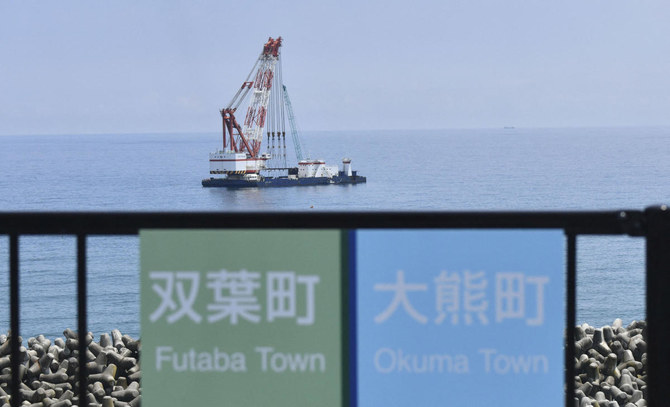
Crane ship seen near discharge outlet meant to release Advanced Liquid Processing System (ALPS) treated water into the sea off the tsunami-crippled Fukushima Daiichi nuclear power plant in Okuma town. (File/Reuters)
Short Url
Updated 22 August 2023
Follow

Japan to start releasing Fukushima water on Thursday

  • Announcement came despite opposition from fishermen and protests by China
  • Japan insists that the gradual water release is safe

TOKYO: Japan will begin releasing cooling water from the stricken Fukushima power plant on Thursday, 12 years after one of the world’s worst nuclear disasters.
The announcement came despite opposition from fishermen and protests by China, which has already banned food shipments from several Japanese prefectures.
Japan insists the gradual release into the sea of the more than 500 Olympic swimming pools’ worth of water that has accumulated at the stricken nuclear plant is safe, a view backed by the UN atomic agency.
Prime Minister Fumio Kishida announced the start date on Tuesday, a day after talks with fishing industry representatives who are opposed, “if weather and sea conditions do not hinder it.”
The Fukushima-Daiichi nuclear plant was knocked out by a massive earthquake and tsunami that killed around 18,000 people in March 2011, with three of its reactors sent into meltdown.
Since then, operator TEPCO has collected 1.34 million tons of water used to cool what remains of the still highly radioactive reactors, mixed with groundwater and rain that has seeped in.
TEPCO says the water has been diluted and filtered to remove all radioactive substances except tritium, levels of which are far below dangerous levels.
“Tritium has been released (by nuclear power plants) for decades with no evidential detrimental environmental or health effects,” Tony Hooker, a nuclear expert from the University of Adelaide, told AFP.
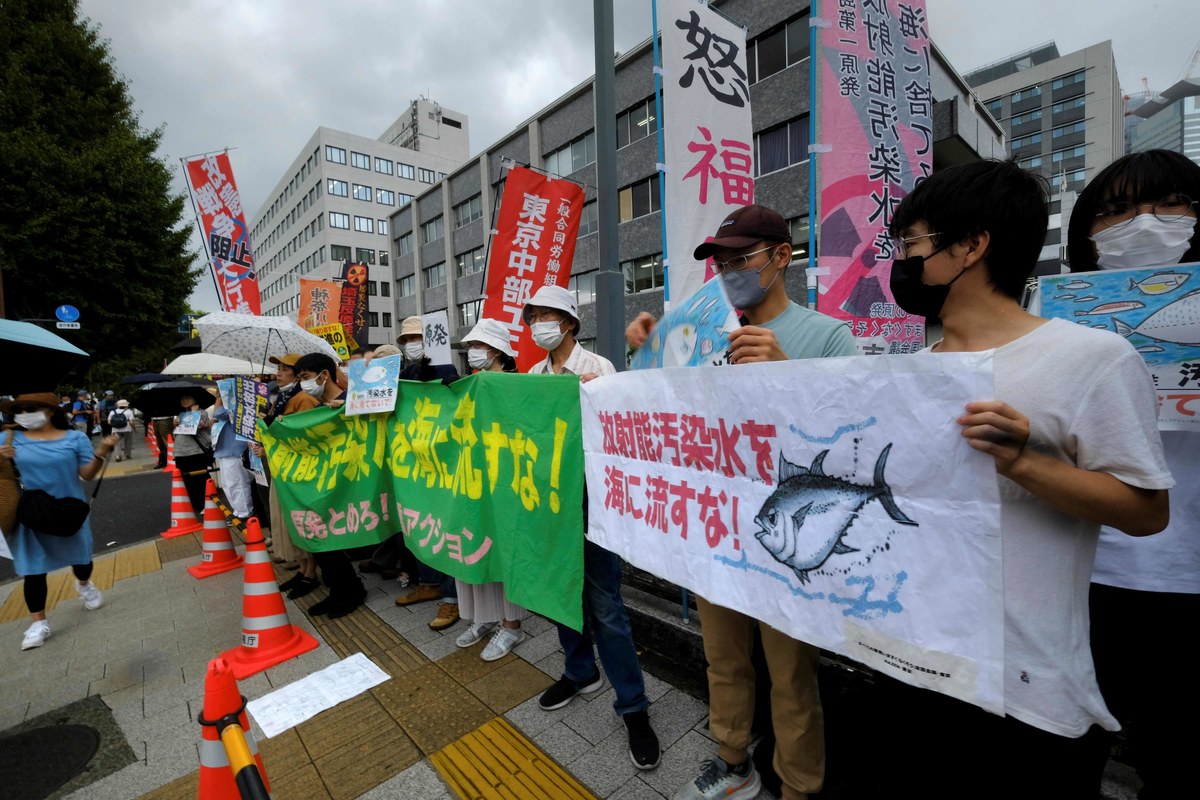


Protesters hold signs reading "Don't throw radioactive contaminated water into the sea!"(R) as they take part in a rally against the Japanese government's plan to release treated wastewater from the crippled Fukushima Daiichi power plant into the ocean, outside the prime minister's office in Tokyo. (AFP)


This water will now be released into the ocean off Japan’s northeast coast at a maximum rate of 500,000 liters (132,000 US gallons) per day.
Environmental pressure group Greenpeace has said the filtration process is flawed and that an “immense” quantity of radioactive material will be dispersed into the sea over the coming decades.
Japan “has opted for a false solution — decades of deliberate radioactive pollution of the marine environment — during a time when the world’s oceans are already facing immense stress and pressures,” Greenpeace said Tuesday.
The UN atomic watchdog said in July that the release would have a “negligible radiological impact on people and the environment.”
Many South Koreans are alarmed at the prospect of the release, staging demonstrations and even stocking up on sea salt because of fears of contamination.
But President Yoon Suk Yeol’s government, taking political risks at home, has sought to improve long-frosty relations with Japan and has not objected to the plan.
Yoon last week held a first-ever trilateral summit with Kishida and US President Joe Biden at Camp David, the three united by worries about China and North Korea.
China has accused Japan of treating the ocean like a “sewer,” banning imports of food from 10 Japanese prefectures even before the release and imposing strict radiation checks.
Hong Kong, an important market for Japanese seafood exports, has also threatened restrictions.
This has worried people involved in Japan’s fishing industry, just as business was beginning to recover more than a decade after the nuclear disaster.
“Nothing about the water release is beneficial to us,” third-generation fisherman Haruo Ono, 71, whose brother was killed in 2011, told AFP in Shinchimachi, 60 kilometers (40 miles) north of the nuclear plant.
James Brady from the Teneo risk consultancy said that while China’s safety concerns may be sincere, there was a distinct whiff of geopolitics and economic rivalry in its harsh reaction.
“The multifaceted nature of the Fukushima wastewater release issue makes it quite a useful one for Beijing to potentially exploit,” Brady told AFP.
Beijing can “leverage a degree of economic pressure on the trade axis, exacerbate internal domestic political cleavages on the issue within Japan... and even potentially put pressure on improving diplomatic ties between Seoul and Tokyo.”
Naoya Sekiya from the University of Tokyo last year conducted a survey which found that 90 percent of people China and South Korea thought Fukushima food was “very dangerous” or “somewhat dangerous.”
“I think that’s because Japan hasn’t properly dispelled such concerns,” Sekiya told AFP.
“(We) have to make a proper and sufficient explanation.”


Court ruling jeopardizes freedom for pro-Palestinian activist Mahmoud Khalil

Updated 10 sec ago
Follow

Court ruling jeopardizes freedom for pro-Palestinian activist Mahmoud Khalil

  • The panel ruled a federal judge in New Jersey didn’t have jurisdiction to decide the matter at this time
  • The law bars Khalil “from attacking his detention and removal in a habeas petition,” the panel added

WASHINGTON: A federal appeals panel on Thursday reversed a lower court decision that released former Columbia University graduate student Mahmoud Khalil from an immigration jail, bringing the government one step closer to detaining and ultimately deporting the Palestinian activist.
The three-judge panel of the 3rd US Circuit Court of Appeals didn’t decide the key issue in Khalil’s case: whether the Trump administration’s effort to throw Khalil out of the US over his campus activism and criticism of Israel is unconstitutional.
But in its 2-1 decision, the panel ruled a federal judge in New Jersey didn’t have jurisdiction to decide the matter at this time. Federal law requires the case to fully move through the immigration courts first, before Khalil can challenge the decision, they wrote.
“That scheme ensures that petitioners get just one bite at the apple — not zero or two,” the panel wrote. “But it also means that some petitioners, like Khalil, will have to wait to seek relief for allegedly unlawful government conduct.”
The law bars Khalil “from attacking his detention and removal in a habeas petition,” the panel added.
Ruling won’t result in immediate detention
It was not clear whether the government would seek to detain Khalil, a legal permanent resident, again while his legal challenges continue.
Thursday’s decision marked a major win for the Trump administration’s sweeping campaign to detain and deport noncitizens who joined protests against Israel.
In a statement distributed by the American Civil Liberties Union, Khalil said the appeals ruling was “deeply disappointing, but it does not break our resolve.”
He added: “The door may have been opened for potential re-detainment down the line, but it has not closed our commitment to Palestine and to justice and accountability. I will continue to fight, through every legal avenue and with every ounce of determination, until my rights, and the rights of others like me, are fully protected.”
Baher Azmy, one of Khalil’s lawyers, said the ruling was “contrary to rulings of other federal courts.” He noted the panel’s finding concerned a “hypertechnical jurisdictional matter,” rather than the legality of the Trump administration’s policy.
“Our legal options are by no means concluded, and we will fight with every available avenue,” he added, saying Khalil would remain free pending the full resolution of all appeals, which could take months or longer.
The ACLU said the Trump administration cannot lawfully re-detain Khalil until the order takes formal effect, which won’t happen while he can still immediately appeal.
Khalil has multiple options to appeal
Khalil’s lawyers can request the active judges on the 3rd Circuit hear an appeal, or they can go to the US Supreme Court.
An outspoken leader of the pro-Palestinian movement at Columbia, Khalil was arrested on March 8, 2025. He then spent three months detained in a Louisiana immigration jail, missing the birth of his firstborn.
Federal officials have accused Khalil of leading activities “aligned to Hamas,” though they have not presented evidence to support the claim and have not accused him of criminal conduct. They have also accused Khalil, 30, of failing to disclose information on his green card application.
The government has justified the arrest under a seldom-used statute that allows for the expulsion of noncitizens whose beliefs are deemed to pose a threat to US foreign policy interests.
In June, a federal judge in New Jersey ruled that justification would likely be declared unconstitutional and ordered Khalil released.
President Donald Trump’s administration appealed that ruling, arguing the deportation decision should fall to an immigration judge, rather than a federal court.
Khalil has dismissed the allegations as “baseless and ridiculous,” framing his arrest and detention as a “direct consequence of exercising my right to free speech as I advocated for a free Palestine and an end to the genocide in Gaza.”
Dissenting judge says Khalil has right to fight detention

Judge Arianna Freeman dissented Thursday, writing that her colleagues were holding Khalil to the wrong legal standard. Khalil, she wrote, is raising “now-or-never claims” that can be handled at the district court level. He does not have a final order of removal, which would permit a challenge in an appellate court, she wrote.
Both judges who ruled against Khalil, Thomas Hardiman and Stephanos Bibas, were Republican appointees. President George W. Bush appointed Hardiman to the 3rd Circuit, while Trump appointed Bibas. President Joe Biden, a Democrat, appointed Freeman.
The majority opinion noted Freeman worried the ruling would leave Khalil with no remedy for unconstitutional immigration detention, even if he later can appeal.
“But our legal system routinely forces petitioners — even those with meritorious claims — to wait to raise their arguments, the judges wrote. “To be sure, the immigration judge’s order of removal is not yet final; the Board has not affirmed her ruling and has held the parties’ briefing deadlines in abeyance pending this opinion. But if the Board ultimately affirms, Khalil can get meaningful review.”
The decision comes as an appeals board in the immigration court system weighs a previous order that found Khalil could be deported. His attorneys have argued that the federal order should take precedence.
That judge has suggested Khalil could be deported to Algeria, where he maintains citizenship through a distant relative, or Syria, where he was born in a refugee camp to a Palestinian family.
His attorneys have said he faces mortal danger if forced to return to either country.