

Pakistan detects poliovirus traces in environmental samples from Rawalpindi

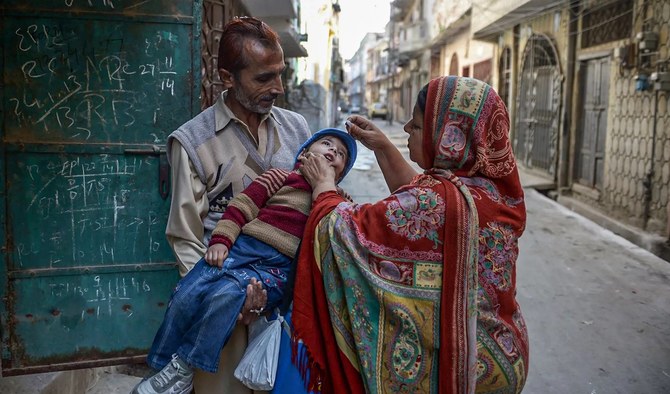
A Pakistani health worker, right, administers the polio vaccine to a child during a vaccination campaign in Rawalpindi, Pakistan on December 9, 2014. (AFP/File)
Short Url
Updated 30 August 2023
Follow

Pakistan detects poliovirus traces in environmental samples from Rawalpindi

  • Pakistan and Afghanistan are the only two countries in the world where polio disease remains endemic
  • Interim health minister says polio program will continue to focus efforts on early detection, swift response

ISLAMABAD: Pakistani health authorities identified traces of poliovirus in environmental samples collected from the country's eastern Rawalpindi city, a statement from the National Institute of Health (NIH) confirmed on Wednesday, noting that the isolated virus bore a genetic resemblance to a cluster currently circulating in Afghanistan's Nangarhar province.

Pakistan and Afghanistan are the only two countries worldwide where polio remains a looming threat to the health and well-being of children. The disease, which targets the nervous system and often leads to paralysis, continues to be a critical concern for the two countries. 

Part of the reason why polio remains endemic in Pakistan is due to the prevailing sentiment in conservative segments of its tribal areas where polio vaccination campaigns are perceived as part of a Western agenda aimed at limiting the country's population. Attacks on polio volunteers and security personnel who guard them are common in Pakistan, especially after the Taliban imposed a ban on vaccination in the country's western tribal areas in 2012. 

“The virus was found in an environmental sample collected from the Safdarabad site on August 10, according to the Pakistan Polio Laboratory at the National Institute of Health, which is also the WHO Regional Reference Laboratory for the polio program," the NIH statement read.

It added that the recently discovered sample was the second positive one collected from Rawalpindi this year.

Interim federal health minister, Dr. Nadeem Jan, voiced deep concern over the presence of the poliovirus in the environment, highlighting the danger it poses to children's well-being. He emphasized safeguarding children against the debilitating effects of the disease through timely vaccination.

“Parents and caregivers must ensure that their children receive multiple doses of the vaccine to ensure lifelong disability,” the statement quoted Dr. Jan as saying.

Pakistan organized a polio eradication campaign in 65 districts of the country this month from August 7 to 13 to vaccinate over eight million children under the age of five.

The South Asian country has registered two polio cases and identified 16 positive environmental samples so far this year. Afghanistan, on the other hand, has reported five cases and detected 33 positive samples during the same timeframe.


Pakistan army chief meets world leaders in rare Davos appearance

Updated 6 sec ago
Follow

Pakistan army chief meets world leaders in rare Davos appearance

  • Field Marshal Asim Munir attends World Economic Forum alongside prime minister
  • Pakistan delegation holds meetings with US, Saudi and Azerbaijani leaders

ISLAMABAD: Pakistan’s Chief of Army Staff Field Marshal Syed Asim Munir is attending the World Economic Forum’s annual meeting in Davos this week alongside Prime Minister Shehbaz Sharif, marking a rare appearance by a serving army chief at the global gathering of political and business leaders.

Pakistan’s participation at Davos comes as Islamabad seeks to attract investment, project economic stability and deepen engagement with key international partners following recent reforms aimed at stabilizing the economy. 

While Pakistani leaders routinely attend the World Economic Forum, it is uncommon for a serving army chief to be present. In 2017, former army chief Raheel Sharif addressed the forum only after his retirement, while General Pervez Musharraf spoke at Davos on a number of occasions in his role as president, not as military chief. 

Pakistan’s governance structure has evolved in recent years, particularly through the expanded role of the military in economic decision-making through bodies such as the Special Investment Facilitation Council, a civil-military platform designed to fast-track foreign investment in sectors including minerals, energy, agriculture and technology.

“The Prime Minister and the Field Marshal met with the President of Azerbaijan Ilham Aliyev, United States Secretary of State Marco Rubio, and Saudi Arabia’s Foreign Minister Prince Faisal bin Farhan Al Saud,” Sharif’s office said in a statement.

Officials say the delegation’s engagements focused on strengthening economic ties and maintaining high-level contact with partners in the Middle East, Central Asia and the United States at a time of shifting global economic and strategic alignments.

The World Economic Forum’s annual meeting brings together heads of state, ministers, investors and corporate leaders to discuss global economic risks, investment trends and geopolitical challenges. Davos is not a military forum, and while security issues are discussed there, the physical presence of a serving military chief remains the exception, not the norm, across countries. When military figures do appear, it is usually because they are heads of state or government, retired and speaking as security experts or hold a civilian defense portfolio such as defense minister or national security adviser.