

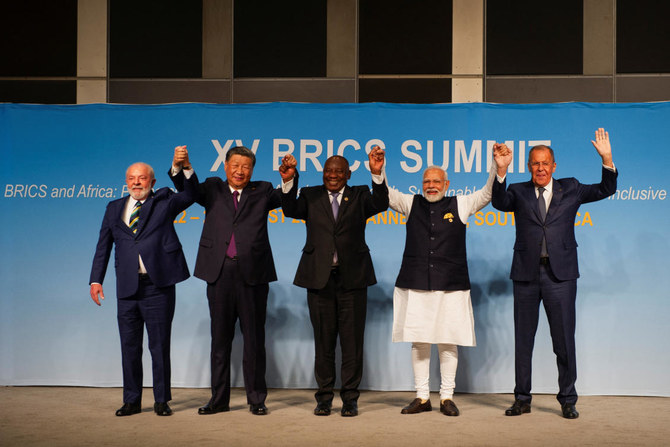
BRICS heads of state express support for expansion of group

Brazil's President Luiz Inacio Lula da Silva, China's President Xi Jinping, South African President Cyril Ramaphosa, Indian Prime Minister Narendra Modi and Russia's Foreign Minister Sergei Lavrov pose for a picture at the BRICS Summit in Johannesburg. (Reuters)
Short Url
Updated 24 August 2023
Follow

BRICS heads of state express support for expansion of group

  • South African President Cyril Ramaphosa: BRICS stands for solidarity and for progress. It stands for inclusivity, sustainable development and a more just, equitable world order

JOHANNESBURG: The leaders of the BRICS countries — Brazil, Russia, India, China and South Africa — expressed their support for expanding the alliance during the 15th BRICS Summit on Wednesday.

On the second day of the BRICS summit in South Africa, the group’s leaders and delegations gathered for the heads of state opening remarks. Each head of state made a speech detailing their proposals, pressing global issues and current developments for BRICS.

“BRICS stands for solidarity and for progress. BRICS stands for inclusivity and a more just, equitable world order. BRICS stands for sustainable development,” South African President Cyril Ramaphosa said.

Each leader expressed support for expanding the membership of BRICS while stressing the importance of retaining its true purpose.

Ramaphosa referenced the admission of South Africa to BRICS and how the addition of another member nation “strengthened the BRICS family.”


South African President Cyril Ramaphosa address the 15th BRICS Summit being held in his country. (AFP)

“We once again stand in another momentous moment where more than 20 other countries are seeking to be part of the BRICs family, and I know as BRICS leaders you are discussing this matter and giving close attention to it,” Ramaphosa said.

Chinese President Xi Jinping’s speech highlighted that the world was undergoing a shift and entering a new era of turbulence.

“We the BRICS countries should always bear in mind our founding purpose of strengthening ourselves in unity and in a strong sense of responsibility in enhancing cooperation across the board,” Xi said.

He urged the deepening of business and economic cooperation to boost economic growth, arguing that development was an unalienable right of all countries and not just a privilege reserved for a few.

Discussing the conflicts in the Russian-Ukrainian war, the South African president commended the BRICS members on their efforts to bring about a peaceful end to the conflict.

“We agree that this type of conflict is best brought to an end by negotiation,” Ramaphosa said. “BRICS members will continue to be supportive of various efforts to bring this conflict to an end through dialogue, mediation and negotiation.”

Russian President Vladimir Putin made remarks on the reforms of international financial systems. Ramaphosa responded by highlighting a decision to be announced shortly on international financial systems reforms, as this marked one of the important discussion topics of the BRICS leaders retreat the previous day.


Russian President Vladimir Putin makes remarks virtually at the 15th BRICS Summit being held in South Africa. (AFP)

During his speech, made virtually, Putin highlighted that BRICS was working to develop effective mechanisms for trade settlements, currency and financial control.

“Over the past decade, BRICS investment in the global economy has doubled, and the cumulative exports reached 20 percent of the overall indicator,” Putin said. “We are successfully implementing the strategy for BRICS economic partnership 2025, namely strengthening bilateral cooperation in such areas as diversification of supply chains, de-dollarization and transfer to local currencies in our mutual economies.”

Ramaphosa said: “The world is changing. New economic, political, social and technological realities call for greater cooperation between nations. These realities call for a fundamental reform of the institutions of global governance so that they may be more representative and better able to respond to the challenges that confront humanity.”

During his speech, Brazil’s president Lula Da Silva said that “BRICS should act as a force for understanding and for cooperation.”

Da Silva highlighted the power BRICS holds, and that it represented 41 percent of the world population and was responsible for 32 percent of GDP purchasing power.

“The BRICS — we should say all (countries) — suffer the consequences of war,” he said.

The Brazilian president said that the Ukraine war showed the limitations of the UN Security Council, adding: “BRICS is a forum to discuss the main issues that affect peace and world security.

“The quest for peace is a collective obligation and imperative for a fair development and a sustainable development,” Da Silva said.

“Haitians, Yemenites, Syrians, Sudanese and Palestinians all deserve to live in peace, it is unacceptable that global military spending in one year goes beyond 2 trillion dollars while the FAO says to us that 735 million people are in hunger every day in the world,” he said.

Indian Prime Minister Narendra Modi proposed new areas for BRICS nations’ cooperation — in space exploration and research, cooperation in skill development, education and technology, joint efforts in the protection of big cats, and shared know-how and cooperation in the traditional medicines ecosystem.

As part of the leaders’ speeches session, a draft declaration to establish a BRICS Youth Council is in the final stages of consideration by the heads of state of BRICS.



US immigration officials grilled by Congress over Trump crackdown

Updated 2 sec ago
Follow

US immigration officials grilled by Congress over Trump crackdown

  • Trump administration officials faced a barrage of criticism and tough questions from Democratic lawmakers over the major crackdown on migrants in multiple US cities
  • Rodney Scott hailed efforts on the southern US frontier, saying CBP ‘spent the last year rebuilding what was an intentionally broken border’
WASHINGTON: The heads of US immigration agencies faced heavy criticism in Congress Tuesday as they defended President Donald Trump’s mass deportation drive and fielded questions about the fatal shootings of two protesters in Minneapolis.
Trump acknowledged in the wake of the Minneapolis killings that a “softer touch” may be needed on immigration, and his administration announced concessions including the withdrawal of hundreds of officers from the Midwestern city.
But the issue remains far from resolved, with Democrats demanding changes to the way the Department of Homeland Security (DHS) conducts its immigration sweeps and threatening to block its funding, while Trump’s administration vows to maintain its deportation efforts, with backing from Republican lawmakers.
“The president tasked us with mass deportation, and we are fulfilling that mandate,” Todd Lyons, the acting head of Immigration and Customs Enforcement (ICE), said in his opening remarks during the Tuesday hearing on DHS oversight.
He testified alongside Rodney Scott, the head of US Customs and Border Protection (CBP), and Citizenship and Immigration Services director Joseph Edlow.
Scott hailed efforts on the southern US frontier, saying CBP “spent the last year rebuilding what was an intentionally broken border” and that “the United States... enjoys the most secure border in our nation’s history.”
The Trump administration officials faced a barrage of criticism and tough questions from Democratic lawmakers over the major crackdown on migrants in multiple US cities, which Republican representatives largely defended.
“This administration and the agencies represented before us have shown a complete and utter disregard for the law and the Constitution,” Democratic Representative Tim Kennedy said.
Representative Eli Crane, a Republican, pushed back on criticism of immigration enforcement, accusing Democrats of seeking to “demonize ICE and Homeland Security.”

‘Days, not weeks’

In Minneapolis, thousands of federal agents have in recent weeks conducted raids in what the administration claims are targeted operations against criminals.
Minnesota Governor Tim Walz said Tuesday that he expects the crackdown — which has seen detentions of broad categories of immigrants and sometimes citizens — to end soon.
“We’re very much in a ‘trust but verify’ mode. But it’s my expectation... that we are talking days, not weeks and months, of this occupation,” Walz said.
The operations have sparked mass protests in Minneapolis, and the fatal shootings of US citizens Renee Good and Alex Pretti less than three weeks apart last month led to a wave of outrage.
When Democratic Representative Eric Swalwell asked Tuesday if Lyons would apologize to Good and Pretti’s families over the Trump administration’s initial description of them as “domestic terrorists,” he declined, saying he would not comment on active investigations.
Opposition Democrats have been calling for sweeping reforms to ICE operations, including ending mobile patrols, prohibiting agents from concealing their faces, and requiring warrants.
Democratic leaders in Congress are also threatening to block the 2026 funding bill for DHS. The White House has indicated it is willing to negotiate, but its response has failed to satisfy opposition lawmakers so far.
“Republicans shared an outline of a counterproposal, which included neither details nor legislative text,” House Minority Leader Hakeem Jeffries and Senate Minority Leader Chuck Schumer said in a statement.
They denounced the White House response as “incomplete and insufficient in terms of addressing the concerns Americans have about ICE’s lawless conduct,” and said they were awaiting further details.
If negotiations fail, DHS could face a funding shortfall starting Saturday. CBP and ICE operations could continue using funds approved by Congress last year, but other sub-agencies such as federal disaster organization FEMA could be affected.
