

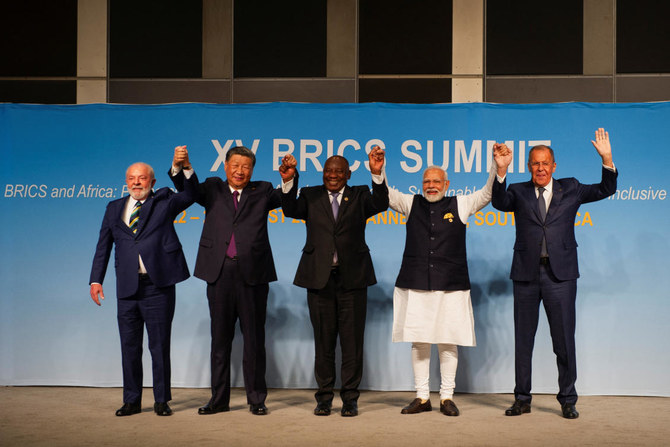

JOHANNESBURG: The leaders of the BRICS countries — Brazil, Russia, India, China and South Africa — expressed their support for expanding the alliance during the 15th BRICS Summit on Wednesday.
On the second day of the BRICS summit in South Africa, the group’s leaders and delegations gathered for the heads of state opening remarks. Each head of state made a speech detailing their proposals, pressing global issues and current developments for BRICS.
“BRICS stands for solidarity and for progress. BRICS stands for inclusivity and a more just, equitable world order. BRICS stands for sustainable development,” South African President Cyril Ramaphosa said.
Each leader expressed support for expanding the membership of BRICS while stressing the importance of retaining its true purpose.
Ramaphosa referenced the admission of South Africa to BRICS and how the addition of another member nation “strengthened the BRICS family.”

South African President Cyril Ramaphosa address the 15th BRICS Summit being held in his country. (AFP)
“We once again stand in another momentous moment where more than 20 other countries are seeking to be part of the BRICs family, and I know as BRICS leaders you are discussing this matter and giving close attention to it,” Ramaphosa said.
Chinese President Xi Jinping’s speech highlighted that the world was undergoing a shift and entering a new era of turbulence.
“We the BRICS countries should always bear in mind our founding purpose of strengthening ourselves in unity and in a strong sense of responsibility in enhancing cooperation across the board,” Xi said.
He urged the deepening of business and economic cooperation to boost economic growth, arguing that development was an unalienable right of all countries and not just a privilege reserved for a few.
Discussing the conflicts in the Russian-Ukrainian war, the South African president commended the BRICS members on their efforts to bring about a peaceful end to the conflict.
“We agree that this type of conflict is best brought to an end by negotiation,” Ramaphosa said. “BRICS members will continue to be supportive of various efforts to bring this conflict to an end through dialogue, mediation and negotiation.”
Russian President Vladimir Putin made remarks on the reforms of international financial systems. Ramaphosa responded by highlighting a decision to be announced shortly on international financial systems reforms, as this marked one of the important discussion topics of the BRICS leaders retreat the previous day.

Russian President Vladimir Putin makes remarks virtually at the 15th BRICS Summit being held in South Africa. (AFP)
During his speech, made virtually, Putin highlighted that BRICS was working to develop effective mechanisms for trade settlements, currency and financial control.
“Over the past decade, BRICS investment in the global economy has doubled, and the cumulative exports reached 20 percent of the overall indicator,” Putin said. “We are successfully implementing the strategy for BRICS economic partnership 2025, namely strengthening bilateral cooperation in such areas as diversification of supply chains, de-dollarization and transfer to local currencies in our mutual economies.”
Ramaphosa said: “The world is changing. New economic, political, social and technological realities call for greater cooperation between nations. These realities call for a fundamental reform of the institutions of global governance so that they may be more representative and better able to respond to the challenges that confront humanity.”
During his speech, Brazil’s president Lula Da Silva said that “BRICS should act as a force for understanding and for cooperation.”
Da Silva highlighted the power BRICS holds, and that it represented 41 percent of the world population and was responsible for 32 percent of GDP purchasing power.
“The BRICS — we should say all (countries) — suffer the consequences of war,” he said.
The Brazilian president said that the Ukraine war showed the limitations of the UN Security Council, adding: “BRICS is a forum to discuss the main issues that affect peace and world security.
“The quest for peace is a collective obligation and imperative for a fair development and a sustainable development,” Da Silva said.
“Haitians, Yemenites, Syrians, Sudanese and Palestinians all deserve to live in peace, it is unacceptable that global military spending in one year goes beyond 2 trillion dollars while the FAO says to us that 735 million people are in hunger every day in the world,” he said.
Indian Prime Minister Narendra Modi proposed new areas for BRICS nations’ cooperation — in space exploration and research, cooperation in skill development, education and technology, joint efforts in the protection of big cats, and shared know-how and cooperation in the traditional medicines ecosystem.
As part of the leaders’ speeches session, a draft declaration to establish a BRICS Youth Council is in the final stages of consideration by the heads of state of BRICS.


