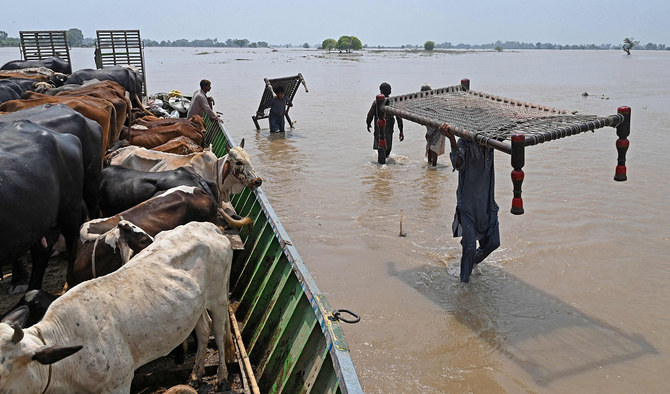
KASUR, Pakistan: Around 100,000 people have been evacuated from flooded villages in Pakistan’s Punjab province, emergency services said on Wednesday.
Several hundred villages and thousands of acres of cropland in the central province were inundated when the Sutlej River burst its banks on Sunday.
The head of Punjab’s government, Mohsin Naqvi, said that monsoon rains had prompted authorities in India to release excess reservoir water into the Sutlej River, causing flooding downstream on the Pakistani side of the border.
“The flood waters came a couple of days ago and all our houses were submerged. We walked all the way here on foot with great difficulty,” 29-year-old Kashif Mehmood, who fled with his wife and three children to a relief camp, told AFP on Tuesday.
The summer monsoon brings South Asia 70-80 percent of its annual rainfall between June and September every year.
It is vital for the livelihoods of millions of farmers and food security in a region of around two billion people -- but it also brings landslides and floods that lead to frequent evacuations.
“We have rescued 100,000 people and transferred them to safer places,” Farooq Ahmad, spokesman for the Punjab emergency services, told AFP on Wednesday.
More than 175 people have died in Pakistan in rain-related incidents since the monsoon season began in late June, mainly due to electrocution and buildings collapsing, emergency services have reported.
Officials on the Indian side could not immediately be reached for comment.
“There is five or six feet (1.5-1.8 meters) of water accumulated over the roads. The only route that could have been used to come and go is now under water. This 15- or 16-kilometre route is now being covered by boat so that we can rescue people,” Muhammad Amin, a local doctor volunteering at a relief camp, told AFP on Tuesday.
The Punjab disaster management agency warned that forecasted monsoon rains could exacerbate the flooding in the coming days.
Pakistan is still recovering from the devastating floods that inundated nearly one-third of the country in 2022, affecting more than 33 million people.
Scientists have said climate change is making seasonal rains heavier and more unpredictable.
Pakistan, which has the world’s fifth-largest population, is responsible for less than one percent of global greenhouse gas emissions, according to officials, but is highly vulnerable to extreme weather exacerbated by global warming.


Around 100,000 people evacuated due to floods in Pakistan
https://arab.news/4hgss
Around 100,000 people evacuated due to floods in Pakistan
- Official in Punjab say monsoon rains can exacerbate the flooding in the coming days
- Monsoon rains are vital for people’s livelihood but they also cause landslides and flooding

Pakistan Air Force conducts successful test of air-launched cruise missile
- The indigenously developed ‘Taimoor’ missile has a range of 600 kilometers and carries a conventional warhead
- The missile is designed to fly at low altitudes, which enables it to evade hostile air, missile defense systems
ISLAMABAD: The Pakistan Air Force (PAF) has successfully conducted a test of an air-launched cruise missile, ‘Taimoor,’ the Pakistani military said on Saturday, marking another significant milestone in advancement of national aerospace and defense capabilities.
The indigenously developed Taimoor weapon system is capable of engaging enemy land and sea targets with high precision. The missile has a range of 600 kilometers and carries a conventional warhead.
The missile test comes months after a brief but intense military conflict between Pakistan and India in which the nuclear-armed neighbors exchanged missile and artillery fire and deployed drones and fighter jets.
Equipped with state-of-the-art navigation and guidance system, Taimoor is designed to fly at very low altitudes, enabling it to effectively evade hostile air and missile defense systems.
“Its precision-strike capability significantly enhances the conventional deterrence and operational flexibility of Pakistan Air Force, further strengthening the country’s overall defense posture,” said the Inter-Services Public Relations (ISPR), the military’s media wing.
“The successful flight test underscores the technical maturity, innovation and self-reliance achieved by Pakistan’s defense industry.”
The missile’s launch was witnessed by senior officers of the armed forces along with distinguished scientists and engineers, who played a pivotal role in the development of this advanced weapon system.
PAF’s Air Chief Marshal Zaheer Ahmed Baber Sidhu congratulated the scientists, engineers and the entire PAF team on this remarkable achievement, lauding their professional excellence, dedication and unwavering commitment to strengthening Pakistan’s defense capabilities.
“The air chief reaffirmed that such accomplishments are a testament to the nation’s resolve to achieve technological self-sufficiency and maintain a credible conventional deterrent in the evolving regional security environment,” the ISPR said.
“The successful test of the Taimoor weapon system reflects Pakistan Air Force’s continued pursuit of operational readiness, technological superiority and national security objectives.”
Pakistan has placed greater emphasis on battle readiness in recent months. On Dec. 15, Pakistan Navy test-fired surface-to-air missile in the northern Arabian Sea.
Prior to that, Chief of Defense Forces Field Marshal Asim Munir visited frontline garrisons of Gujranwala and Sialkot to observe a field training exercise involving tanks and drones, where he had highlighted the importance of technological adaptability, saying modern warfare required agility, precision, situational awareness and rapid decision-making.


