

President’s secretary disputes mishandling of power-granting bills to military after removal

Pakistan's former Chief of the Army Staff General Qamar Javed Bajwa (2L) and Pakistan's President Arif Alvi (2R) watch a military parade to mark Pakistan's National Day in Islamabad on March 25, 2021. (AFP/File)
Short Url
Updated 22 August 2023
Follow

President’s secretary disputes mishandling of power-granting bills to military after removal

  • President Alvi said earlier this week he directed his staff to return two unsigned bills to parliament, but they ‘undermined’ his command
  • The presidential secretariat subsequently announced it did not require the services of Alvi’s principal secretary who claimed be innocent

ISLAMABAD: President Arif Alvi’s secretary on Monday disputed any negligence or irregularity in handling two important pieces of legislation while requesting an inquiry, shortly after the presidential secretariat sought his removal from the post and demanded his return to the establishment division.
The situation emerged after the president announced in a social media post that he had not signed two bills granting widespread powers to the Pakistani military and intelligence agencies, while calling into question the status of these legislations, which had recently been declared as laws.
The president accused his staff of insubordination on Sunday, adding that they had undermined his authority after he asked them to return the Official Secrets (Amendment) Bill and Pakistan Army (Amendment) Bill without signing them, since he did not agree with their content and wanted to render them ineffective.
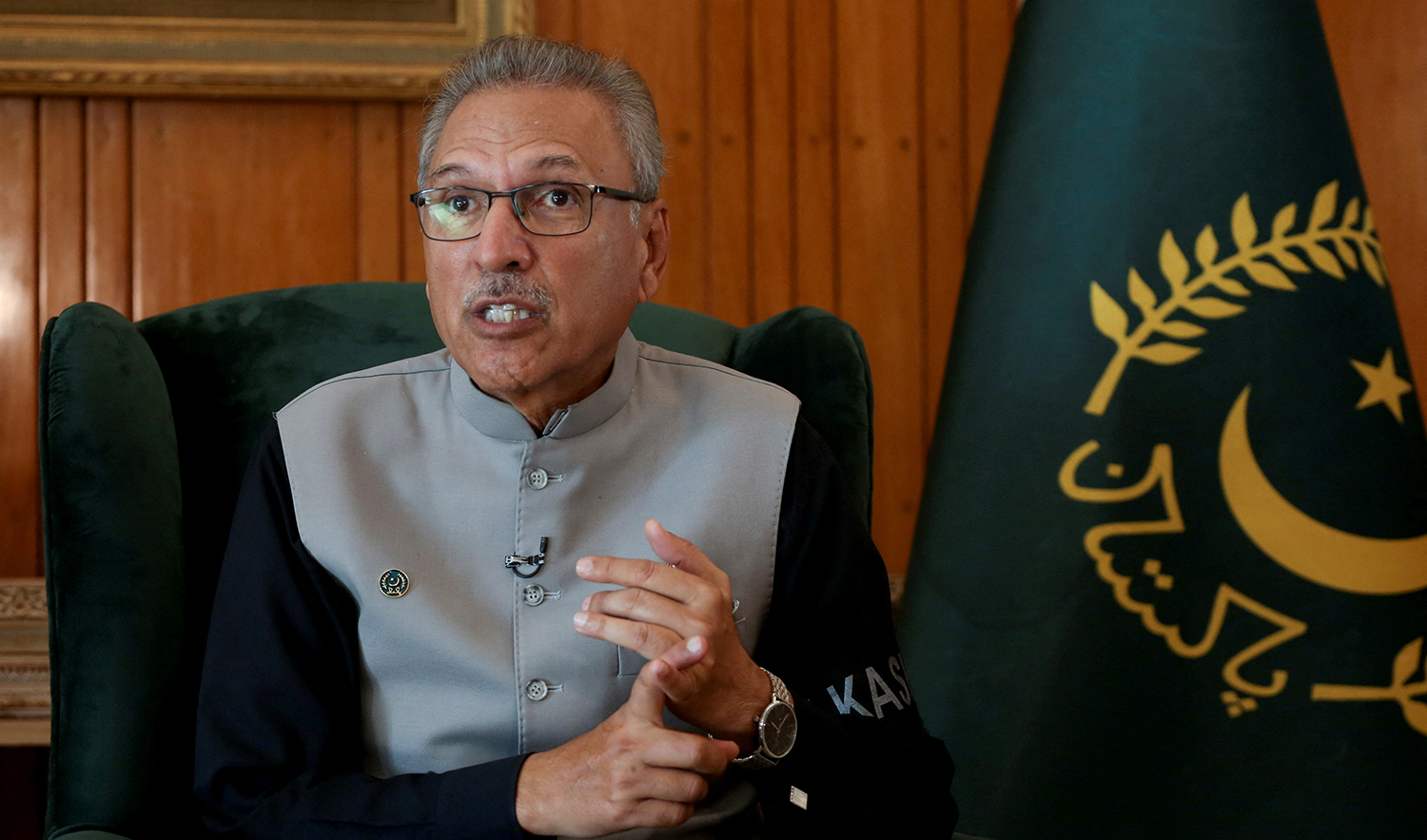


Pakistan's President Arif Alvi speaks with Reuters in an interview after Pakistan's presidency was recognized as the world's first presidential secretariat running on clean energy, in Islamabad on October 27, 2021. (REUTERS/File)

Subsequently, his secretariat announced Monday afternoon that it no longer required the services of the secretary to the president, Waqar Ahmed, and was sending him back to the establishment division.
“The Honourable President has surrendered my services to the Establishment Division on 21-08-2023, which conveys a message to the general public and media that perhaps Secretary to the President is responsible for any irregularity in connection with [the] processing of the ... Bills,” Ahmed wrote in a confidential letter to the president, a copy of which is in possession of Arab News.
He recalled that the president had neither approved the bills nor said it in writing to send them back to parliament for reconsideration.
“I neither delayed [the] above mentioned two Bills nor committed any irregularity or negligence,” he added. “The said files are still lying in the office of Honourable President as of today i.e. 21-08-2023, therefore, the Honourable President’s judgment/decision to surrender [my] services [to] Secretary to the Establishment Division is not based on justice.”
Ahmed urged President Alvi to order an inquiry by the Federal Investigation Agency (FIA) to probe the facts and fix responsibility for any lapse committed by anyone.
He noted he was willing to appear before any court to present all the record to prove his innocence while calling for the decision to send him back to the establishment division to be withdrawn.
The president’s assertion that he had not signed the bill on the messaging platform X, formally known as Twitter, was unprecedent.
It prompted the country’s caretaker administration to point out that returning a bill without any observations from the president was against the relevant constitutional provision.
The caretaker setup also pointed out that if the president did not grant his assent to a bill or return it with objections, it was notified as law after the expiry of a 10-day period.


Pakistan plans 3,000 EV charging stations as green mobility push gathers pace

Updated 10 sec ago
Follow

Pakistan plans 3,000 EV charging stations as green mobility push gathers pace

  • Roadmap unveiled by energy efficiency regulator and a private conglomerate amid early-stage EV rollout
  • New EV Policy and related plans aim to install 3,000 EV stations by 2030, including 240 stations in current fiscal year

ISLAMABAD: Pakistan’s energy efficiency regulator and a private conglomerate have unveiled an approved roadmap to establish 3,000 electric vehicle (EV) charging stations across the country, state-run Associated Press of Pakistan (APP) reported on Tuesday.

The announcement comes as Pakistan looks to build out basic EV charging infrastructure, which remains limited and unevenly distributed, largely concentrated in major cities. Despite policy commitments to promote electric mobility as part of climate and energy-efficiency goals, the absence of a nationwide charging network has slowed broader EV adoption.

Pakistan’s EV ecosystem is still at a formative stage, with progress constrained by regulatory approvals, grid connectivity issues and coordination challenges among utilities, regulators and fuel retailers. Expanding charging infrastructure is widely seen as a prerequisite for scaling electric transport for both private and commercial use.

According to APP, the roadmap was presented during a meeting between Malik Group Chief Executive Officer Malik Khuda Baksh and National Energy Efficiency and Conservation Authority Managing Director and Additional Secretary Humayon Khan.

“Baksh ... in a meeting with Khan, unveiled the approved roadmap for establishing 3,000 electric vehicle charging stations across Pakistan,” APP reported. “Khan reaffirmed the authority’s full institutional backing and pledged to expand the initiative to 6,000 EV charging stations nationwide.”

The discussion reviewed hurdles delaying the rollout, including EV charger imports, customs duties, regulatory documentation and inter-agency coordination.

APP said Khan welcomed the proposal and sought recommendations for “internationally compliant EV charger brands,” while asking for a detailed “issue-and-solutions report within three days” to facilitate timely implementation of the national green mobility initiative.

Despite the issuance of 13 licenses by NEECA and the arrival of five EV charging units at designated sites, progress has been slowed by procedural bottlenecks, officials said. These include delays in electricity connections, prolonged installation of separate meters and pending no-objection certificates from power distribution companies and oil marketing firms, which continue to stall operational readiness.

Pakistan’s electric vehicle ecosystem is still in its early stages, with charging infrastructure far behind levels seen in more advanced markets. The government’s New Energy Vehicle Policy and related plans aim to install 3,000 EV charging stations by 2030, including 240 stations planned in the current fiscal year, but actual deployment remains limited and uneven, mostly clustered in major cities and along key urban corridors.

Despite regulatory backing, including the 2024 Electric Vehicles Charging Infrastructure and Battery Swapping Stations framework, progress has been slow. Many proposed stations have yet to become operational due to delays in grid connections and approvals, and public maps of nationwide charging coverage are not yet available.

Private players are beginning to install more chargers, and there are over 20 public EV charging points reported in urban centers, offering both slower AC chargers and faster DC options. However, such infrastructure is still sparse compared with the growing number of electric vehicles and the government’s long-term targets.