Tense calm in divided Cyprus after UN says peacekeepers attacked

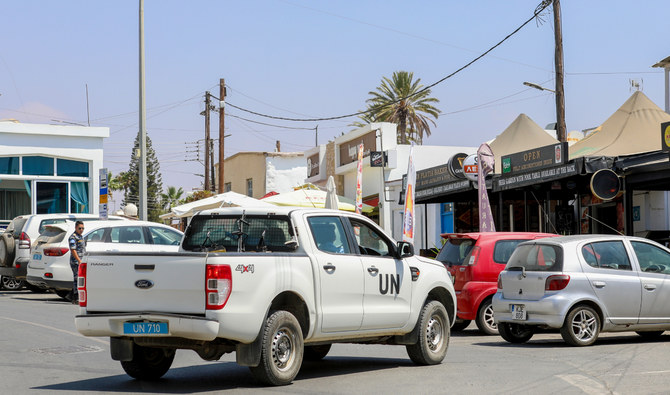
A tense calm held in Cyprus after the United Nations accused Turkish Cypriot forces of assaulting peacekeepers attempting to block construction of a road in the buffer zone. (AFP)
Short Url
Updated 21 August 2023
Follow

Tense calm in divided Cyprus after UN says peacekeepers attacked

  • Peacekeepers were attempting to block construction of a road in the buffer zone between the internationally recognized Republic of Cyprus in the south and a breakaway Turkish Cypriot statelet in the north

NICOSIA: A tense calm held Monday in Cyprus after the UN accused Turkish Cypriot forces of assaulting peacekeepers attempting to block construction of a road in the buffer zone.

It was one of the most serious incidents for years on the divided Mediterranean island and drew widespread international condemnation.

The confrontation occurred on Friday in Pyla, an ethnically mixed village in the UN-patrolled buffer zone between the internationally recognized Republic of Cyprus in the south and a breakaway Turkish Cypriot statelet in the north.

The UN said four peacekeepers were injured and its vehicles were also damaged as they tried to block the “unauthorized construction work” near Pyla.

“All is calm in Pyla this morning,” Aleem Siddique, spokesman for the UN Peacekeeping Force in Cyprus, said.

“The mission remains on standby to block any resumption of construction works,” he said, adding that the injured peacekeepers have been released from hospital.

Cyprus government spokesman Konstantinos Letymbiotis told reporters that meetings have been held internally and with permanent members of the UN Security Council since Thursday over the tensions.

“At this time, very delicate and specific handling is required,” he said on Monday. Special Representative of the UN Secretary-General, Colin Stewart, is to brief the UN Security Council later Monday about the Pyla incident, Siddique said.

Authorities in Turkish Republic of Northern Cyprus, who say the road project is aimed at easing the plight of its people, dismissed the UN mission’s allegations as “baseless.”

Veysal Guden, the Turkish Cypriot mayor of Pyla, said construction on the road would continue Monday in Turkish Cypriot controlled areas, but workers would not enter the UN-controlled zone.

“A chance will be given to diplomacy. Talks will continue,” Guden said.

The EU condemned the incident, and in a joint statement Britain, France and the US expressed “serious concern at the launch of unauthorized construction” of the road.

Local media reported that talks would take place between TRNC and the UN on Monday.


Ugandan opposition denounces ‘military state’ ahead of election

Updated 5 sec ago
Follow

Ugandan opposition denounces ‘military state’ ahead of election

KAMPALA: As dark clouds gathered overhead, young and old members of Uganda’s long-embattled opposition gathered for prayers at the home of an imprisoned politician — the mood both defiant and bleak.
The mayor of Kampala, Erias Lukwago, told the gathering on Sunday that this week’s election was a “face off” between ordinary Ugandans and President Yoweri Museveni.
“All of you are in two categories: political prisoners and potential political prisoners,” he said.
Museveni is widely expected to extend his 40-year rule of the east African country in Thursday’s election, thanks to his near-total control of the state and security apparatus.
The 81-year-old came to power as a bush fighter in the 1980s and has maintained a militarised control over the country, brutally cracking down on challengers.
The latest campaign has seen hundreds of opposition supporters arrested and at least one killed, with the police claiming they are confronting “hooligans.”
The main opposition candidate Bobi Wine, real name Robert Kyagulanyi, is rarely seen in public without his flak jacket and has described the campaign as a “war.”
He has been arrested multiple times in the past and tortured in military custody.
The only other significant opposition leader, Kizza Besigye, was kidnapped in Kenya in 2024 and secretly smuggled to a Ugandan military prison to face treason charges in a case that has dragged on for months.
His wife, UNAIDS director Winnie Byanyima, hosted Sunday’s prayer meeting at their home. She said Uganda has only a “thin veneer” of democracy.
“We are really a military state,” she told AFP. “There’s total capture of state institutions by the individual who holds military power, President Museveni.”

Police ‘not neutral’

“The police officers I have met have never looked at themselves as neutral,” said Jude Kagoro, a researcher at the University of Bremen who has spent more than a decade studying African police.
Most officers view it as their duty to support the incumbent power, he said, and often require no explicit order to use brute force on opposition rallies.
Museveni’s regime has used many strategies to infiltrate and divide opposition groups, including through handouts to different ethnic groups.
Under a system informally known as “ghetto structures,” security officials recruit young people in opposition areas who “work for the police to disorganize opposition activities, and also to spy,” said Kagoro.
The government was taken by surprise when Wine burst on to the political scene ahead of the 2021 election, becoming the voice of the urban youth, and responded with extreme violence.
Similarly, Tanzania’s authoritarian government was caught unawares when protests broke out over rigging in last October’s election, and security forces responded by killing hundreds.
The Ugandan government is better prepared now.
“For the last four-plus years, they have been building an infrastructure that can withstand any sort of pressure from the opposition,” said Kagoro.
“We are used to the military and the police on the streets during elections.”

‘Too dangerous’

Still, the authorities are not taking any chances. Citizens are being told to vote and return home immediately.
“The regime wants to make people very scared so they don’t come out to vote,” said David Lewis Rubongoya, secretary-general of Wine’s National Unity Platform.
There has been a spate of arrests and abductions targeting the opposition — a tactic also increasingly used in neighboring Kenya and Tanzania — with rights groups accusing the east African governments of coordinating their repression.
The violence makes it hard for opposition groups to organize.
“The price people have to pay for engaging in political opposition has become very high,” said Kristof Titeca, a Uganda expert based at Antwerp University.
“What’s left is a group of core supporters. Is there a grassroots opposition? No, there isn’t. It’s way too dangerous.”