Saudi Arabia to launch Nusuk platform for Bangladeshi pilgrims 

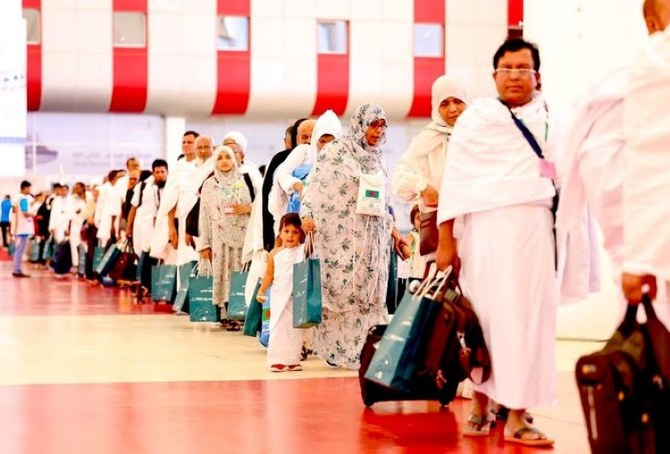
Bangladeshi pilgrims arrive in Jeddah, Saudi Arabia, May 21, 2023. (AN Photo)
Short Url
Updated 21 August 2023
Follow

Saudi Arabia to launch Nusuk platform for Bangladeshi pilgrims 

  • More than 332,000 Bangladeshis have visited Saudi Arabia so far this year 
  • Bangladesh is one of the Kingdom’s top five markets in the Asia-Pacific region, STA says

DHAKA: Saudi Arabia will launch the Nusuk platform in Dhaka on Thursday, Saudi tourism authorities told Arab News, as the Kingdom hopes to better facilitate Umrah pilgrims from Bangladesh. 

The South Asian nation is the fourth-largest Muslim-majority country in the world, where over 150 million people profess Islam. Every year, thousands of Bangladeshis visit Saudi Arabia for Umrah and Hajj pilgrimages. 

A Saudi delegation led by the Minister of Hajj and Umrah Tawfig Al-Rabiah is visiting Dhaka on Aug. 24-25 to promote the Kingdom’s efforts in transforming the Hajj and Umrah ecosystem, during which he will also inaugurate the launch of the Nusuk platform in Bangladesh. 

“In order to facilitate the Umrah pilgrims and tourists from Bangladesh, the Nusuk Roadshow has been organized for the first time in Dhaka. The main objective of this roadshow is to launch the Nusuk platform in the country … Bangladesh is a very important market for Saudi Arabia,” Alhasan Aldabbagh, Nusuk president for Asia Pacific markets, told Arab News on Monday. 

The platform, also launched earlier this year in Malaysia and Singapore by the Saudi Tourism Authority, allows pilgrims to plan and book visits to the holy cities of Makkah and Madinah, and beyond. 

Aldabbagh said the platform works as a digital passport that eases the journey for pilgrims, while also making it more accessible. 

Saudi Arabia has so far welcomed around 332,000 travelers from Bangladesh this year, which exceeded the Kingdom’s target by 7 percent, he added. 

“Dhaka is one of our top five markets in the Asia Pacific region. So, this market has a very important role in achieving Saudi’s Vision 2030 goals,” Aldabbagh said, referring to Saudi Arabia’s transformation plan that also focuses on the tourism sector. 

“Saudi Arabia is looking forward to welcoming 700,000 Bangladeshis this year, and in 2030, it will be 2.6 million.”

In the Kingdom, travelers with a personal visit visa can perform Umrah and also explore various tourist destinations in the Gulf nation, including its historical and cultural sites. 


Prabowo, Trump expected to sign Indonesia-US tariff deal in January 2026

Updated 23 December 2025
Follow

Prabowo, Trump expected to sign Indonesia-US tariff deal in January 2026

  • Deal will mean US tariffs on Indonesian products are cut from a threatened 32 percent to 19 percent
  • Jakarta committed to scrap tariffs on more than 99 percent of US goods

JAKARTA: Indonesia expects to sign a tariff deal with the US in early 2026 after reaching an agreement on “all substantive issues,” Jakarta's chief negotiator said on Tuesday.

Indonesia’s Coordinating Minister for Economic Affairs Airlangga Hartarto met with US trade representative Jamieson Greer in Washington this week to finalize an Indonesia-US trade deal, following a series of discussions that took place after the two countries agreed on a framework for negotiations in July.

“All substantive issues laid out in the Agreement on Reciprocal Trade have been agreed upon by the two sides, including both the main and technical issues,” Hartarto said in an online briefing.

Officials from both countries are now working to set up a meeting between Indonesian President Prabowo Subianto and US President Donald Trump. 

It will take place after Indonesian and US technical teams meet in the second week of January for a legal scrubbing, or a final clean-up of an agreement text.

“We are expecting that the upcoming technical process will wrap up in time as scheduled, so that at the end of January 2026 President Prabowo and President Trump can sign the Agreement on Reciprocal Trade,” Hartarto said.  

Indonesian trade negotiators have been in “intensive” talks with their Washington counterparts since Trump threatened to levy a 32 percent duty on Indonesian exports. 

Under the July framework, US tariffs on Indonesian imports were lowered to 19 percent, with Jakarta committing to measures to balance trade with Washington, including removing tariffs on more than 99 percent of American imports and scrapping all non-tariff barriers facing American companies. 

Jakarta also pledged to import $15 billion worth of energy products and $4.5 billion worth of agricultural products such as soybeans, wheat and cotton, from the US. 

“Indonesia will also get tariff exemptions on top Indonesian goods, such as palm oil, coffee, cocoa,” Hartarto said. 

“This is certainly good news, especially for Indonesian industries directly impacted by the tariff policy, especially labor-intensive sectors that employ around 5 million workers.” 

In the past decade, Indonesia has consistently posted trade surpluses with the US, its second-largest export market after China. 

From January to October, data from the Indonesian trade ministry showed two-way trade valued at nearly $36.2 billion, with Jakarta posting a $14.9 billion surplus.