

Special Pakistan court established for cases under Official Secrets Act hears first case today

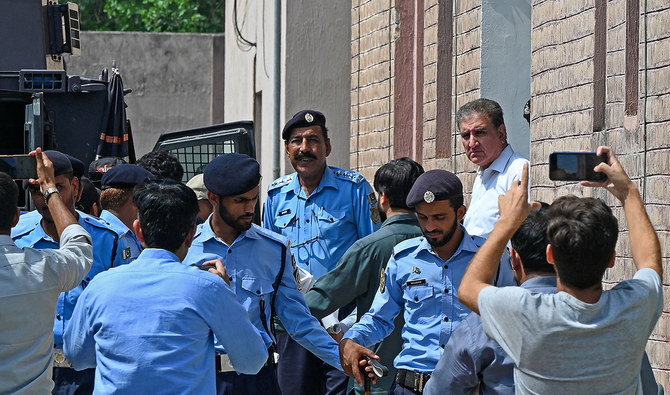
Shah Mahmood Qureshi, Vice Chairman of Pakistan Tehreek-e-Insaf (PTI) party and Pakistan's former Foreign Affairs Minister is seen outside a special court after he was granted a four-day physical remand in Islamabad on August 21, 2023. (Photo courtesy: AFP)
Short Url
Updated 21 August 2023
Follow

Special Pakistan court established for cases under Official Secrets Act hears first case today

  • Court remands former FM Shah Mahmood Qureshi in custody of Federal Investigation Agency for four day
  • Case is related to alleged diplomatic correspondence that ex-PM Khan says proves US conspiracy against his government

KARACHI: A special court set up to try cases under the Official Secrets Act started hearing its first case on Monday, remanding former foreign minister Shah Mahmood Qureshi in custody of the Federal Investigation Agency (FIA) for four days.

The FIA arrested Qureshi, a close aide of former Prime Minister Imran Khan, on Saturday after a case was registered against him and Khan last Tuesday under the Official Secrets Act of 1923. The case is related to alleged diplomatic correspondence between Washington and Islamabad, which Khan has said proved a US conspiracy to topple his government. Washington has denied being involved in any such conspiracy.

According to a copy of the First Information Report (FIR), or police complaint, seen by Arab News, Khan and Qureshi, who was the ex-PM’s foreign minister, are both accused of divulging the contents of a classified document to unauthorized individuals and distorting facts “with ulterior motives and personal gains, thereby jeopardizing state security interest.”

Justice Abdul Hasnat Muhammad Zulqarnain, the judge of the special court, remanded Qureshi into FIA custody for four days though the agency had requested a 13-day remand.

Speaking to Arab News, legal expert Justice (retired) Rasheed A. Rizvi said Khan’s Pakistan Tehreek-e-Insaf (PTI) party would likely challenge the proceedings as they were being conducted under “questionable legislation.”

The retired jurist was referring to a statement by Pakistan’s President Arif Alvi on Sunday that he had refused to sign into law two bills, the Official Secrets Amendment Bill 2023 and the Pakistan Army Amendment Bill 2023, that would give authorities more power to prosecute people for acts against the state and military.

The bills have already been passed by both houses of Pakistan’s parliament but Alvi is a member of former prime minister PTI party, which opposes the coalition government that passed the two bills.

“As God is my witness, I did not sign Official Secrets Amendment Bill 2023 & Pakistan Army Amendment Bill 2023 as I disagreed with these laws,” Alvi said on social media platform X, formerly known as Twitter, raising questions about the status of the two laws. 

He said he had asked his staff to return the bills unsigned to the legislature within the stipulated time to make them ineffective.

“However I have found out today that my staff undermined my will and command,” he said.

According to the constitution, if the president doesn’t sign a draft bill or return it back with his observations or objections within 10 days after it has already been through the two houses it will become law.

“After the tweet by President Dr. Arif Alvi wherein he has said that he had not signed the bills, a fact which the federal ministry of law and justice endorsed in its press release, the legislation has become questionable,” Rizvi said, adding that an arrest under the Official Secrets Act was thus also questionable.

The decision to prosecute Khan for exposing official secrets was taken last month by the outgoing government of Prime Minister Shehbaz Sharif after Khan’s former principal secretary Azam Khan recorded a court statement saying a US diplomatic encrypted letter was manipulated by Khan in March 2022 to serve his political goals.

The 70-year-old former cricket hero lost power in a vote of no confidence in April 2022, in which he has said Washington got involved after his visit to Moscow. Khan waved a piece of paper at public gatherings saying he was holding a copy of a secret diplomatic letter, which spoke of dire consequences if he continued getting closer to Russia.

Khan had traveled to Moscow on the eve of Russia’s invasion of Ukraine and argues that the US and Pakistan’s own army were opposed to him for purusing an independent foreign police. Both deny the charge. 


Islamabad dismisses claims about paying up to 8 percent interest on foreign loans as ‘misleading’

Updated 22 February 2026
Follow

Islamabad dismisses claims about paying up to 8 percent interest on foreign loans as ‘misleading’

  • Pakistan has long relied on external loans to help bridge persistent gaps in public finances and foreign exchange reserves
  • Pakistan’s total external debt, liabilities stand at $138 billion at an overall average cost of around 4 percent, ministry says

KARACHI: Pakistan’s finance ministry on Sunday dismissed as “misleading” claims that the country is paying up to 8 percent interest on external loans, saying the overall average cost of external public debt is approximately 4 percent.

Pakistan has long relied on external loans to help bridge persistent gaps in public finances and foreign exchange reserves, driven largely by a narrow tax base, chronic trade deficits, rising debt-servicing costs and repeated balance-of-payments pressures.

Over the decades, successive governments have turned to multilateral and bilateral lenders, including the International Monetary Fund, the World Bank and the Asian Development Bank, to support budgetary needs and shore up foreign exchange reserves.

The finance ministry on Sunday issued a clarification in response to a “recent press commentary” regarding the country’s external debt position and associated interest payments, and said the figures required contextual explanation to ensure accurate understanding of Pakistan’s external debt profile.

“Pakistan’s total external debt and liabilities currently stand at $138 billion. This figure, however, encompasses a broad range of obligations, including public and publicly guaranteed debt, debt of Public Sector Enterprises (both guaranteed and non-guaranteed), bank borrowings, private-sector external debt, and intercompany liabilities to direct investors. It is therefore important to distinguish this aggregate figure from External Public (Government) Debt, which amounts to approximately $92 billion,” it said.

“Of the total External Public Debt, nearly 75 percent comprises concessional and long-term financing obtained from multilateral institutions (excluding the IMF) and bilateral development partners. Only about 7 percent of this debt consists of commercial loans, while another 7 percent relates to long-term Eurobonds. In light of this composition, the claim that Pakistan is paying interest on external loans ‘up to 8 percent’ is misleading.

The overall average cost of External Public Debt is approximately 4 percent, reflecting the predominantly concessional nature of the borrowing portfolio.”

With respect to interest payments, public external debt interest outflows increased from $1.99 billion in Fiscal Year (FY) 2022 to $3.59 billion in FY2025, representing an increase of 80.4 percent, not 84 percent as reported. In absolute terms, interest payments rose by $1.60 billion over this period, not $1.67 billion, it said.

According to the State Bank of Pakistan’s records, Pakistan’s total debt servicing payments to specific creditors during the period under reference were as follows: the IMF received $1.50 billion, of which $580 million constituted interest; Naya Pakistan Certificates payments totaled $1.56 billion, including $94 million in interest; the Asian Development Bank received $1.54 billion, including $615 million in interest; the World Bank received $1.25 billion, including $419 million in interest; and external commercial loans amounted to nearly $3 billion, of which $327 million represented interest payments.

“While interest payments have increased in absolute terms, this rise cannot be attributed solely to an expansion in the debt stock,” the ministry said. “Although the overall debt stock has increased slightly since FY2022, the additional inflows have primarily originated from concessional multilateral sources and the IMF’s Extended Fund Facility (EFF) under the ongoing IMF-supported program.”

Pakistan secured a $7 billion IMF bailout in Sept. 2024 as part of Prime Minister Shehbaz Sharif’s efforts to stabilize the South Asian economy that narrowly averted a default in 2023. The government has since been making efforts to boost trade and bring in foreign investment to consolidate recovery.

“It is also important to note that the increase in interest payments reflects prevailing global interest rate dynamics. In response to the inflation surge of 2021–22, the US Federal Reserve raised the federal funds rate from 0.75-1.00 percent in May 2022 to 5.25–5.50 percent by July 2023. Although rates have since moderated to around 3.75 percent, they remain significantly higher than 2022 levels,” the finance ministry said.

“The government remains committed to prudent debt management, transparency, and the continued strengthening of Pakistan’s macroeconomic stability,” it added.