

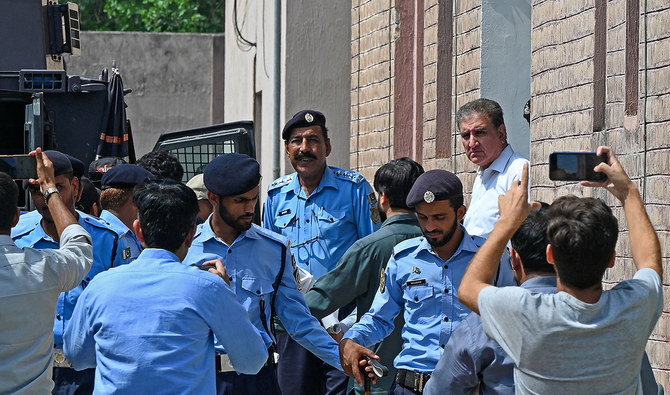

KARACHI: A special court set up to try cases under the Official Secrets Act started hearing its first case on Monday, remanding former foreign minister Shah Mahmood Qureshi in custody of the Federal Investigation Agency (FIA) for four days.
The FIA arrested Qureshi, a close aide of former Prime Minister Imran Khan, on Saturday after a case was registered against him and Khan last Tuesday under the Official Secrets Act of 1923. The case is related to alleged diplomatic correspondence between Washington and Islamabad, which Khan has said proved a US conspiracy to topple his government. Washington has denied being involved in any such conspiracy.
According to a copy of the First Information Report (FIR), or police complaint, seen by Arab News, Khan and Qureshi, who was the ex-PM’s foreign minister, are both accused of divulging the contents of a classified document to unauthorized individuals and distorting facts “with ulterior motives and personal gains, thereby jeopardizing state security interest.”
Justice Abdul Hasnat Muhammad Zulqarnain, the judge of the special court, remanded Qureshi into FIA custody for four days though the agency had requested a 13-day remand.
Speaking to Arab News, legal expert Justice (retired) Rasheed A. Rizvi said Khan’s Pakistan Tehreek-e-Insaf (PTI) party would likely challenge the proceedings as they were being conducted under “questionable legislation.”
The retired jurist was referring to a statement by Pakistan’s President Arif Alvi on Sunday that he had refused to sign into law two bills, the Official Secrets Amendment Bill 2023 and the Pakistan Army Amendment Bill 2023, that would give authorities more power to prosecute people for acts against the state and military.
The bills have already been passed by both houses of Pakistan’s parliament but Alvi is a member of former prime minister PTI party, which opposes the coalition government that passed the two bills.
“As God is my witness, I did not sign Official Secrets Amendment Bill 2023 & Pakistan Army Amendment Bill 2023 as I disagreed with these laws,” Alvi said on social media platform X, formerly known as Twitter, raising questions about the status of the two laws.
He said he had asked his staff to return the bills unsigned to the legislature within the stipulated time to make them ineffective.
“However I have found out today that my staff undermined my will and command,” he said.
According to the constitution, if the president doesn’t sign a draft bill or return it back with his observations or objections within 10 days after it has already been through the two houses it will become law.
“After the tweet by President Dr. Arif Alvi wherein he has said that he had not signed the bills, a fact which the federal ministry of law and justice endorsed in its press release, the legislation has become questionable,” Rizvi said, adding that an arrest under the Official Secrets Act was thus also questionable.
The decision to prosecute Khan for exposing official secrets was taken last month by the outgoing government of Prime Minister Shehbaz Sharif after Khan’s former principal secretary Azam Khan recorded a court statement saying a US diplomatic encrypted letter was manipulated by Khan in March 2022 to serve his political goals.
The 70-year-old former cricket hero lost power in a vote of no confidence in April 2022, in which he has said Washington got involved after his visit to Moscow. Khan waved a piece of paper at public gatherings saying he was holding a copy of a secret diplomatic letter, which spoke of dire consequences if he continued getting closer to Russia.
Khan had traveled to Moscow on the eve of Russia’s invasion of Ukraine and argues that the US and Pakistan’s own army were opposed to him for purusing an independent foreign police. Both deny the charge.


