

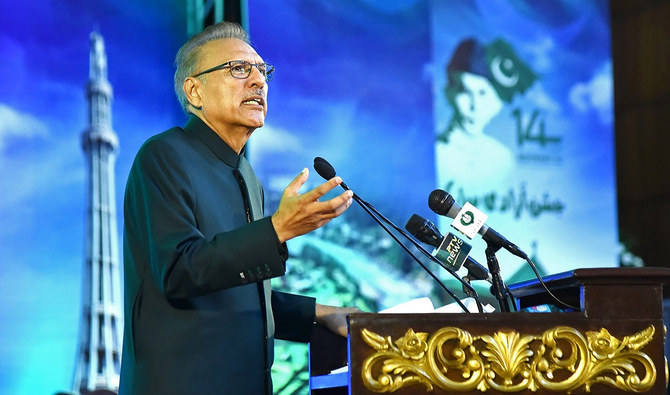

ISLAMABAD: Pakistan President Arif Alvi on Sunday said he did not sign into law two bills granting widespread powers to the Pakistani military and intelligence agencies, raising questions about the status of the legislations.
The development comes a day after Pakistani media widely reported that the president signed the Official Secrets (Amendment) Bill 2023 & Pakistan Army (Amendment) Bill 2023 into laws, which were sent to him for approval by the outgoing Prime Minister Shehbaz Sharif-led government days before its term ended this month.
In Pakistan, the National Assembly and the Senate, the lower and upper houses of parliament, approve a draft legislation before it goes to the president for a final nod. Unless the president signs a bill, it cannot become law.
“As God is my witness, I did not sign Official Secrets Amendment Bill 2023 & Pakistan Army Amendment Bill 2023 as I disagreed with these laws,” President Alvi said in a message on X messaging platform that came as a shock to many.
Alvi said he had asked his staff to return the bills unsigned within the stipulated time to make them ineffective and upon confirming with them, he was assured the drafts had been returned.
“However, I have found out today that my staff undermined my will and command,” he said. “As Allah knows all... I ask forgiveness from those who will be effected.”
Such an assertion by the president, who is the head of the state and supreme commander of the Pakistani armed forces, is unprecedent in Pakistan, which has had a troubled history of military interventions.
The development has raised several questions about the status of the two legislations as well as the president’s authority, and is expected to fuel further political turmoil in the South Asian country that is already engulfed in a crisis since the ouster of former prime minister Imran Khan in a parliamentary no-trust vote in 2022 and his subsequent arrest in a graft case earlier this month.
Responding to the president’s post, Pakistan’s law ministry said in a press statement it had noted Alvi’s statement with “grave concern,” adding that as per Article 75 of Pakistan’s constitution, the president can either give his assent to a bill or send it to parliament with observations.
“Article 75 does not provide for any third option,” the ministry noted. “In the instant matter, neither of the requirements were fulfilled. Instead, the President purposely delayed the assent.”
It said returning bills without any observations is against the letter and spirit of the constitution. The law ministry said the Pakistani president could have returned the bills with his observations, as he had done in the past.
“It is a matter of concern that the President has chosen to discredit his own officials,” the law ministry said. “The President should take responsibility for his own actions.”
Separately in a press conference with Caretaker Information Minister Murtaza Solangi, Caretaker Law Minister Ahmad Irfan Aslam said the president had not returned the bills that were sent to him for his assent.
“So, when you asked about any observations [by the president] regarding the bills, when they weren’t even received, so what can we say about the observations,” Aslam told reporters.
He said when the president does not either grant his assent to a bill or returns them with objections, then after the expiry of the 10-day tenure, the bill is notified as law.
Amendments to the bills
On August 6, Pakistan’s Senate passed the Official Secrets (Amendment) Bill 2023 by a majority vote after the former government removed a clause that gave spy agencies the power to carry out raids or make arrests without warrants. The legislation had been tabled amid growing criticism of military and intelligence officers by Khan and his deputies.
The Official Secrets (Amendment) Bill, 2023 originally made it legal for two premier intelligence agencies, the Inter-Services Intelligence (ISI) and Intelligence Bureau (IB), to seize any document, sketch, plan, electronic or modern devices or anything which can be evidence of an offense committed.
The legislation broadened the definition of “document” to include “any written, unwritten, electronic, digital, or any other tangible or intangible instrument” related to the military’s procurements and capabilities. Likewise, the definition of “enemy” in the proposed law stated that “any person who is directly or indirectly, intentionally or unintentionally working for or engaged with a foreign power, foreign agent, non-state actor, organization, entity, association or group guilty of a particular act… prejudicial to the safety and interest of Pakistan.”
Another amendment in the Official Secrets Bill proposed a prison term of three years for disclosing the “identity of the members of the intelligence agencies or the informants or sources.”
The amendments to the Pakistan Army Act, 1952 criminalizes social media campaigns against the armed forces, aim to put a check on serving and retired military officials from divulging sensitive information, and keep them from participating in political activities immediately after retirement, analysts told Arab News after the bill’s passage from parliament in late July.
One of the amendments in the Army Act proposed up to five years in jail for those who disclosed sensitive information pertaining to the security of the country or the military.
The amended bill barred dual nationals to take a commission in the armed forces and authorizes the federal government, in extraordinary circumstances, to retain any person of the army compulsorily in service up to 60 years of age with the recommendation of the army chief.
“If any person, who is or has been subject to this act, discloses or causes to be disclosed any information … shall be guilty of an offense, and on conviction by the court constituted under this Act, be punished with rigorous imprisonment for a term which may extend to five years,” the amended bill said.
The legislation also proposed barring any person subject to the Army Act from engaging in any political activity for two years from the date of their “retirement, release, resignation, discharge, removal or dismissal from service.”


