WEST KELOWNA, British Columbia: Canada’s western province of British Columbia declared a state of emergency on Friday as firefighters battled a wildfire raging in the hills and mountains above the town of West Kelowna forcing thousands of evacuations.
West Kelowna, a city of 36,000 people is some 300 kilometers (180 miles) east of Vancouver. Wildfires and evacuations were also being carried out in Kelowna, a city with a population of about 150,000 also on Okanagan Lake.
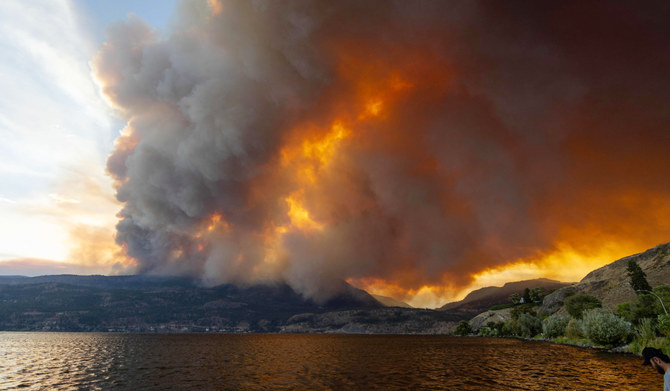
The flames and smoke were visible from West Kelowna, according to a Reuters witness, and smoke filled the valley surrounding the lake.
Officials said the next 24 to 48 hours could be the most difficult. Earlier the airspace in the area was closed to clear the way for water bombers.
“Over the past 24 hours, the situation has evolved rapidly and we are in for an extremely challenging situation in the days ahead,” the government of British Columbia said in a statement.
“We fought hard last night to protect our community,” Jason Brolund, West Kelowna fire chief, told reporters. “Night turned to day because of the orange glow of the clouds and the fire.”
More than 2,400 properties were evacuated, officials said, and thousands more are on alert to leave with little notice if necessary. Several structures were destroyed in West Kelowna during the night, he said.


British Columbia declares state of emergency as firefighters battle blazes
https://arab.news/8ux6u
British Columbia declares state of emergency as firefighters battle blazes

- Hundreds of kilometers (miles) south of Yellowknife, homes were burning in West Kelowna, British Columbia, a city of about 38,000, after a wildfire grew “exponentially worse” than expected overnight, the fire chief said


Philippines eyes closer cooperation on advanced defense tech with UAE
- Philippine-UAE defense agreement is Manila’s first with a Gulf country
- Philippines says new deal will also help modernize the Philippine military
MANILA: The Philippines is seeking stronger cooperation with the UAE on advanced defense technologies under their new defense pact — its first such deal with a Gulf country — the Department of National Defense said on Friday.
The Memorandum of Understanding on Defense Cooperation was signed during President Ferdinand Marcos Jr.’s visit to Abu Dhabi earlier this week, which also saw the Philippines and the UAE signing a comprehensive economic partnership agreement, marking Manila’s first free trade pact with a Middle Eastern nation.
The Philippines-UAE defense agreement “seeks to deepen cooperation on advanced defense technologies and strengthen the security relations” between the two countries, DND spokesperson Assistant Secretary Arsenio Andolong said in a statement.
The MoU “will serve as a platform for collaboration on unmanned aerial systems, electronic warfare, and naval systems, in line with the ongoing capability development and modernization of the Armed Forces of the Philippines,” he added.
It is also expected to further military relations through education and training, intelligence and security sharing, and cooperation in the fields of anti-terrorism, maritime security, and peacekeeping operations.
The UAE’s Ministry of Foreign Affairs has described security and defense as “very promising fields” in Philippine-UAE ties, pointing to Abu Dhabi being the location of Manila’s first defense attache office in the Middle East.
The UAE is the latest in a growing list of countries with defense and security deals with the Philippines, which also signed a new defense pact with Japan this week.
“I would argue that this is more significant than it looks on first read, precisely because it’s the Philippines’ first formal defense cooperation agreement with a Gulf state. It signals diversification,” Rikard Jalkebro, associate professor at the Anwar Gargash Diplomatic Academy in Abu Dhabi, told Arab News.
“Manila is widening its security partnerships beyond its traditional circles at a time when strategic pressure is rising in the South China Sea, and the global security environment is (volatile) across regions.”
Though the MoU is not an alliance and does not create mutual defense obligations, it provides a “framework for the practical stuff that matters,” including access, training pathways, procurement discussions and structured channels” for security cooperation, he added.
“For the UAE, the timing also makes sense, seeing that Abu Dhabi is no longer only a defense buyer; it’s increasingly a producer and exporter, particularly in areas like UAS (unmanned aerial systems) and enabling technologies. That opens a new lane for Manila to explore capability-building, technology transfer, and industry-to-industry links,” Jalkebro said.
The defense deal also matters geopolitically, as events in the Middle East and the Indo-Pacific region have ripple effects on global stability and commerce.
“So, a Philippines–UAE defense framework can be read as a pragmatic hedge, strengthening resilience and options without formally taking sides,” Jalkebro said.


