Pakistan’s mangrove carbon credit sales hit $40mn, boosts target to $12bn by 2075

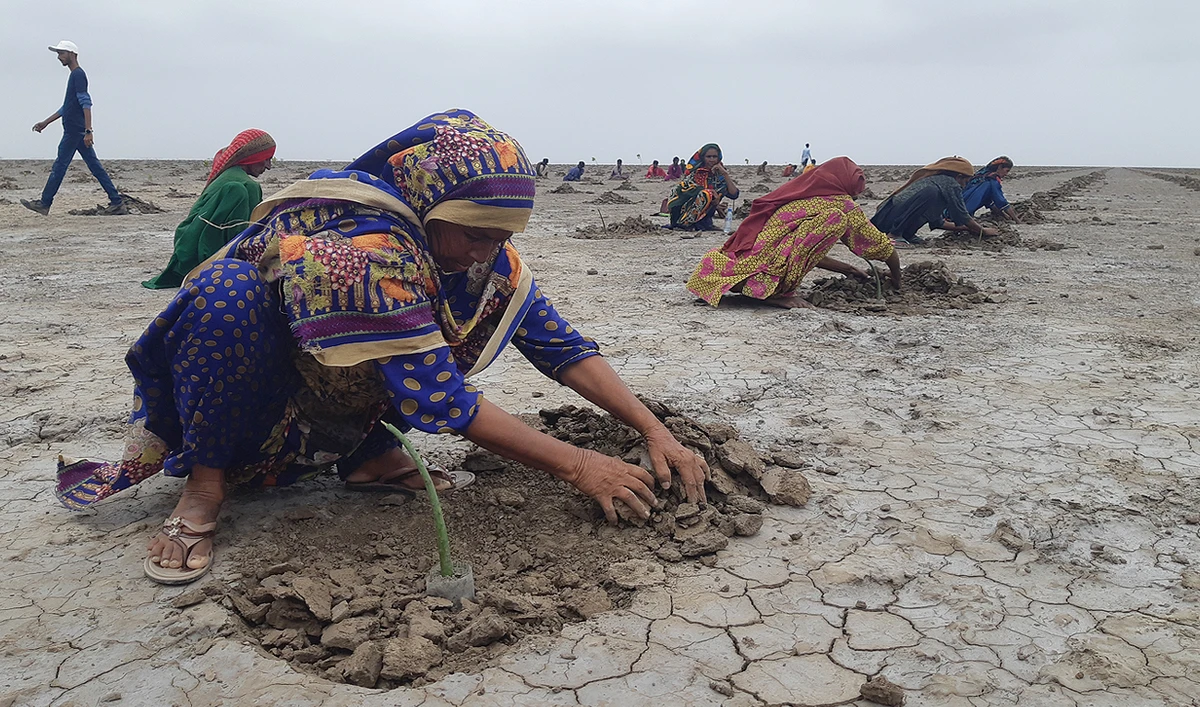
Woman gardener plants mangroves in Village Haji Doongar Jatt in Sujawal District on August 14, 2023 to mark the start of the Delta Blue Carbon (DBC) - 2 project, which aims to plant and restore mangroves. (AN Photo/ Zulfiqar Kunbhar)
Short Url
Updated 18 August 2023
Follow

Pakistan’s mangrove carbon credit sales hit $40mn, boosts target to $12bn by 2075

  • Sindh launches Delta Blue Carbon (DBC) — 2 mangrove plantation, restoration project in coastal districts of Badin, Sujawal
  • Combined foreign direct investment in mangrove plantation project expected to reach $100 million, as per official data

SUJAWAL, SINDH: Cash-starved Pakistan raised its carbon trading sales target this month to $12 billion by launching a new mangrove plantation project at the Indus Delta in the country’s southern Sindh province that has till date sold $40 million worth of carbon credits, officials confirmed.

Known as the vertebra of Pakistan’s ecology and economy, the Indus Delta is the fifth largest in the world and home to the seventh biggest mangrove forest. According to the Sindh Forest Department (SFD), Indus Delta mangroves are unique as they are the largest arid climate mangroves in the world.

With the help of foreign private funding, on August 14, 2023, the SFD launched the new Delta Blue Carbon (DBC) — 2 mangrove plantation and restoration project in the coastal districts of Badin and Sujawal in Sindh. The DBC-2 is a continuation of the 60-year-long Delta Blue Carbon (DBC) — 1 mangrove restoration and plantation project that began in the Indus Delta in 2015 and is still carrying on.

“The current size of the Indus Delta is 670,000 hectares while the Sindh Forest Department aims to complete mangrove restoration and plantation in the Indus Delta on 450,000 hectares by 2030 though DBC-1 and DBC-2 projects,” Riaz Ahmed Wagan, chief conservator of forests in the Sindh Forest Department, told Arab News.
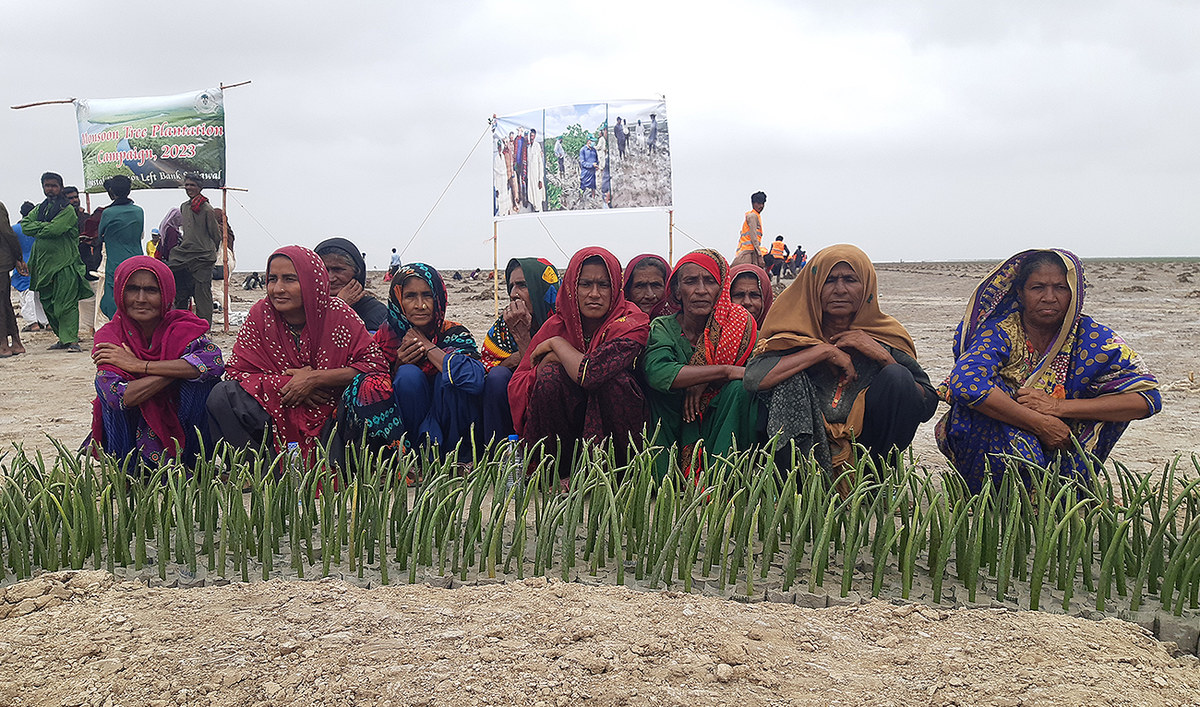


Women gardeners gesture for a group photo at an event to mark the start of the Delta Blue Carbon (DBC) - 2 project, aims to plant and restore mangroves, in Village Haji Doongar Jatt in Sujawal District on August 14, 2023. (AN Photo/ Zulfiqar Kunbhar)

“The ongoing DBC-1 project focuses on 250,000 hectares, while the new DBC-2 project plans to add 200,000 hectares in mangrove growth,” he added.

The forest department official said Sindh’s Indus Delta mangrove plantation is currently Pakistan’s only carbon credits seller project. These projects are designed to reduce or remove carbon dioxide from the atmosphere, and the resulting credits can be bought and sold on the carbon market.

Wagan said Sindh estimated to generate $7 billion in certified emission reductions (CERs) by completing the DBC-1 project by 2075. With the introduction of the DBC-2 initiative, the province aims to add an additional $5 billion by the same year, he added.

“As a result, through the combined projects Sindh is projected now to yield earnings of $12 billion by the year 2075 through carbon credit afforestation sales,” Wagan said.
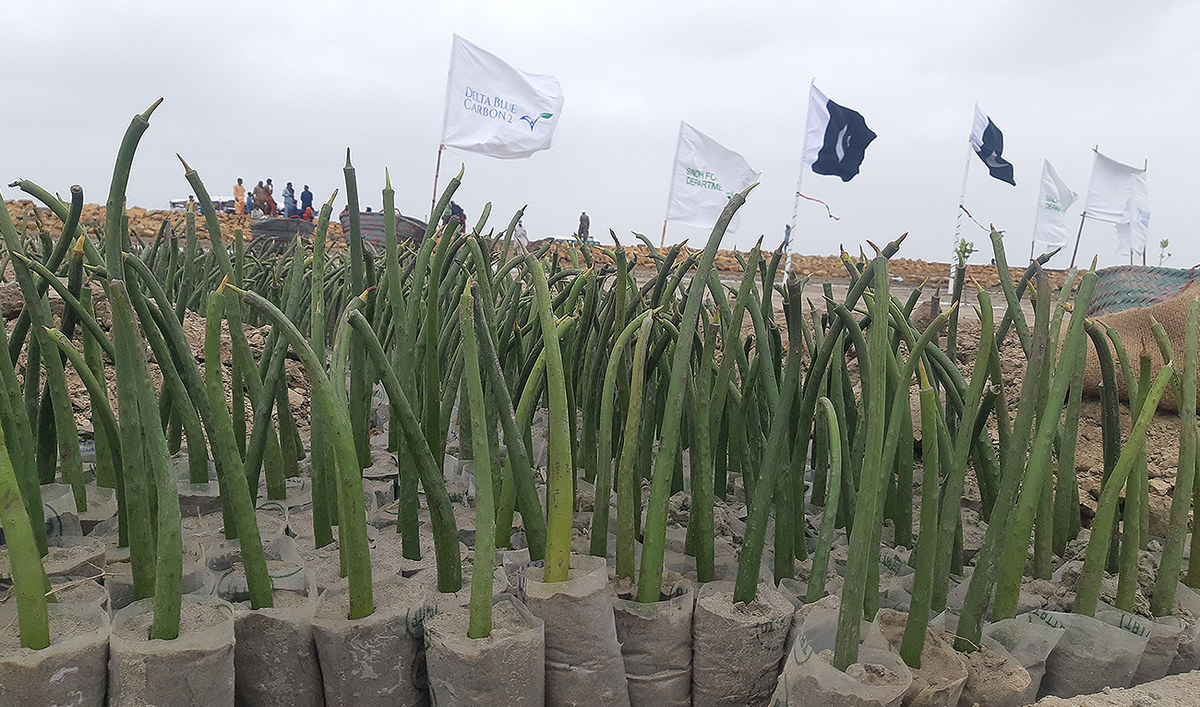


This photo shows a mangrove nursery at the launch of Delta Blue Carbon (DBC) - 2 project, aiming to plant and restore mangroves, in Village Haji Doongar Jatt in Sujawal District on August 14, 2023. (AN Photo/ Zulfiqar Kunbhar)

According to Pakistan’s Ministry of Climate Change and Environmental Coordination document much of the original area where mangroves were planted has been degraded in the Indus Delta, primarily due to freshwater diversion, over-exploitation (wood, fodder, and grazing), and land-based pollution.

The Kyoto Protocol, an international treaty of which Pakistan is also a signatory, was established in 1997 and enforced in 2005. The treaty aimed to combat climate change and set mandatory emission reduction goals for developed nations.

According to the United Nations Framework Convention on Climate Change (UNFCCC), the Clean Development Mechanism (CDM) lets countries that promised to lower their emissions as part of the Kyoto Protocol, work on projects that reduce pollution in poorer countries. These projects can earn them credits called certified emission reductions (CERs), which help them meet their Kyoto goals.

Pakistan is currently among the top ten countries most impacted by climate change in the world. Officials say as a signatory of the Kyoto Protocol, Pakistan is also making efforts to mitigate and adapt to the effects of climate change. The Indus Delta mangrove plantation is a part of these efforts.
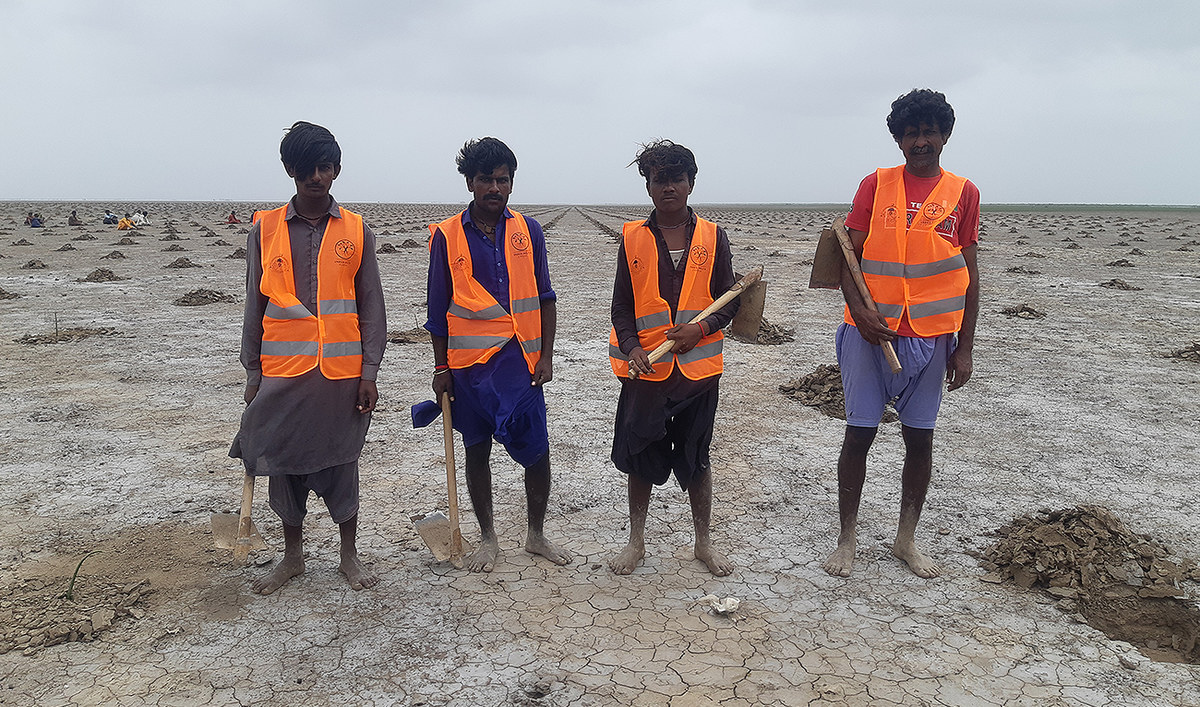


Male gardeners gesture for a group photo at an event to mark the start of the Delta Blue Carbon (DBC) - 2 project, aims to plant and restore mangroves, in Village Haji Doongar Jatt in Sujawal District on August 14, 2023. (AN Photo/ Zulfiqar Kunbhar)

 As per official figures, Pakistan’s emissions in 2018 totaled 489.87 metric tons of CO2 equivalent (MtCO2e), accounting for around 0.50 percent of global carbon dioxide emissions. This suggests that the DBC-1 and DBC-2 emissions credits projects will approximately be equal to half of the country’s emissions.

“The combined carbon offsetting of Pakistan through the DBC-1 and DBC-2 projects is anticipated to reach 240 million metric tons of carbon dioxide equivalent (MtCO2e),” Wagan noted.

“Within this, DBC-1 is projected to capture 140 million metric tons of carbon dioxide equivalent (MtCO2e) through carbon credits, while DBC-2 is expected to reduce approximately 100 million metric tons of carbon dioxide equivalent (MtCO2e) through carbon credits.”

As per official figures, Sindh has sold 3.1 million carbon credits as of now, worth $40 million. By 2075, Sindh is expected to create 140 million carbon credits in the Voluntary Carbon Market (VCM) — a global system to trade carbon offsets.
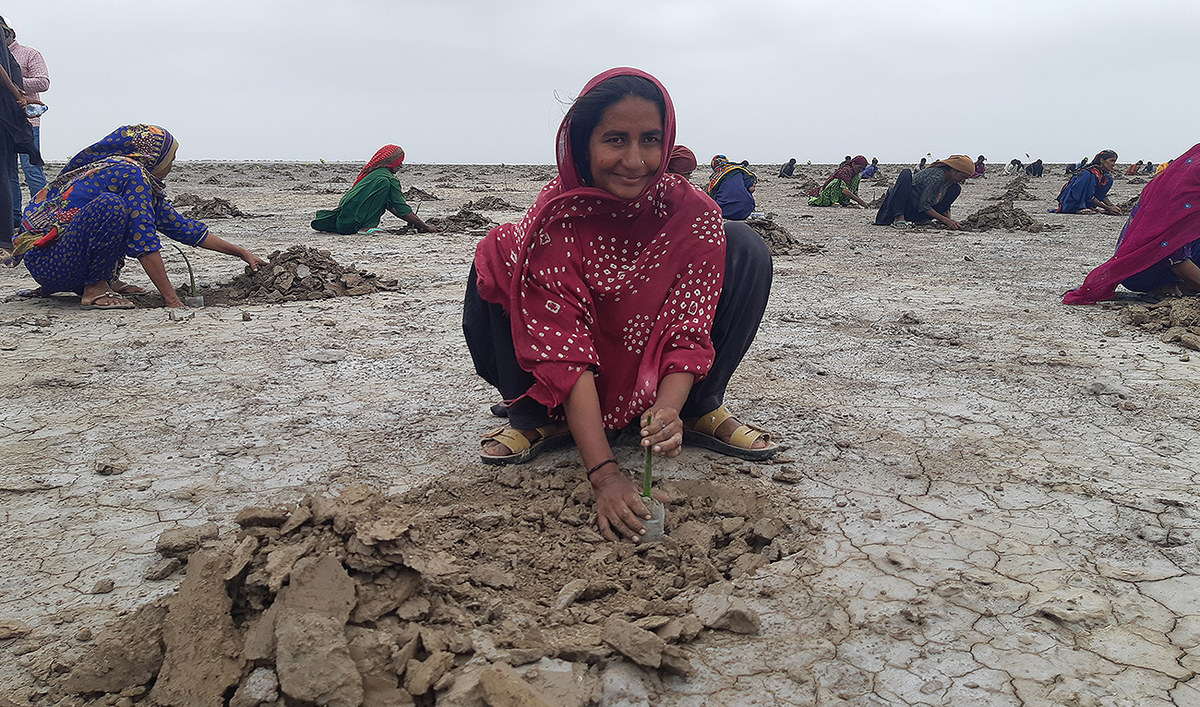


A woman gardener poses for a photo while planting mangroves in Village Haji Doongar Jatt in Sujawal District on August 14, 2023 to mark the start of the Delta Blue Carbon (DBC) - 2 project, which aims to plant and restore mangroves. (AN Photo/ Zulfiqar Kunbhar)

To date, Sindh has sold a total of $40 million worth of carbon credits in the carbon credit market through DBC-1. The value per carbon credit sold by Sindh has ranged from $12 to $50, reflecting variations in the market, Wagan said.

According to official statistics, combined foreign direct investment in DBC-1 and DBC-2 is projected to reach around $100 million, with an estimated investment of $60 million in DBC-1 and an anticipated investment of $40 million in DBC-2.

According to Waqar Hussain, a senior official at Environment, Climate Change & Coastal Development Department Sindh, the increasing mangrove cover in the Indus Delta would have a positive impact on the economy.

“Mangroves have the ability to absorb four times more carbon dioxide than other trees,” he said. “They act as protective barriers against cyclones and create habitats for aquatic life, benefiting fishing,” Hussain added.
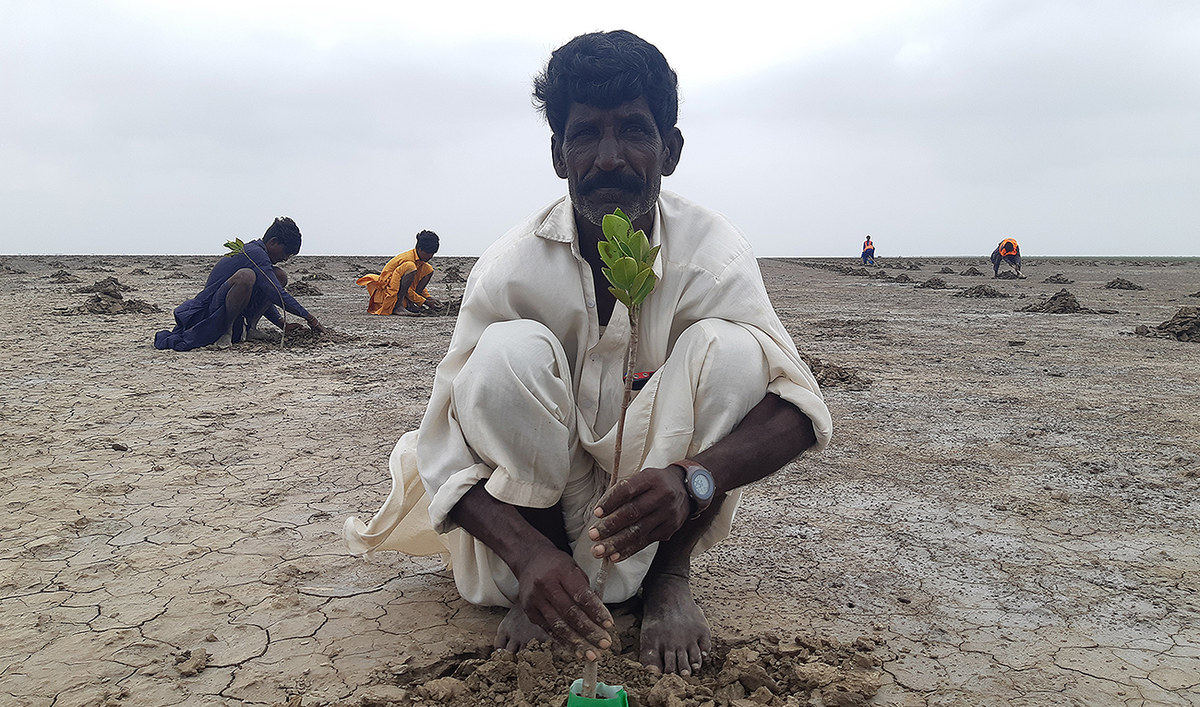

A male gardener poses for a photo while planting mangroves in Village Haji Doongar Jatt in Sujawal District on August 14, 2023, to mark the start of the Delta Blue Carbon (DBC) - 2 project, which aims to plant and restore mangroves. (AN Photo/ Zulfiqar Kunbhar)


Tens of thousands flee northwest Pakistan over fears of military operation

Updated 28 January 2026
Follow

Tens of thousands flee northwest Pakistan over fears of military operation

  • More than 70,000 people, mostly women and children, have fled remote Tirah region bordering Afghanistan 
  • Government says no military operation underway or planned in Tirah, a town in Khyber Pakhtunkhwa province

BARA, Pakistan: More than 70,000 people, mostly women and children, have fled a remote region in northwestern Pakistan bordering Afghanistan over uncertainty of a military operation against the Pakistani Taliban, residents and officials said Tuesday.

Pakistan’s Defense Minister Khawaja Mohammad Asif has denied the claim by residents and provincial authorities. He said no military operation was underway or planned in Tirah, a town in Khyber Pakhtunkhwa province.

Speaking at a news conference in Islamabad, he said harsh weather, rather than military action, was driving the migration. His comments came weeks after residents started fleeing Tirah over fears of a possible army operation.

The exodus began a month after mosque loudspeakers urged residents to leave Tirah by Jan. 23 to avoid potential fighting. Last August, Pakistan launched a military operation against Pakistani Taliban in the Bajau r district in the northwest, displacing hundreds of thousands of people.

Shafi Jan, a spokesman for the provincial government in Khyber Pakhtunkhwa, posted on X that he held the federal government responsible for the ordeal of the displaced people, saying authorities in Islamabad were retracting their earlier position about the military operation.

Khyber Pakhtunkhwa Chief Minister Suhail Afridi, whose party is led by imprisoned former Prime Minister Imran Khan, has criticized the military and said his government will not allow troops to launch a full-scale operation in Tirah.

The military says it will continue intelligence-based operations against Pakistani Taliban, who are known as Tehrik-e-Taliban Pakistan, or TTP. Though a separate group, it has been emboldened since the Afghan

Taliban returned to power in 2021. Authorities say many TTP leaders and fighters have found sanctuary in Afghanistan and that hundreds of them have crossed into Tirah, often using residents as human shields when militant hideouts are raided.

Caught in the middle are the residents of Tirah, who continued arriving in Bara.

So far, local authorities have registered roughly 10,000 families — about 70,000 people — from Tirah, which has a population of around 150,000, said Talha Rafiq Alam, a local government administrator overseeing the relief effort. He said the registration deadline, originally set for Jan. 23, has been extended to Feb. 5.

He said the displaced would be able to return once the law-and-order situation improves.

Among those arriving in Bara and nearby towns was 35-year-old Zar Badshah, who said he left with his wife and four children after the authorities ordered an evacuation. He said mortar shells had exploded in villages in recent weeks, killing a woman and wounding four children in his village. “Community elders told us to leave. They instructed us to evacuate to safer places,” he said.

At a government school in Bara, hundreds of displaced lined up outside registration centers, waiting to be enrolled to receive government assistance. Many complained the process was slow.

Narendra Singh, 27, said members of the minority Sikh community also fled Tirah after food shortages worsened, exacerbated by heavy snowfall and uncertain security.

“There was a severe shortage of food items in Tirah, and that forced us to leave,” he said.

Tirah gained national attention in September, after an explosion at a compound allegedly used to store bomb-making materials killed at least 24 people. Authorities said most of the dead were militants linked to the TTP, though local leaders disputed that account, saying civilians, including women and children, were among the dead.