

Heavy rain and landslides have killed at least 72 people this week in an Indian Himalayan state

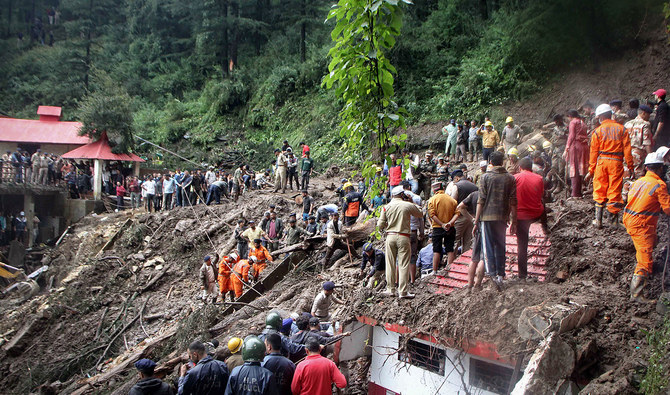
National Disaster Response Force (NDRF) personnel search for victims at the site of a landslide after a temple collapsed due to heavy rains in Shimla on August 14, 2023. (AFP)
Short Url
Updated 17 August 2023
Follow

Heavy rain and landslides have killed at least 72 people this week in an Indian Himalayan state

  • Rescuers in mountainous Himachal Pradesh state work through tough weather conditions
  • Last month, record monsoon showers killed over 100 people in two weeks in northern India

NEW DELHI: Days of relentless rain in India’s Himalayan region have killed at least 72 people this week, a government official said Thursday, as a heavy monsoon triggered landslides and flash floods that have submerged roads, washed away buildings and left residents scrambling for safety.

Rescuers in the mountainous Himachal Pradesh state have been working through challenging weather conditions to save people trapped under mud and debris from the rains that struck over the weekend. India’s weather department has put the state on high alert and expects the downpours to continue over the next few days.

Vikram Singh, an operator at the state’s emergency operation center, said on Thursday that the 72 deaths occurred over the previous five days and that rescue work was ongoing.

Hundreds of roads remain blocked and schools in the capital city of Shimla have been ordered shut as the Indian Air Force and disaster response teams help evacuate people from low-lying, vulnerable areas. The state’s chief minister, Sukhvinder Singh Sukhu, said over 2,000 people have been rescued using helicopters and motor boats and are now safe in relief camps.

Visuals on social media showed trees falling apart as homes, built atop the hills, collapsed in succession. In the background, people can be heard crying out in horror, as they shouted “get out from here” and “get back.”

In Shimla, a Hindu temple collapsed on Monday amid deadly landslides, and authorities feared that people are still buried under the debris. Authorities said the temple was crowded with devotees, raising fears that the death toll could rise as rescue work carries on.

Homes in some districts were also washed away after a cloudburst — a sudden, very heavy rain — Sunday night, leaving roads flooded and people stranded.

Cloudbursts are defined as when more than 10 centimeters (3.9 inches) of rainfall occurs within 10 square kilometers (3.8 square miles) within an hour. They are a common occurrence in Himalayan regions, where they have the potential to cause intense flooding and landslides affecting thousands of people.

Sukhu, the chief minister, told the Press Trust of India news agency that it will take a year to rebuild infrastructure destroyed by the rains of this monsoon, and claimed the estimated loss to be about 100 billion rupees ($1.2 billion). “It's a big challenge, a mountain-like challenge,” he said.

Last month, record monsoon showers killed more than 100 people over two weeks in parts of northern India, including in Himachal Pradesh, which was the worst hit.

Disasters caused by landslides and floods are common in India’s Himalayan north during the June-September monsoon season. Scientists say they are becoming more frequent as global warming increases.

However, local experts say the current disaster is likely due to unplanned construction in this vulnerable region. “It is poor planning and governance that has led to this much damage,” said Anand Sharma, a retired meteorologist with the Indian Meteorological Department, the country’s weather agency.

Sharma is from the Himalayan region and has closely observed weather patterns in this region for over three decades. He said the heavy and sometimes extreme rains is expected in the Himalayan foothills during the monsoon season.

“All the fallen buildings are those that were constructed recently, buildings built a 100 years ago have witnessed little to no damage," he said, adding that growing tourism to the region is another factor.

“They build anywhere they like and when heavy rains occur, such disasters inevitably follow," Sharma said.


US, Ukrainian and Russian negotiators to meet in UAE for security talks

Updated 3 sec ago
Follow

US, Ukrainian and Russian negotiators to meet in UAE for security talks

MOSCOW: Ukrainian, US and Russian officials will hold security talks in the United Arab Emirates on Friday, the Kremlin said, following a meeting of top US negotiators with President Vladimir Putin in Moscow on a US-drafted plan to end the Ukraine war.
Diplomatic efforts to end Europe’s deadliest conflict since World War II have gained pace in recent months, though Moscow and Kyiv remain at odds over the key issue of territory in a post-war settlement.
US negotiators, led by envoy Steve Witkoff, talked with the Russian leader in Moscow into the early hours of Friday, according to a Kremlin statement.
Kremlin diplomatic adviser Yuri Ushakov told reporters their discussions had been “useful in every respect.”
Witkoff and the US team are next flying to Abu Dhabi, where talks are expected to continue.
A Russian delegation, headed by General Igor Kostyukov, director of Russia’s GRU military intelligence agency, will also head there “in the coming hours,” according to Ushakov.
“It was agreed that the first meeting of a trilateral working group on security issues will take place today in Abu Dhabi,” Ushakov added.
“We are genuinely interested in resolving (the conflict) through political and diplomatic means,” he said, but added: “Until that happens, Russia will continue to achieve its objectives... on the battlefield.”
Witkoff previously said he believed the two sides were “down to one issue,” without elaborating.
Video published by the Kremlin showed a smiling Putin shaking hands with Witkoff, US President Donald Trump’s son-in-law Jared Kushner and White House adviser Josh Gruenbaum.
The high-stakes meeting came just hours after Ukrainian President Volodymyr Zelensky said a draft deal was “nearly, nearly ready” and that he and Trump had agreed on the issue of post-war security guarantees.
He also said the UK and France had already committed to forces on the ground.
Zelensky said Ukraine’s delegation at the UAE meeting would be led by Secretary of the National Security and Defense Council, Rustem Umerov, and would include Lt. Gen. Andriy Gnatov, the chief of staff of Ukrainian armed forces.
Russia, which occupies around 20 percent of Ukraine, is pushing for full control of the country’s eastern Donbas region as part of a deal.
But Kyiv has warned that ceding ground will embolden Moscow and says it will not sign a peace deal that fails to deter Russia from launching a renewed assault.
- Europe ‘fragmented’ -

The full details of the upcoming talks in the United Arab Emirates have not been released, and it is not clear whether the Russian and Ukrainian officials will meet face-to-face.
Zelensky said these talks would last two days.
Trump repeated on Wednesday his oft-stated belief that Putin and Zelensky were close to a deal.
“I believe they’re at a point now where they can come together and get a deal done. And if they don’t, they’re stupid — that goes for both of them,” he said after delivering a speech at Davos.
Zelensky, at his address in Davos, blasted the EU’s lack of “political will” in countering Putin in a fiery address.
“Instead of becoming a truly global power, Europe remains a beautiful but fragmented kaleidoscope of small and middle powers,” he said.
Trump’s dramatic foreign policy pivots including a recent bid to take over Greenland — an autonomous Danish territory — have stirred worries in Europe about whether Washington can be trusted as a reliable security partner.
In his speech, Zelensky criticized Europe for pinning hopes on the United States defending them in case of aggression.
“Europe looks lost trying to convince the US President to change,” Zelensky said.
Russian strikes this week have left most of Kyiv without electricity, with residents of 4,000 buildings without heat in sub-zero temperatures.
Russia, which launched its Ukraine offensive in February 2022, says its strikes are aimed at energy infrastructure fueling Ukraine’s “military-industrial complex.”
Kyiv says the strikes are a war crime designed to wear down its civilian population.