

Pakistan pitches digital finance reforms to foreign fintech investors

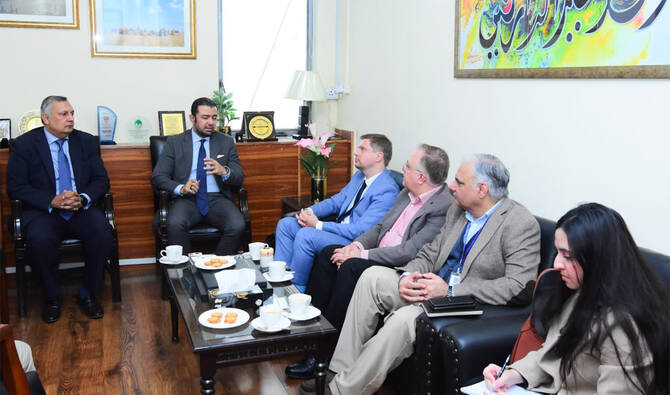
Advisor to Finance Minister, Khurram Schehzad meeting with a high-level delegation of leading international fintech investors from the Middle East led by Dr. John Sfakianakis, Chairman Fintech Solutions Holding, in Islamabad on December 20, 2025. (Finance ministry)
Short Url
Updated 20 December 2025
Follow

Pakistan pitches digital finance reforms to foreign fintech investors

  • Khurram Schehzad highlights progress on digital banking and plans for regulating blockchain and virtual assets
  • Visiting delegation welcomes policy clarity, sees scope for long-term investment and partnerships in Pakistan

KARACHI: Pakistan on Saturday pitched its digital finance and fintech reforms to foreign investors as part of a broader effort to attract capital after macroeconomic stabilization, with a senior official highlighting progress on digital banking, payments infrastructure and regulatory overhaul.

The outreach came as Islamabad seeks to sustain reform momentum following a period of economic stress, positioning technology-led financial inclusion as a pillar of its recovery and growth strategy while courting international investors.

Khurram Schehzad, adviser to the finance minister, briefed a delegation of international fintech investors on Pakistan’s reform agenda and digital growth plans at a meeting in federal capital, according to a statement from the finance ministry.

“Consistent policy implementation and structural reforms have strengthened macroeconomic fundamentals and improved Pakistan’s investment outlook,” he said, highlighting the “renewed global confidence” in the economy.

Officials said the discussions focused on the government’s Digital Pakistan Vision, including efforts to expand digital payments, build public digital infrastructure and digitize government transactions to widen financial inclusion and formalize the economy.

Schehzad cited the role of Raast, Pakistan’s instant payment system, which enables real-time, low-cost and interoperable digital payments nationwide, as well as regulatory reforms introduced by the State Bank of Pakistan to modernize retail digital banking.

Under the new framework, easypaisa Digital Bank has been operational for nearly a year, while Mashreq Digital Bank has also begun operations, with several other digital banks moving toward launch, the statement said.

The adviser also outlined Pakistan’s plans to develop a regulatory framework for blockchain, Web3.0 and virtual assets, saying authorities were engaging with global platforms to support innovation while ensuring compliance and investor protection.

The investor delegation was led by John Sfakianakis, chairman of Fintech Solutions Holding, alongside the company’s chief executive Kirill Smolin, and was facilitated by local technology firm Tech Avenue.

The investors welcomed the “clarity of reforms and policy direction,” saying Pakistan’s combination of macroeconomic stabilization, digital infrastructure and emerging technologies offered opportunities for long-term investment and strategic partnerships, the finance ministry said.


Pakistan urges pilgrims to complete Saudi biometrics as Hajj preparations gain pace

Updated 30 January 2026
Follow

Pakistan urges pilgrims to complete Saudi biometrics as Hajj preparations gain pace

  • Government warns pilgrims biometric verification is required for Hajj visas
  • Step follows tighter oversight after last year’s Hajj travel disruptions

ISLAMABAD: Pakistan’s government on Friday urged aspiring pilgrims to complete mandatory Saudi biometric verification for Hajj visas, as preparations for the 2026 pilgrimage gather pace following stricter oversight of the Hajj process.

The announcement comes only a day after Pakistan’s Religious Affairs Minister Sardar Muhammad Yousuf said regulations for private Hajj operators had been tightened, reducing their quota following widespread complaints last year, when tens of thousands of pilgrims were unable to travel under the private Hajj scheme.

“Saudi biometric verification is mandatory for the issuance of Hajj visas,” the Ministry of Religious Affairs said in a statement, urging pilgrims to complete the process promptly to avoid delays.

“Hajj pilgrims should complete their biometric verification at home using the ‘Saudi Visa Bio’ app as soon as possible,” it added.

The statement said the pilgrims who were unable to complete biometric verification through the mobile application should visit designated Saudi Tasheer centers before Feb. 8, adding that details of the centers were available on Pakistan’s official Hajj mobile application.

Pakistan has been steadily implementing digital and procedural requirements for pilgrims ahead of Hajj 2026, including mandatory training sessions, biometric checks and greater use of mobile applications, as part of efforts to reduce mismanagement.

Saudi Arabia has allocated Pakistan a quota of 179,210 pilgrims for Hajj 2026, with the majority of seats reserved under the government scheme and the remainder allocated to private tour operators.