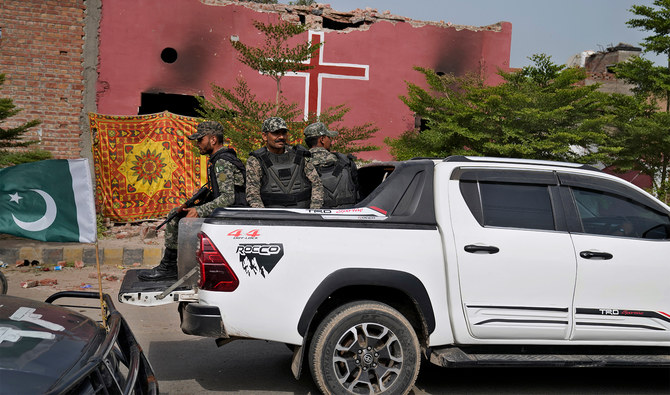

FAISALABAD: Police were guarding a Christian neighborhood in central Pakistan on Thursday, after hundreds of Muslim men rampaged through its streets setting fire to churches and ransacking homes over accusations of blasphemy a day earlier.
The violence broke out in Jaranwala, on the outskirts of the industrial city of Faisalabad, after allegations spread that Christians had desecrated the Qur’an, forcing families to flee their homes.
A spokesperson for the Punjab provincial government said late Wednesday that more than 100 people were arrested, with police also seeking to arrest the people accused of defiling the Muslim holy book.
“The desecration of the Holy Qur’an has been made and emotions of the Muslims have been injured. An order has been issued for the arrest of the accused,” a statement said.
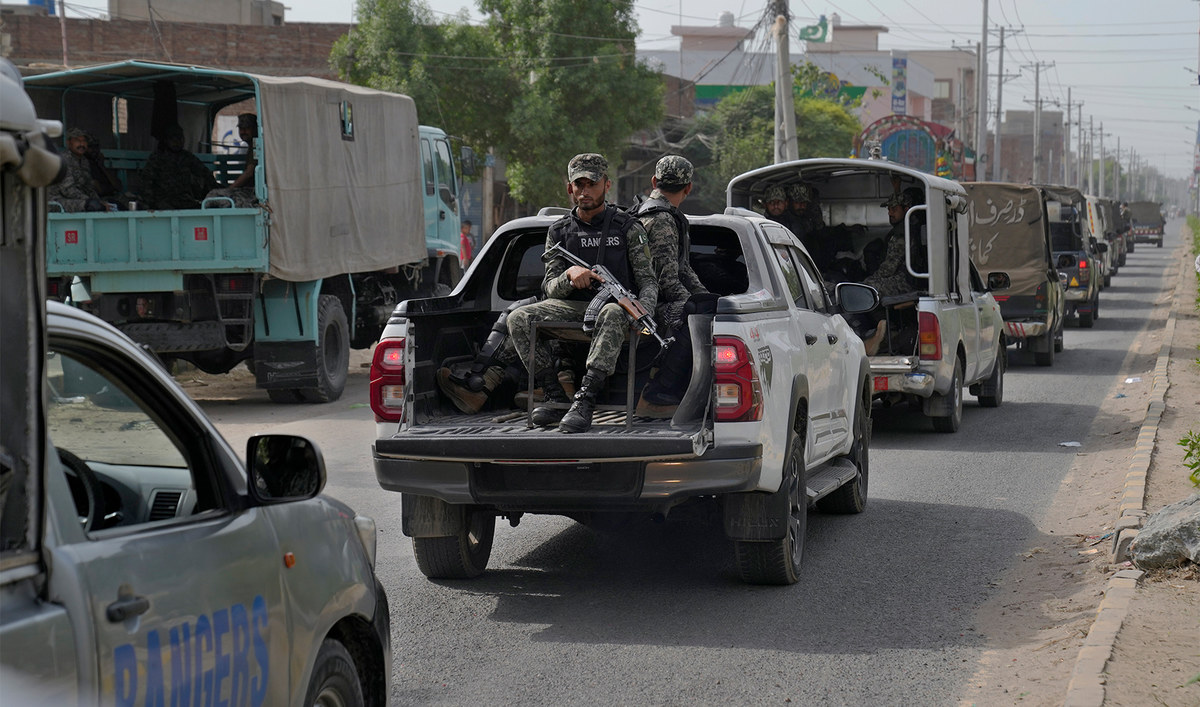
A convoy of paramilitary forces and police patrol on a road after an angry Muslim mob attacked a Christian area in Jaranwala in the Faisalabad district, Pakistan, on August 17, 2023. (Photo courtesy: AP)
Images on social media showed crowds of hundreds armed with sticks and rocks storming through the streets, with smoke rising from church buildings.
Yasir Bhatti, a 31-year-old Christian, fled his home in a narrow alley next to one of the churches that was ransacked by the mob.
“They broke the windows, doors and took out fridges, sofas, chairs and other household items to pile them up in front of the church to be burnt. They also burnt and desecrated Bibles, they were ruthless,” he told AFP by phone.
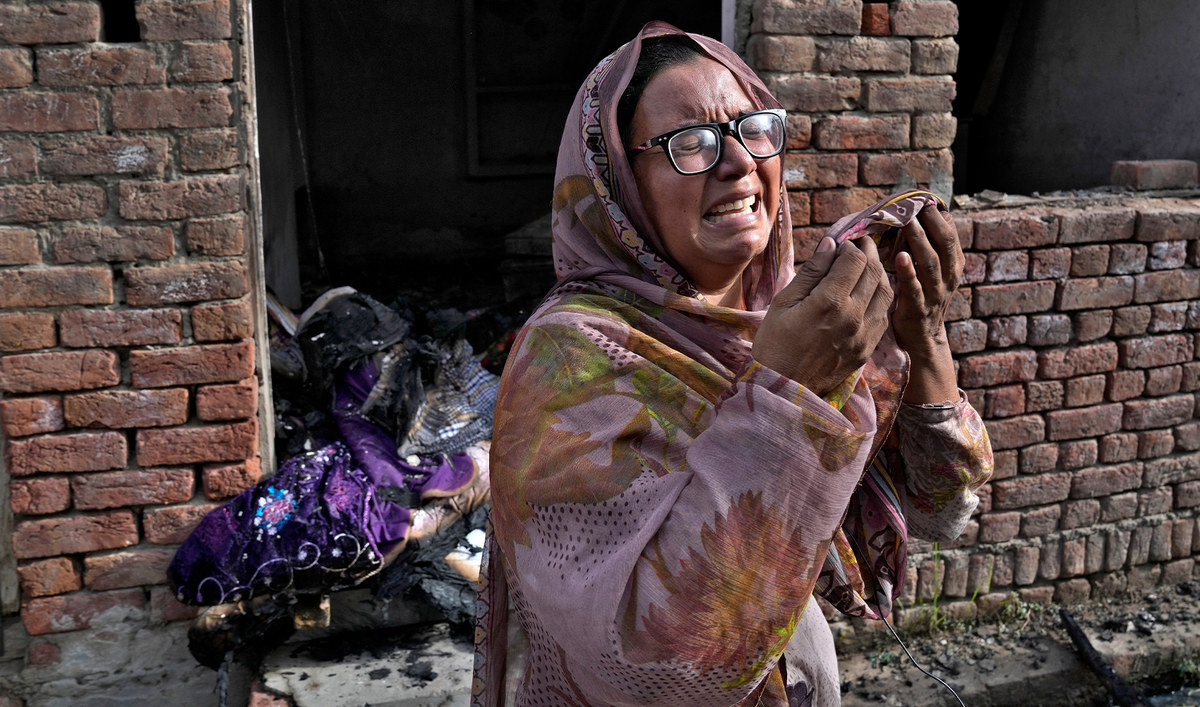
A Christian woman weeps after looking at her home vandalized by an angry Muslim mob in Jaranwala in the Faisalabad district, Pakistan, on August 17, 2023. (Photo courtesy: AP)
In one video, crowds cheer and demand punishment for the accused blasphemers as a cross is torn from the top of a church.
The boundary walls of a Christian cemetery were vandalized, police said.
“The crowd inflicted heavy damage on the area including to homes of Christians, and many churches,” Ahad Noor, a government official, told AFP.
Local Muslim leaders used mosque loudspeakers to urge their followers to demonstrate, according to videos posted on social media.
“Christians have desecrated the Holy Qur’an. All the clerics, all the Muslims should unite and gather in front of the mosque. Better to die if you don’t care about Islam,” one cleric is heard saying.
Blasphemy is a sensitive issue in Muslim-majority Pakistan, where anyone deemed to have insulted Islam or Islamic figures can face the death penalty.
Pakistani bishop Azad Marshall, in the neighboring city of Lahore, said the Christian community was “deeply pained and distressed” by the events.
“We cry out for justice and action from law enforcement and those who dispense justice and the safety of all citizens to intervene immediately and assure us that our lives are valuable in our own homeland,” he posted on X, formerly known as Twitter.
Christians, who make up around two percent of the population, occupy one of the lowest rungs in Pakistani society and are frequently targeted with spurious and unfounded blasphemy allegations that can be used to settle personal vendettas.
Islamist right-wing leaders and political parties across Pakistan frequently rally around the issue.
Politicians have been assassinated, lawyers murdered and students lynched over accusations of blasphemy.
“The frequency and scale of such attacks — which are systematic, violent and often uncontainable — appear to have increased in recent years,” the Human Rights Commission of Pakistan said on Wednesday.
“Not only has the state failed to protect its religious minorities, but it has also allowed the far right to permeate and fester within society and politics.”
In one of Pakistan’s most high-profile cases, Christian woman Aasia Bibi was at the center of a decade-long blasphemy row, which eventually saw her death sentence overturned and ended with her fleeing the country.
Her case sparked violent demonstrations and high-profile assassinations while spotlighting religious extremism across wide sections of Pakistani society.
Washington on Wednesday voiced alarm at the latest attacks and urged Pakistan to launch an investigation.
State Department spokesman Vedant Patel said that while the United States backed free expression, “violence or the threat of violence is never an acceptable form of expression.”
Pakistan’s newly appointed caretaker Prime Minister Anwaar-ul-Haq Kakar said on X that he was “gutted” by what was happening.
“Stern action would be taken against those who violate law and target minorities,” he said.