Pakistan’s main opposition party writes letter to caretaker PM, demands elections on time

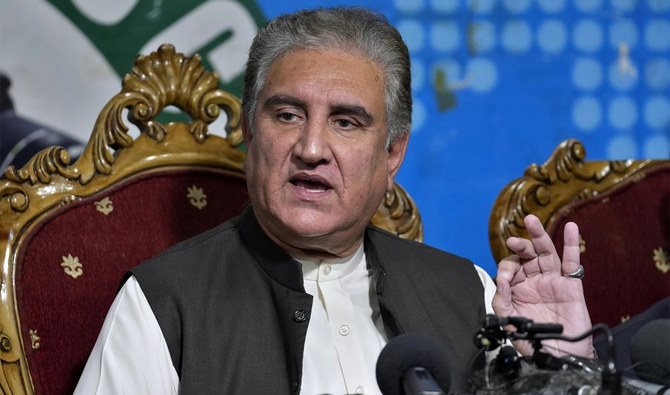
Shah Mahmood Qureshi, Vice Chairman of former prime minister Imran Khan's party, addresses a press conference in Islamabad, Pakistan, on August 7, 2023. (Photo courtesy: AP/File)
Short Url
Updated 17 August 2023
Follow

Pakistan’s main opposition party writes letter to caretaker PM, demands elections on time

  • PTI says fresh delimitation of constituencies should not prevent timely elections as constitution was clear on the matter
  • Its vice chairman announces plan to challenge the ‘belated’ approval of a recent census in Pakistan in a relevant court of law

ISLAMABAD: Former prime minister Imran Khan’s Pakistan Tehreek-e-Insaf (PTI) party on Wednesday urged Caretaker Prime Minister Anwaar-ul-Haq Kakar to hold general elections on time while describing the people’s right to vote as the essence of the country’s democracy.

Kakar’s interim government will oversee the upcoming national polls after the dissolution of the lower house of parliament last week. While it is constitutionally required to supervise the elections within 90 days, there is still a great deal of uncertainty surrounding the date amid political and economic crises prevailing in the country.

The timing of the next general elections has also become a matter of debate since the previous administration of Shehbaz Sharif endorsed the results of a digital census which was carried out earlier this year in May.

This implies that the Election Commission of Pakistan (ECP) will have to redraw hundreds of national and provincial constituencies before holding the next elections which can be a time-consuming process.

“The timely holding of elections is crucial to public trust, upholding democratic values, and ensuring a smooth transition of power,” PTI vice chairman Shah Mahmood Qureshi said in a letter to the caretaker PM on behalf of his party’s core committee.

“We, therefore, call upon you to ensure the holding of elections on time, but no later than the constitutionally mandated period of ninety days after the dissolution of the national assembly,” he continued. “It must also be ensured that these elections are free, fair, and transparent that reflect the genuine will of the people of Pakistan.”

Qureshi maintained the issue of fresh delimitation of constituencies raised by the ECP after the approval of census results “cannot be taken as a pretext to delay the elections as the timeline contained in the constitution is clear and cannot be stretched.”

He also questioned the “belated” endorsement of the census result by the Council of Common Interests (CCI) while pointing out that the government body also included chief ministers of all provinces.

He noted the chief ministers of Punjab and Khyber Pakhtunkhwa had failed to hold general elections in their respective provinces within the stipulated constitutional period, adding that his party intended to challenge the CCI decision in the relevant court of law.

The PTI vice chairman also expressed concern over the incarceration of his top party leader, Imran Khan, while expressing confidence that Pakistan would come out of its current crises under the leadership of the caretaker PM.


Pakistan opens real-time digital payment system to exchange companies as reserves edge up

Updated 5 sec ago
Follow

Pakistan opens real-time digital payment system to exchange companies as reserves edge up

  • Raast enables low-cost transfers between banks, microfinance firms and electronic money wallets
  • Pakistan’s overall foreign reserves stand at $21.25 billion as central bank holdings rise $16 million

KARACHI: Pakistan’s central bank on Thursday allowed exchange companies to route home remittances through its instant payment system, Raast, saying the move aims to promote digital transactions and improve the efficiency of inflows, as the country’s foreign exchange reserves rose modestly in the latest week.

The State Bank of Pakistan (SBP) said in a statement that the country's total liquid foreign reserves stood at $21.25 billion as of Jan. 9, while the central bank’s own reserves rose $16 million to $16.07 billion.

The statement said the decision to extend Raast to exchange companies forms part of the central bank’s broader push to strengthen digital payments infrastructure and support a shift toward a cashless economy.

“Building an innovative and inclusive digital financial services ecosystem is one of the key objectives of State Bank of Pakistan under its Strategic Plan 2023-2028,” the SBP said.

“In furtherance of this vision, SBP has now allowed Exchange Companies (ECs) to utilize ‘Raast,’ a state-of-the-art payment system launched by SBP in 2021, to facilitate remitters and beneficiaries of home remittances,” it added.

Raast, a real-time digital payment system, allows instant and low-cost transfers between banks, microfinance institutions and electronic money wallets.

“Through this enablement, the beneficiaries receiving remittances through ECs can receive their funds in their accounts and wallets ... in a safe and efficient manner,” the statement said.

Pakistan relies heavily on workers’ remittances from abroad and has been seeking to channel more inflows through formal banking systems by strengthening digital and regulated payment networks, as authorities try to curb informal mechanisms such as hawala and hundi, underground value transfer systems that move money outside the banking sector.