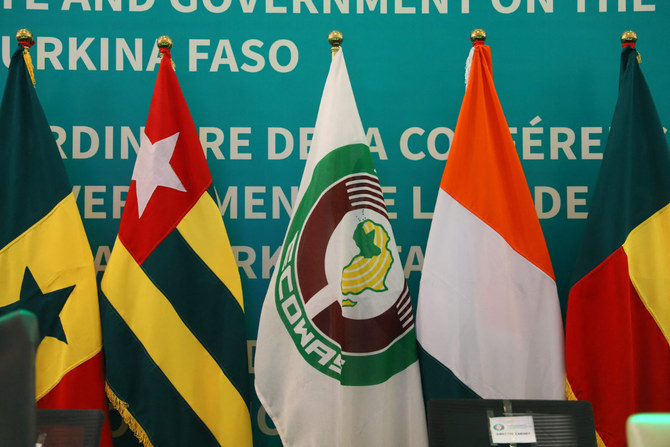

ACCRA: The West African bloc ECOWAS stands ready to intervene militarily in Niger should diplomatic efforts to reverse a coup there fail, a senior official told army chiefs who were meeting in Ghana on Thursday to discuss the details of a standby force.
ECOWAS Commissioner for Political Affairs, Peace and Security Abdel-Fatau Musah accused the junta that deposed President Mohamed Bazoum on July 26 of “playing cat-and-mouse” with the bloc by refusing to meet with envoys and seeking justifications for the takeover.
“The military and the civilian forces of West Africa are ready to answer to the call of duty,” he told assembled chiefs of defense staff from member states.
He listed past ECOWAS deployments in Gambia, Liberia and elsewhere as examples of readiness.
“If push comes to shove we are going into Niger with our own contingents and equipment and our own resources to make sure we restore constitutional order. If other democratic partners want to support us they are welcome,” he said.
Musah strongly criticized the junta’s announcement that it had elements to put Bazoum, who is being detained, on trial for treason. The United Nations, European Union and ECOWAS have all expressed concerns over the conditions of his detention.
“The irony of it is that somebody who is in a hostage situation himself...is being charged with treason. When did he commit high treason is everybody’s guess,” Musah said.
ECOWAS on Thursday began a two-day meeting to discuss their response to the July 26 coup in Niger, including details of a standby force the bloc has decided to assemble for a possible intervention.
Alarmed by a cascade of takeovers in the region, the ECOWAS has decided to create a “standby force to restore constitutional order” in Niger.
The meeting of the top brass on Thursday and Friday comes after fresh violence in the insurgent-hit country, with militants killing at least 17 soldiers in an ambush.
An army detachment was “the victim of a terrorist ambush near the town of Koutougou” in the Tillaberi region near Burkina Faso on Tuesday, Niger’s defense ministry said.
Twenty more soldiers were wounded, six seriously, in the heaviest losses since the July 26 coup.
Militant insurgencies have gripped Africa’s Sahel region for more than a decade, breaking out in northern Mali in 2012 before spreading to neighboring Niger and Burkina Faso in 2015.
The “three borders” area between the countries is regularly the scene of attacks by rebels affiliated with the Daesh group and Al-Qaeda.
The unrest across the region has killed thousands of troops, police officers and civilians, and forced millions to flee their homes.
Anger at the bloodshed has fueled military coups in all three countries since 2020, with Niger the latest to fall when its elected president Mohamed Bazoum was ousted on July 26.
The generals who have detained Bazoum said “the deteriorating security situation” sparked the coup.
Analysts say an intervention to oust the coup’s leaders would be militarily and politically risky, and the bloc has said it prefers a diplomatic outcome.
ECOWAS issued a statement Tuesday “strongly condemning” the latest attack, urging the military “to restore constitutional order in Niger to be able to focus (its) attention on security... weaker since the attempted coup d’etat.”
Talks have taken place this week in Addis Ababa among ECOWAS and Niger representatives under the aegis of the African Union.
The United States said Wednesday that a new ambassador would soon head to Niger to help lead diplomacy aimed at reversing the coup.
Kathleen FitzGibbon, a career diplomat with extensive experience in Africa, will travel to Niamey despite the ordered departure of the embassy’s non-emergency staff.
On Tuesday, Niger’s military-appointed civilian prime minister, Ali Mahaman Lamine Zeine, made an unannounced visit to neighboring Chad — a key nation in the unstable Sahel but not a member of ECOWAS.
He met President Mahamat Idriss Deby Itno, offering what he described as a message of “good neighborliness and good fraternity” from the head of Niger’s regime.
“We are in a process of transition, we discussed the ins and outs and reiterated our availability to remain open and talk with all parties, but insist on our country’s independence,” Zeine said.
Bazoum’s election in 2021 was a landmark in Niger’s history, ushering in its first peaceful transfer of power since independence from France in 1960.
He survived two attempted coups before being toppled in the country’s fifth military takeover.
ECOWAS has applied a raft of trade and financial sanctions while France, Germany and the United States have suspended their aid programs.
The measures are being applied to one of the poorest countries in the world, which regularly ranks bottom of the UN’s Human Development Index.
The United Nations warned Wednesday that the crisis could significantly worsen food insecurity in the impoverished country, urging humanitarian exemptions to sanctions and border closures to avert catastrophe.
Niger is also facing a militant insurgency in its southeast from militants crossing from Nigeria — the cradle of a campaign initiated by Boko Haram in 2010.