

Saudi Arabia more than doubles mining licenses allocation in July

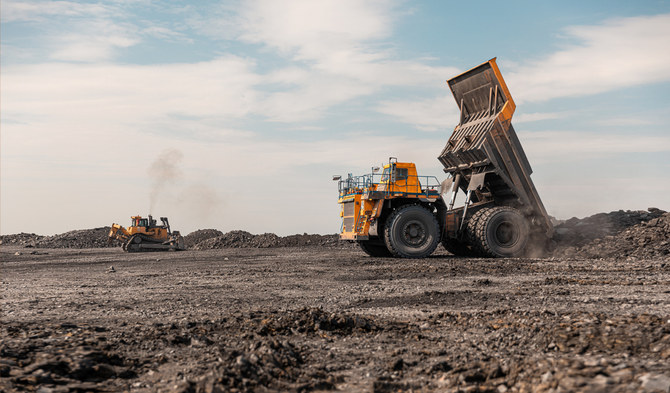
The new permits included 45 for exploration and 21 for quarrying building materials. (Shutterstock)
Short Url
Updated 16 August 2023
Follow

Saudi Arabia more than doubles mining licenses allocation in July

RIYADH: Amid the ongoing expansion in the mining industry in line with Saudi Arabia’s Vision 2030 economic diversification plan, the Kingdom issued 71 new licenses in July, compared to 32 the month before.   

According to the Ministry of Industry and Mineral Resources, the new permits included 45 for exploration, 21 for quarrying building materials and five licenses for surplus mineral ores.   

This allocation follows the ministry’s issuance of 34 permits in May and 55 in April.   

The report stated that the total number of mining licenses valid in the sector until the end of July 2023 reached 2,348, topped by 1,453 for quarrying building material, followed by 651 for explorations.    

Moreover, the ministry released 25 permits for surplus mineral ores.

From a location standpoint, Riyadh acquired the most significant chunk of the total mining licenses with 610 permits, followed by Makkah with 384 authorizations. 

The Eastern province, Madinah and Asir received 380, 265 and 191 licenses, respectively. 

Tabuk bagged 150 permits, while Al-Qasim and Jizan obtained 84 and 75 licenses, respectively. 

The ministry has been actively pursuing options to safeguard the mining industry and increase its value per the Kingdom’s Vision 2030 objectives and the National Industry Development and Logistics Program.   

Saudi Arabia is also on track to utilize around 5,300 mineral resource sites, valued at SR5 trillion ($1.33 trillion), as it makes mining the third pillar of its economy.    

The Saudi government has introduced various regulations to attract private investment to its mining sector as part of this drive.   

On Wednesday, the government allocated eight mining complexes for competition in the Riyadh region and the Eastern province, indicating the country’s continuous commitment to attracting investment in the industry.    

The Ministry of Industry and Mineral Resources initiated this effort as part of a larger strategy to improve openness, attract investment and stimulate growth in mining communities.   

In July, Saudi Arabia extended its global footprint in the mining sector after the Kingdom’s Manara Minerals secured a 10 percent share in Brazilian company Vale Base Metals Ltd.

The firm — a joint venture between the Saudi Arabian Mining Company, also known as Ma’aden and the Kingdom’s Public Investment Fund — will now have access to supply chains across strategic minerals, including nickel, copper, and cobalt. 


As world fractures, experts weigh in on the politics of AI at WGS

Updated 26 sec ago
Follow

As world fractures, experts weigh in on the politics of AI at WGS

  • e& group CEO Hatem Dowidar said there was increasing pressure to choose between the Chinese and US ecosystems

DUBAI: Across three days of rigorous debate at the World Government Summit in Dubai, experts from some of the world’s largest tech and telecommunication companies debated what the future political landscape of artificial intelligence development would be.

Speaking at the summit on Thursday, e& group CEO Hatem Dowidar said there was increasing pressure to choose between the Chinese and US ecosystems, which could have impacts on the sovereign capabilities of countries, like Gulf Cooperation Council member states, which thus far have stayed in the middle.

“I think the fracture and the pressure today is if you use this technology, you cannot use the other. You must separate them completely and this is something that never happened before,” Dowidar said.

He warned that whilst people around the world currently have access to both the leading large language models in the US and China, ChatGPT and Deepseek, this would not always be the case, and middle powers would need to develop their own capability to maintain their sovereignty.

“Europe is trying to find its own way as well, because Europe — having been caught now in the middle — they don’t have platforms, they don’t have the data center capability,” he said.

“So now, Europe is focusing a lot on building sovereign capability, sovereign data centers to run AI applications within Europe.”

Dowidar said the GCC had been ahead of the curve in this regard, having worked out early on that sovereign capability would be necessary in the new multipolar world and subsequently investing heavily in local infrastructure and capability.

“We were lucky here in the region that already — I would say a couple of years ago —we have kind of ironed out how this works,” he said.

“I think that everyone will try to see how they can either utilize the global platforms in a sovereign manner, or they end up trying to push to develop their own platforms.” 

This sentiment was echoed by Chamath Palihapitiya, the founder and managing partner of Social Capital, who said that China’s dedication to open-source models — whose code is released under a license granting users rights to view, study, modify, and redistribute it freely — could make Chinese AI more popular in the long run for nations looking to keep some level of sovereignty.

“I do think that there are a handful of American open-source models that are quite good. I think Nvidia’s models are excellent. But in fairness, the Chinese open-source models are just superb,” he told the summit on Wednesday.

“It’s going to be important for every country to make their own decisions about their own sovereignty, and in that realm, I think the open-source models provide the clearest path, because it just gives you total transparency to what’s happening underneath the hood.”

This was reiterated by Joseph Tsai, the chairman and co-founder of Alibaba Group, who said Chinese open-source systems would be favored by middle powers — but warned they had yet to find a way to be economically self-sufficient. 

“Because countries care about the sovereignty aspect and care about their data privacy, you can take an open-source model and deploy it on your own infrastructure … giving you ownership and control” he said.

“But it remains to be seen how economically all the model companies are going to make it sort of sustainable with an open-source approach … This is the biggest challenge for the Chinese firms.”