Dollar appreciates by Rs3 in interbank market after Dar’s departure, amid rise in demand

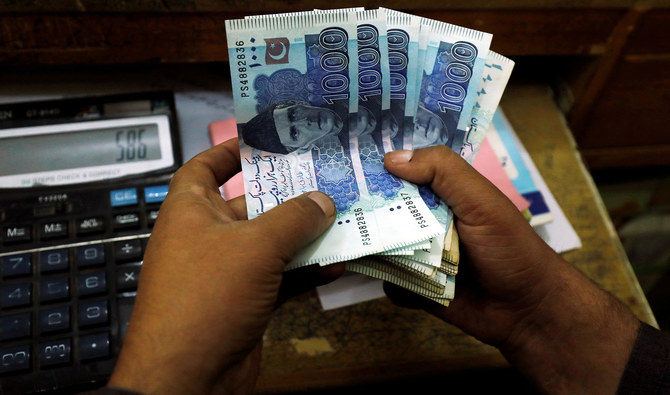
A trader counts Pakistani rupee notes at a currency exchange booth in Peshawar, Pakistan, on December 3, 2018. (Photo courtesy: REUTERS/File)
Short Url
Updated 15 August 2023
Follow

Dollar appreciates by Rs3 in interbank market after Dar’s departure, amid rise in demand

  • The greenback closed at Rs291.51 against the rupee in the interbank market as compared to Friday’s close of Rs288.49
  • Under a $3 billion IMF deal, Pakistan is required to keep exchange rate gap between open and interbank market at 1.5%

KARACHI: Pakistan national currency lost its value by 1.04 percent on Tuesday against United States (US) dollar, currency dealers said, following the departure of finance minister Ishaq Dar from office and amid a surge in demand for import payments. 

The greenback closed at Rs291.51 in the interbank market as compared to Friday’s close of Rs288.49, according to the State Bank of Pakistan and Exchange Companies Association of Pakistan (ECAP). The Pakistani currency also depreciated in the open market, with the dollar rising by Rs4 to Rs300. 

“The departure of Ishaq Dar is also a factor behind the currency depreciation as he was considered a hurdle in the freefall of rupee,” Malik Bostan, the ECAP chairman, told Arab News. 

When Dar assumed charge last year, his arrival was seen as favorable for the rupee. It was followed by a 4.32 percent gain in the value of Pakistani currency in September last year. 

However, the rupee could not continue to strengthen during his stay in office and subsequently lost its value by around 20 percent. 

High demand from Pakistanis going to perform the Umrah pilgrimage is also contributing to pressure on the rupee, according to Bostan. The government has allowed importers to arrange dollars for oil imports on their own, which is also one of the factors behind the rupee’s fall. 

“The importers are arranging dollars from the open market and other sources to make payments for the import of fuel oils that is why the pressure on the rupee is building up,” he said. 

The South Asian nation, under an agreement with the International Monetary Fund (IMF), is bound to keep the exchange rate gap between open and interbank markets not more than 1.5 percent in any five consecutive days, according to Samiullah Tariq, a research director at the Pakistan Kuwait Investment Company. 

However, the gap widened to around 3 percent on Tuesday. 

As Pakistan entered the election phase with the appointment of a caretaker prime minister this week, analysts said the currency market was also jittery as the caretakers would have to make some tough decisions in line with the IMF agreement.  

The stock market remained range-bound and closed up by 141 points at 48,565-level on the back of strong valuation. 

“Pakistan stocks closed higher led by selected scrips across the board on strong valuations though late session pressure was witnessed on falling global crude oil prices and concerns for over Rs2.3 trillion unresolved power sector circular debt issue,” said Ahsan Mehanti, CEO of Arif Habib Corporation brokerage house. 


IMF mission begins talks in Islamabad as Pakistan seeks next program review

Updated 5 sec ago
Follow

IMF mission begins talks in Islamabad as Pakistan seeks next program review

  • Finance ministry confirms ‘kick-off meeting’ with visiting IMF delegation
  • Review critical for next tranche under $7 billion bailout program

Karachi: Pakistan began formal talks with a visiting International Monetary Fund (IMF) delegation on Monday as the country prepares for the next review of its $7 billion bailout program.

The IMF team is in Pakistan to conduct a review under the Extended Fund Facility (EFF) approved in September 2024, a multi-year program aimed at stabilizing the economy after a balance-of-payments crisis, high inflation and dwindling foreign exchange reserves.

Pakistan has so far received roughly $3 billion of the EFF. Successful completion of the latest review could pave the way for the release of the next tranche of funds, subject to IMF board approval.

Separately in 2024, Pakistan also secured about $1.3 billion under the IMF’s Resilience and Sustainability Facility, a climate-focused funding window aimed at strengthening the country’s capacity to manage environmental and disaster-related risks.

“Kick-off meeting with IMF Mission held today,” the finance ministry said on Monday as it shared visuals of Finance Minister Muhammad Aurangzeb and senior officials meeting the delegation in Islamabad.

IMF country representative in Pakistan, Mahir Binici, told Arab News in an emailed statement; 

“An IMF mission led by Ms. Iva Petrova has started discussions with the authorities in Karachi and Islamabad on the third review of Pakistan’s Extended Fund Facility (EFF) arrangement and the second review of the Resilience and Sustainability Facility (RSF).”

The discussions are expected to focus on Pakistan’s fiscal performance, revenue collection targets, structural reform implementation and broader macroeconomic stability measures agreed under the program.

The review comes at a sensitive time for Pakistan’s economy, with rising global oil prices and regional instability adding pressure to inflation and external accounts. Analysts say continued IMF engagement remains crucial for maintaining investor confidence and securing external financing.

Pakistan entered the IMF program to restore macroeconomic stability, strengthen public finances and rebuild foreign exchange reserves. Authorities have repeatedly described the reform agenda as necessary to ensure long-term economic resilience.

Further meetings between technical teams are expected over the coming days.