Egypt’s president and Jordan’s king hold talks ahead of summit with Palestinian leader

1 / 3
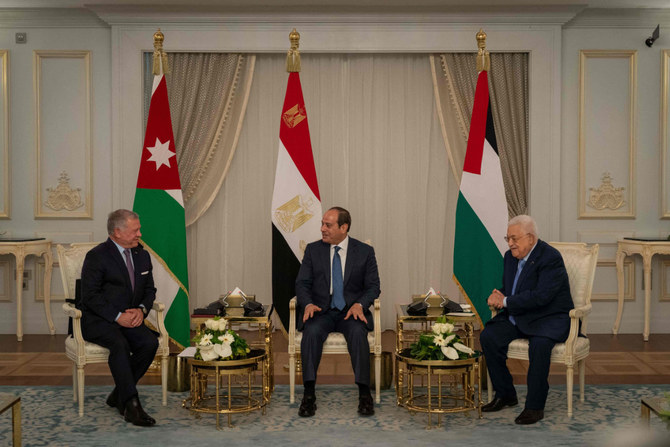
Jordan's King Abdullah II, Egyptian President Abdel Fattah El-Sisi and Palestinian leader Mahmud Abbas at a trilateral summit in El Alamein on Egypt's northern coast on August 14, 2023. (Jordanian Royal Palace handout via AFP)
2 / 3
Egyptian President Abdel Fattah El-Sisi welcomes Jordan King Abdullah II at El Alamein International Airport on August 14, 2023. (Jordanian Royal Palace handout via AFP)
3 / 3
Jordan's King Abdullah II, Egyptian President Abdel Fattah El-Sisi and Palestinian leader Mahmud Abbas at a trilateral summit in El Alamein on Egypt's northern coast on August 14, 2023. (Jordanian Royal Palace handout via AFP)
Short Url
Updated 15 August 2023
Follow

Egypt’s president and Jordan’s king hold talks ahead of summit with Palestinian leader

  • Abdel Fattah El-Sisi and King Abdullah II discuss bilateral relations before attending a tripartite summit with President Mahmoud Abbas on developments in the Palestinian cause
  • In the final communique from the summit, El-Sisi and Abbas stress the importance of the historical Hashemite custodianship of Islamic and Christian holy sites in Jerusalem

CAIRO: Egyptian President Abdel Fattah El-Sisi on Monday received a visit from Jordan’s King Abdullah II. Their meeting came ahead of a tripartite summit the same day between Egypt, Jordan and Palestine, in the northwestern city of New Alamein on the North Coast, to discuss the latest developments in the Palestinian cause.

Ahmed Fahmy, a spokesperson for the Egyptian presidency, said the president and the king discussed a number of issues and expressed their satisfaction with the distinguished relationship between their countries.

They also shared their aspirations for enhancing relations in ways that benefit the interests of their nations and their peoples, at a bilateral level and within the framework of a tripartite cooperation mechanism with Iraq, especially at the economic and commercial levels, and discussed a number of regional and international issues of common concern.

The two leaders also reviewed developments related to the Palestinian issue and agreed to strengthen the efforts by their nations to provide full support to “the brothers in Palestine, and work to revive the peace process” to help achieve a just and comprehensive solution to the Palestinian issue in accordance with international legitimacy.

King Abdullah thanked Egypt and El-Sisi for hosting the tripartite summit, and then the two leaders joined Palestinian President Mahmoud Abbas for the meeting.

During a tripartite meeting, the leaders discussed “the development of the Palestinian cause” and expressed their support for a “two-state solution” to the Israeli-Palestinian conflict with east Jerusalem as the future Palestinian capital, Fahmy said in a later statement.

In the final communique from the summit, El-Sisi and Abbas stressed the importance of the historical Hashemite custodianship of Islamic and Christian holy sites in Jerusalem, and its role in preserving their Arab identity.

Last week, Egyptian Prime Minister Mostafa Madbouly co-chaired the 31st session of the Jordanian-Egyptian Higher Committee with his Jordanian counterpart, Bishr Al-Khasawneh, at the latter’s office in Amman.

During the meeting they witnessed the signing of 12 agreements for enhanced bilateral cooperation in a number of sectors. They included a memorandum of understanding for cooperation in the field economic and development policies, and others related to financial controls, an executive program in environmental protection, and the field of social affairs.


In major policy shift on Syria, UN Security Council lifts sanctions on Hayat Tahrir Al-Sham

Updated 15 min 13 sec ago
Follow

In major policy shift on Syria, UN Security Council lifts sanctions on Hayat Tahrir Al-Sham

  • Move reflects evolving Syrian political landscape in the post-Assad era, ending a global freeze on assets, travel ban and arms embargo

NEW YORK CITY: The UN Security Council on Friday removed Al-Nusra Front, the militant group that evolved into Hayat Tahrir Al-Sham, from its so-called Daesh and Al-Qaeda Sanctions List.

The move signals a major shift in international policy toward Syria’s evolving political landscape in the post-Assad era, and ends a global freeze on assets, travel ban and arms embargo that have been imposed on the group since 2014.

Al-Nusra Front and Hayat Tahrir Al-Sham were led by Ahmad Al-Sharaa, formerly Abu Mohammed Al-Julani, who is now Syria’s president and was a leading figure in the offensive that toppled the Assad regime.

The consensus decision by the Security Council’s sanctions committee was announced by the UK, which holds the presidency of the Security Council this month and was acting in the absence of the chair of the committee. It followed a request by the new Syrian authorities to delist “Al-Nusrah Front for the People of the Levant.”

The decision means measures that were applied to Hayat Tahrir Al-Sham under Security Council Resolution 2734, adopted in 2024, no longer apply. As a result, UN member states are notrequired to freeze the group’s funds, restrict the movement of its representatives, or block the supply or transfer of arms and related materiel.

Al-Nusra Front was added to the sanctions list for its ties to Al-Qaeda and involvement in the financing and execution of militant activities during the war in Syria. The UN initially continued to treat the group’s successor organization, Hayat Tahrir Al-Sham, as a listed alias.

Al-Sharaa has said the group severed all prior transnational jihadist links and is now solely focused on local Syrian matters.