

Three leaders blast Israel over chaos and violence in West Bank

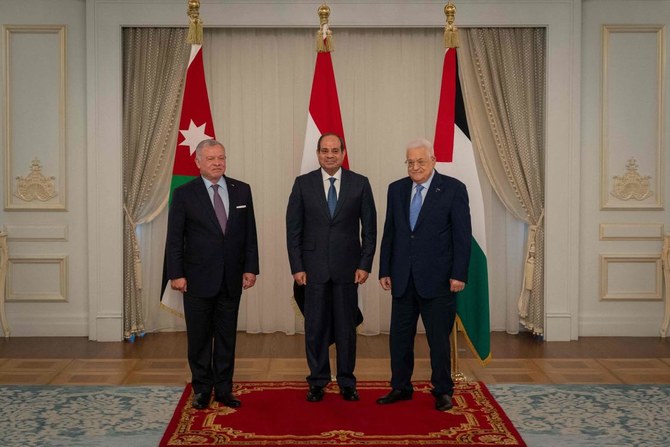
(L2R) King Abdullah II, Egyptian President Abdel Fattah El-Sisi and his Palestinian counterpart Mahmud Abbas participate in a trilateral summit in El Alamein on Egypt’s northern coast on August 14, 2023. (AFP)
Short Url
Updated 15 August 2023
Follow

Three leaders blast Israel over chaos and violence in West Bank

  • El-Sisi, Abbas and King Abdullah meet in Egypt summit

CAIRO: The leaders of Egypt, Jordan and Palestine accused Israel on Monday of fueling chaos and violence in East Jerusalem and the occupied West Bank.

The condemnation came at the end of a summit in the northern Egyptian city of Alamein that brought together Egyptian President Abdel Fattah El-Sisi, Jordan’s King Abdullah and Palestinian President Mahmoud Abbas.

The three accused Israel of a number offenses against Palestinians, including incursions by Israeli soldiers in Al-Aqsa Mosque in East Jerusalem and illegally withholding Palestinian money.

They rejected any attempts to divide Al-Aqsa Mosque temporally or spatially, and they intend to continue their efforts with the main international powers and parties interested in peace to revive a serious peace process.

They also condemned the violation of the legal and historical status quo in Jerusalem.

In the final communique of the meeting, the two presidents and the king said a “just and comprehensive solution” to the Palestinian cause was the key to stability in the region.

The past months have been one of the deadliest periods for years in the Israeli-Palestinian conflict. More than 160 Palestinians have been killed by Israeli fire this year in the West Bank and East Jerusalem.

Israel’s new far-right extremist government, formed last December, has adopted a hard-line approach to the Palestinians. In January it withheld $39 million from the Palestinian Authority and transferred the funds instead to a compensation program for the families of Israeli victims of Palestinian militant attacks.

Egypt hosted Monday’s summit to discuss the Palestinian cause in light of developments in the occupied Palestinian Territory and the related regional and international conditions.

The three leaders said resolving the Palestinian issue and achieving a just and comprehensive peace was a strategic choice, a regional and international necessity, and a matter of international peace and security.


Lebanon finance minister defends tax hike after outcry

Updated 5 sec ago
Follow

Lebanon finance minister defends tax hike after outcry

  • Jaber said the wage hike would cost the state $620 million, hence the decision to raise taxes was made to “preserve financial balance”
  • The decision was not unanimous, with Energy Minister Joe Saddi saying he had “objected”

BEIRUT: Lebanon’s finance minister defended on Tuesday his government’s decision to raise taxes to finance a hike in public sector wages, which sparked an outcry from a major union and a protest that briefly blocked a Beirut artery.
The cabinet’s decision the day before aimed to increase by sixfold rock-bottom wages and pension payments for hundreds of thousands of civil servants and retirees in a country still reeling from a devastating economic crisis that started in 2019.
In addition to the crisis, Lebanon is also suffering the aftereffects of a recent war between Iran-backed Hezbollah and Israel, with the international community conditioning aid on public reforms.
The new decision raises the value-added tax (VAT) to 12 percent, from 11 percent before, and adds 300,000 Lebanese pounds (around $3.30) per 20-liter can of gasoline.
Finance Minister Yassin Jaber said in a press conference on Tuesday that the wage hike would cost the state $620 million, hence the decision to raise taxes was made to “preserve financial balance, because any imbalance would lead us to a crisis.”
The decision was not unanimous, with Energy Minister Joe Saddi saying he had “objected... to approving any tax increases at this stage.”
Lebanon has around 320,000 public servants, including 120,000 security forces members, according to Jaber.
Their salaries have shrunk due to the severe depreciation of the Lebanese pound’s value over the past six years.
Under the decision, public sector wages would increase to about 28 percent of their value before the 2019 crisis, Walid Geagea, head of the Public Sector Employees Association, told AFP.
But Geagea rejected the government’s move, saying “you give us a sixfold increase and it goes away (by paying for) fuel and taxes.”
Bassam Tlais, head of Federations and Unions of the Land Transport Sector, said in a statement they “support improving wages, but we refuse to place this additional burden on citizens and the transport sector.”
“Our demand is to find fair alternatives that don’t burden people financially.”
Taxi drivers briefly blocked a road in central Beirut earlier on Tuesday to protest the decision.
Senior financial adviser Michel Kozah told AFP that the cabinet’s move “will create inflation,” adding that “the central bank will be forced to increase the money in circulation.”