

Afghan universities ready to readmit women but not until Taliban leader says it’s ok — official 

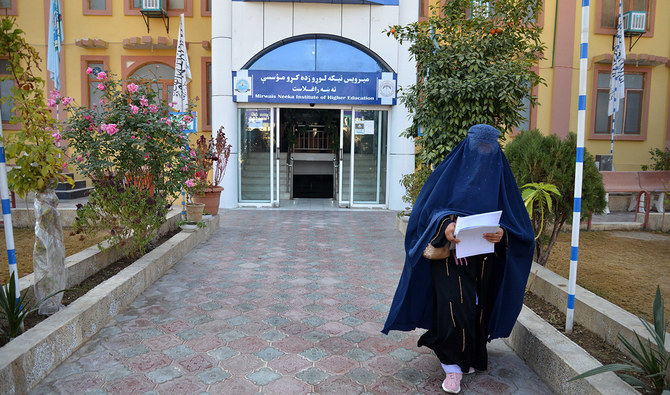
A female university Student walks in front of a university in Kandahar Province on December 21, 2022. (AFP/File)
Short Url
Updated 13 August 2023
Follow

Afghan universities ready to readmit women but not until Taliban leader says it’s ok — official 

  • The Taliban barred women from campuses last December, triggering global outrage 
  • Girls were banned from school beyond 6th grade soon after Taliban returned to power 

KABUL: Afghanistan’s universities are ready to readmit female students, but the ruling Taliban’s leader has the ultimate say on when that might happen — if it happens at all, an education official said Saturday. 

The Taliban barred women from campuses last December, triggering global outrage. Girls had been banned from school beyond sixth grade soon after the Taliban returned to power in August 2021. Afghanistan is the only country in the world with bans on female education. 

Afghanistan’s higher education minister, Nida Mohammed Nadim, said at the time the university ban was necessary to prevent the mixing of genders and because he believed some subjects being taught violated the principles of Islam. 

He said the ban, issued from the southern city of Kandahar by the Taliban leader Hibatullah Akhundzada, was in place until further notice. 

An adviser at the Higher Education Ministry, Molvi Abdul Jabbar, said universities were ready to readmit female students as soon as Akhundzada gives the order for the ban to be lifted. He was unable to say when or if that would happen. 

Akhundzada “ordered that the universities be closed, so they closed,” he told The Associated Press. “When he says they are open, they will open the same day. All our leaders are in favor of (restarting girls’ education), even our ministers are in favor of it.” 

Jabbar said he last met Akhundzada seven or eight years ago. He fought alongside him against the Russians during the 10-year Soviet war in Afghanistan and has been part of the Taliban for 27 years. 

“It is only because of our obedience (to Akhundzada) that we are following his orders,” he said. 

His comments are another sign of diverging opinions within the Taliban about the decision-making process and Akhundzada’s edicts, with chief spokesman Zabihullah Mujahid moving quickly to reject reports of division. They also show the authority that Akhundzada wields over the Taliban. 

Minister Nadim had presented the ban as a temporary measure while solutions were found to fix issues around gender segregation, course material and dress codes. He said universities would reopen for women once they were resolved. 

The Taliban made similar promises about high school access for girls, saying classes would resume for them once “technical issues” around uniforms and transport were sorted out, but girls are still shut out of classrooms. 

Jabbar said the education sector was as it was before. 

“Everything is ready in advance, whether it’s school or university studies. It may be that the (start) times are different, boys in the morning and in the afternoon there will be girls. Or there will be girls in the morning and boys in the afternoon.” 

His comments come days ahead of the second anniversary of the Taliban’s return to power. 


Pakistan, Afghan forces exchange fire after airstrikes deepen tensions

Updated 5 sec ago
Follow

Pakistan, Afghan forces exchange fire after airstrikes deepen tensions

  • Islamabad said Pakistani airstrikes on the weekend targeted camps of the Tehreek-e-Taliban Pakistan (TTP) and Islamic State Khorasan Province in eastern Afghanistan, with security sources putting the militant death toll at 70

KABUL/ KARACHI: ‌Pakistani and Afghan forces exchanged fire along their border on Tuesday, with each side accusing the other of initiating the ​clash, days after Pakistani airstrikes in Afghanistan strained already tenuous ties.
The incident marks the latest flare-up along the 2,600-km (1,615-mile) border, where tensions have risen since Pakistan’s strikes on Saturday and Sunday and threaten a fragile ceasefire following deadly clashes in October.
Mosharraf Zaidi, spokesperson for Pakistan’s prime minister, told Reuters the Afghan ‌Taliban authorities ‌had initiated “unprovoked firing” in ​the ‌Torkham ⁠and Tirah ​sub-sectors along the ⁠Pakistan-Afghanistan border.
“Pakistan’s security forces responded immediately and effectively, silencing the Taliban aggression,” Zaidi said, warning that any further provocation would be met “immediately and severely.”
Afghan officials gave a different account, saying Pakistani forces opened fire and that Afghan troops responded.
Zabihullah Noorani, director of information ⁠and culture for Nangarhar province, said the ‌incident took place in ‌the Shahkot area of Nazyan district ​and that the fighting ‌has since stopped with no Afghan casualties.
Separately, Mawlawi Wahidullah, ‌spokesperson for an Afghan army corps responsible for security in eastern Afghanistan, said border forces were on patrol near the Durand Line in Achin and Durbaba districts when they ‌came under fire, adding that the exchange was not retaliatory but a response ⁠to incoming ⁠fire.
Islamabad said Pakistani airstrikes on the weekend targeted camps of the Tehreek-e-Taliban Pakistan (TTP) and Islamic State Khorasan Province in eastern Afghanistan, with security sources putting the militant death toll at 70.
The United Nations Assistance Mission in Afghanistan said it had received “credible reports” that at least 13 civilians were killed and seven injured in Nangarhar. Taliban officials put the toll higher. Reuters could not independently verify the figures.
Pakistan ​says TTP leaders ​operate from Afghan territory, a charge Kabul denies.