

Pakistan’s first Global Cuisine Show sparks international delight, appetite for local ingredients 

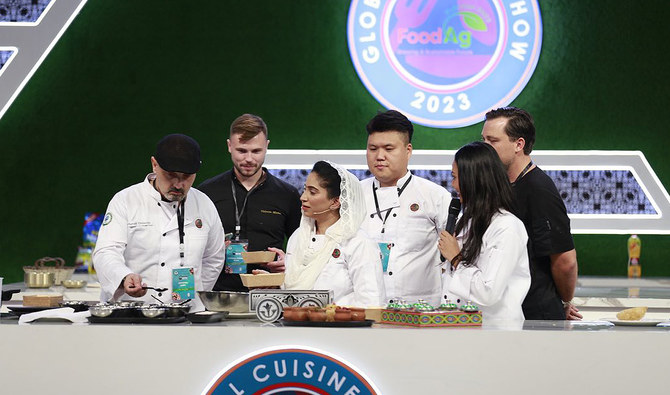
In this photo, posted on August 10, 2023, participating chefs gesture during Pakistan's first Global Cuisine Show in Karachi. (Photo courtesy: Facebook/ Abdul Hammad)
Short Url
Updated 13 August 2023
Follow

Pakistan’s first Global Cuisine Show sparks international delight, appetite for local ingredients 

  • The three-day show was part of the country’s International Food and Agriculture Exhibition that ended on Saturday 
  • Chefs from countries like France, Italy, Indonesia and South Korea prepared their cuisine using Pakistani ingredients 

KARACHI: As Pakistan’s first Global Cuisine Show concluded on Saturday, the organizers revealed its purpose was to enhance the country’s exports and introduce international chefs to the potential and quality of locally sourced food ingredients. 

The cuisine show was a part of the Trade Development Authority of Pakistan’s inaugural International Food and Agricultural Exhibition, bringing together culinary experts from around the world to tantalize the taste buds of international guests visiting the country. 

Chefs from 11 different countries, including France, Italy, the United Arab Emirates, Azerbaijan, Indonesia, and South Korea, created recipes using Pakistani ingredients. The prominent stalls at the cuisine show featured a diverse range of products such as mangoes, honey, dates, and rice, alongside local food stalls. 

“It’s the first ever global cuisine show happening in Pakistan,” Hasan Daudpota, CEO of Keys Productions that organized the show, told Arab News on the sidelines of the event. “The purpose was to increase the exports of Pakistan to benefit our economy.” 

“The 700 buyers who have come from all over the world for the [food and agriculture] exhibition, we decided to make them taste their own dishes that were made by using Pakistani ingredients,” he continued. “The idea was to let them know of the potential and quality of our [homegrown] ingredients. How tasteful and nutritious our fruits and vegetable are.” 

Korean chef Minho Shin made his country’s famous street food, Tteokbokki, made of rice and fishcake, using Pakistani ingredients. 

“We make yeast sweet and spicy,” Shin told Arab News. “For the sweet yeast, I did not use sugar. I used Pakistani dates. I made the sauce with a bowl of dates. And then I chopped the dates for garnish.” 

“Another [dish] is kimchi, which is also a famous Korean cuisine which I made with Pakistani mangoes. [I] mixed it with Pakistani cabbage and other ingredients but mainly the mango taste is good and nice. It fits the Korean dish.” 

Shin said everyone who tasted the dishes at the event was happy with the recipes. 

“I was just showing them, ‘your mango can be like this,’” he said, adding he could use Pakistani mangoes and dates back in his country as well. 

French chef Valentin Mechin, who works at Verde Dubai restaurant, said he was “very happy” with local mangoes in Pakistan which he used to make a scallop dish at the show. 

“Seriously and honestly, I am very happy,” he told Arab News. “I think we don’t find that outside. I tried the mango more than other [chefs]. It’s very amazing. The flavor, it’s so sweet. The color, it’s perfect. It’s so difficult to find that in Dubai. But here, it’s so easy.” 

Chef Sylvia Rozeboom, who co-hosted the global cuisine show with Pakistan’s Faizan Haque, said people were “surprised” by the taste and quality of Pakistani ingredients. 

“I have only heard good things about the locally produced [ingredients in Pakistan],” she said. “All of us are really surprised. This is actually a very good show to do every year and we should invite more people to come over to Pakistan to learn.” 

Responding to a question about what was unique about Pakistani ingredients, Rozeboom said: “The freshness is, obviously, number one. Secondly, the sea food is really good. We didn’t know. And the meat, it is different. The flavor also very nice. I really like it.” 

The Global Cuisine Show will be turned into an annual event in Pakistan, according to the organizers. 

“The next target is to take it internationally as well,” Daudpota said. “International forums such as GulFood, SIAL Food, and others wish to take Global Cuisine Show to the Pakistani pavilions there.” 


Cairo book fair breaks visitor records

Updated 10 min 22 sec ago
Follow

Cairo book fair breaks visitor records

  • Strong Saudi participation underscores KSA’s prominent role in Arab cultural landscape
  • Egyptian writer Naguib Mahfouz, who was awarded the Nobel Prize in Literature in 1988, was selected as the fair’s featured personality

CAIRO: The 57th edition of the Cairo International Book Fair has attracted record public attendance, with the number of visits reaching nearly 6 million, up from a reported 5.5 million previously.

Egypt’s Minister of Culture Ahmed Fouad Hanou said: “This strong turnout reflects the public’s eagerness across all age groups to engage with the exhibition’s diverse cultural and intellectual offerings.”

Hanou said the event included “literary and intellectual activities, meetings with thinkers and creative figures, and thousands of titles spanning various fields of knowledge.”

The Egyptian writer Naguib Mahfouz, who was awarded the Nobel Prize in Literature in 1988, was selected as the fair’s featured personality, coinciding with the 20th anniversary of his death.

The exhibition’s official poster features a famous quote by Mahfouz: “Who stops reading for an hour falls centuries behind.”

A total of 1,457 publishing houses from 83 countries participated in the fair. Mahfouz’s novels occupied a special place, as Egypt’s Diwan Library showcased the author’s complete works, about 54 books.

“The pavilion of the Egyptian National Library and Archives witnessed exceptionally high attendance throughout the fair, showcasing a collection of rare and significant books.

Among the highlights was the book “Mosques of Egypt” in Arabic and English, Dr. Sherif Saleh, head of financial and administrative affairs at the Egyptian National Library and Archives, told Arab News.

The fair ended on Tuesday with a closing ceremony that featured a cultural performance titled “Here is Cairo.”

The event included the announcement of the winners of the fair’s awards, as well as the recipient of the Naguib Mahfouz Award for Arabic Fiction.

Organizers described this year’s edition as having a celebratory and cultural character, bringing together literature, art, and cinema.

Romania was the guest of honor this year, coinciding with the 120th anniversary of Egyptian-Romanian relations.

At the Saudi pavilion, visitors were welcomed with traditional coffee. It showcased diverse aspects of Saudi culture, offering a rich experience of the Kingdom’s heritage and creativity.

There was significant participation from Saudi Arabia at the event, highlighting the Kingdom’s prominent role in the Arab cultural arena.

Saudi Arabia’s participation aimed to showcase its literary and intellectual output, in alignment with the objectives of Vision 2030.

The Kingdom’s delegation was led by Saudi Arabia’s Ambassador to Egypt Saleh bin Eid Al-Hussaini. Also in attendance were Dr. Abdul Latif Abdulaziz Al-Wasel, CEO of the Literature, Publishing and Translation Commission, and Dr. Hilah Al-Khalaf, the commission’s director-general.

The King Abdulaziz Public Library placed the Encyclopedia of Saudi Arabia in a prominent position at the pavilion. The encyclopedia, consisting of 20 volumes, is organized according to the Kingdom’s culturally diverse regions.

Founded in 1980 by King Abdullah, the library was established to facilitate access to knowledge and preserve heritage collections. Over the years, it has grown into one of the Kingdom’s most important cultural institutions.

Internationally, the library has strengthened ties between Saudi Arabia and China, including the opening of a branch at Peking University and receiving the Crown Prince Mohammed bin Salman Award for Cultural Cooperation between the two nations.

Regionally, the library has played a pivotal role in the Arab world through the creation of the Unified Arabic Cataloging Project, one of the most important initiatives contributing to knowledge accessibility and alignment with global standards.