

On Pakistan’s 77th Independence Day, what do its women want?

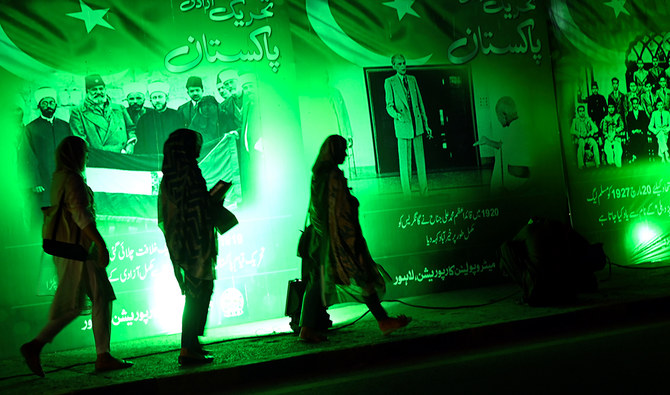
Women walk past illuminated posters illustrating Pakistan's freedom fighters ahead of the country's 76th Independence Day, in Lahore on August 12, 2023. (AFP)
Short Url
Updated 13 August 2023
Follow

On Pakistan’s 77th Independence Day, what do its women want?

  • Arab News speaks to a cross section of Pakistani women in Karachi on what ‘independence’ means for them
  • Many say conditions have improved for women in recent years, others complain of abuse, discrimination, restrictions 

KARACHI: As Pakistan marks 76 years of its independence from British rule on August 14, Arab News asked a wide cross-section of women what independence meant for them and what needed to change in their country to make them feel truly independent and secure in the private, professional and public spheres. 

According to the Global Gender Gap Index Report 2022, Pakistan ranks 145/156 for economic participation and opportunity, 135/156 for educational attainment, 143/156 for health and survival, and 95/156 for political empowerment. The World Economic Forum’s Global Gender Gap 2022, ranks Pakistan higher on political participation at 95/146 as more women than ever before are participating in political activity. 

Women, however, continue to remain underrepresented in leadership roles and are restricted from taking up positions in the political and public sphere due to systemic challenges arising from patriarchal norms. Pakistan is also ranked as one of the top ten countries most affected by climate change in the past 20 years, with women being affected the most.

Women Arab News spoke to in Pakistan’s largest city, Karachi, said 77 years after independence, ordinary Pakistani women were still “fighting for the most basic rights.”

“I don’t think there is any sort of independence for women in our society. Even if you are a working woman, you step out for work, you are harassed,” Iqra Afzal, a 33-year-old nurse, said.

“Nothing has changed [in the last 76 years] except that women have gotten educated and are demanding progress … They have become aware.”

Kiran Fatima, 25, said women would celebrate “independence” when they could feel physically secure.

“We see young girls of ages 10-12 being abused,” Fatima, a housewife, said. “This is independence?”

However, she agreed that women were now “freer than in the past” and had more liberty to find and pursue work.

“Circumstances have gotten really better, they have started to roam around, move around. This wasn’t the case earlier,” Fatima said. “Daughters in the past weren’t allowed to leave the house. Now people say, ‘You will achieve something if you step out’.”

For 37-year-old Fiza Salman, the onus lay on women to go out and claim their rights, saying independence was a “mindset” and women could do a lot if they had the will.

“If you’re free, [you do] whatever you like to do. Nobody can stop me from doing what I want to,” Salman, a banker by profession, said. 

“For women, it has gotten better 100 percent. People’s exposure has increased, new platforms have opened, and they have gotten opportunities.” 

Mishkat Saleem, a 20-year-old Pakistani MBBS student, said she felt “independent as a woman living in Pakistan” but said families and the government needed to support and enable women more. 

“The area I belong to KP (Khyber Pakhtunkhwa province), I have seen girls do not have as much freedom,” Saleem told Arab News, referring to the conservative northwestern province.

“I think people’s perspective needs to change. Our country is left behind because of these things. We should educate girls and fully support them so they can stand on their feet. Our country will also flourish because of it.”

But Saima Siddiqui, who works as a principal at a private school, had no hope and said she did not consider Pakistan “independent” for women.

“There is no freedom of speech, there is no freedom to work, there is harassment, there are no opportunities for women,” she said, as she walked out of a mall. 

“I am not satisfied with this country at all. If I get an opportunity, I will move abroad.” 


Pakistan to launch AI screening in January to target fake visas, agent networks

Updated 05 December 2025
Follow

Pakistan to launch AI screening in January to target fake visas, agent networks

  • New system to flag forged-document travelers before boarding and pre-verify eligibility
  • Move comes amid increasing concern over fake visas, fraudulent agents, forged papers

ISLAMABAD: Pakistan will roll out an AI-based immigration screening system in Islamabad from January to detect forged documents and prevent illegal overseas travel, the government said on Thursday. 

The move comes amid increasing concern over fake visas, fraudulent agents and forged papers, with officials warning that such activity has contributed to deportations, human smuggling and reputational damage abroad. Pakistan has also faced scrutiny over irregular migration flows and labor-market vulnerability, particularly in the Gulf region, prompting calls for more reliable pre-departure checks and digital verification.

The reforms include plans to make the protector-stamp system — the clearance required for Pakistani citizens seeking overseas employment — “foolproof”, tighten labor-visa documentation, and cancel the passports of deportees to prevent them from securing visas again. The government has sought final recommendations within seven days, signalling a rapid enforcement timeline.

“To stop illegal immigration, an AI-based app pilot project is being launched in Islamabad from January,” Interior Minister Mohsin Naqvi said following a high-level meeting chaired by him and Minister for Overseas Pakistanis Chaudhry Salik Hussain.

Naqvi said the new screening technology is intended to determine travelers’ eligibility in advance, reducing airport off-loads and closing loopholes exploited by traffickers and unregistered agents.

The interior minister added that Pakistan remains in contact with foreign governments to improve the global perception and ranking of the green passport, while a uniform international driving license will be issued through the National Police Bureau.

The meeting also approved zero-tolerance measures against fraudulent visa brokers, while the Overseas Pakistanis Ministry pledged full cooperation to streamline the emigration workflow. Minister Hussain said transparency in the protector process has become a “basic requirement,” particularly for labor-migration cases.

Pakistan’s current immigration system has long struggled with document fraud, with repeated cases of passengers grounded at airports due to forged papers or agent-facilitated travel. The launch of an AI screening layer, if implemented effectively, could shift the burden from manual counters to pre-flight verification, allowing authorities to identify risk profiles before departure rather than after arrival abroad.

The reforms also come at a moment when labor mobility is tightening globally. Gulf states have begun demanding greater documentation assurance for imported labor, while European and Asian destinations have increased scrutiny following trafficking arrests and irregular-entry routes from South Asia. For Pakistan, preventing fraudulent departures is increasingly linked to protecting genuine workers, reducing deportation cycles and stabilizing the country’s overseas employment footprint.