

US, Japan to develop hypersonic missile interceptor — Yomiuri

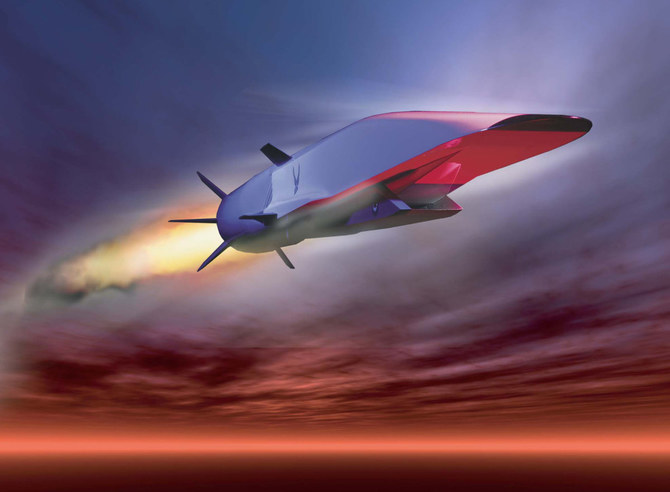
This undated photo illustration courtesy of the US Air Force shows the X-51A Waverider set to demonstrate hypersonic flight, powered by a Pratt & Whitney Rocketdyne SJY61 scramjet engine. (AFP)
Short Url
Updated 13 August 2023
Follow

US, Japan to develop hypersonic missile interceptor — Yomiuri

  • Unlike typical ballistic warheads, hypersonic projectiles can change course, making them more difficult to target

TOKYO: Japan and the US will agree this week to jointly develop an interceptor missile to counter hypersonic warheads being developed by China, Russia and North Korea, Japan’s Yomiuri newspaper said on Sunday.
The agreement on interceptors to target weapons designed to evade existing ballistic missile defenses is expected when President Joe Biden meets Japanese Prime Minister Fumio Kishida in the US on Friday, the report said, without giving any source for the information.
Officials at Japan’s Ministry of Foreign Affairs could not be reached for comment outside business hours.
Unlike typical ballistic warheads, which fly on predictable trajectories as they fall from space to their targets, hypersonic projectiles can change course, making them more difficult to target.
Biden and Kishida are to meet the sidelines of a trilateral summit with South Korea’s President Yoon Suk Yeol at the presidential retreat at Camp David, Maryland, the Yomiuri said.
The US and Japan agreed in January to consider developing the interceptor at a meeting of Secretary of State Antony Blinken and Defense Secretary Lloyd Austin with their Japanese counterparts, Foreign Minister Yoshimasa Hayashi and Defense Minister Yasukazu Hamada.
An agreement would be the second such collaboration in missile defense technology.
Washington and Tokyo developed a longer-range missile designed to hit warheads in space, which Japan is deploying on warships in the sea between Japan and the Korean peninsula to guard against North Korean missiles strikes.


UK supported French operation to board sanctioned Russian tanker, minister says

Updated 5 sec ago
Follow

UK supported French operation to board sanctioned Russian tanker, minister says

  • Healey said this support included a vessel, HMS Dagger, monitoring the tanker as it passed through the Straits of Gibraltar
  • “Deterring, disrupting and degrading the Russian shadow fleet is a priority for this government“

LONDON: Britain provided tracking and monitoring support for a French operation to board a sanctioned Russian oil tanker in a bid to choke off the funds that fuel Russia’s invasion of Ukraine, UK defense minister John Healey said on Thursday.
Healey said this support included a vessel, HMS Dagger, monitoring the tanker as it passed through the Straits of Gibraltar. The ‌tanker, named ‌the GRINCH, is subject to ‌UK ⁠and European sanctions ‌for facilitating trade in sanctioned oil and forms part of a growing web of the so-called “shadow-fleet.”
“Deterring, disrupting and degrading the Russian shadow fleet is a priority for this government,” Healey said in a statement.
“I can confirm that the UK has provided tracking ⁠and monitoring in support of the French operation to board the tanker ‌Grinch.”
He said Britain and its ‍allies were stepping ‍up their response to so-called shadow-fleet vessels, which he ‍described as helping finance Russian President Vladimir Putin’s war against Ukraine.
President Emmanuel Macron said earlier on Thursday that the French Navy had boarded an oil tanker coming from Russia that was subject to international sanctions and suspected of flying a false flag.
He said ⁠the operation was conducted on the high seas in the Mediterranean with support from several allies and in strict compliance with the UN Convention on the Law of the Sea.
A judicial investigation had been opened and the vessel diverted, the French president said, adding that France was determined to enforce sanctions.
Britain’s Ministry of Defense said it routinely tracks suspected Russian shadow-fleet activity and shares information with allies, ‌adding that the country has sanctioned 544 such vessels to date.
