

Saudi Arabia’s KSrelief completes first phase of food security project in Pakistan

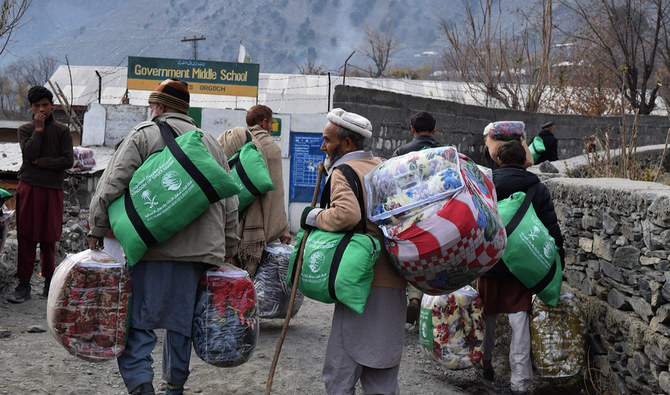
In this handout picture released by King Salman Humanitarian Aid and Relief (KSrelief) on December 14, 2022, elderly men can be seen carrying winter relief packages in the northern areas of Pakistan. (Photo courtesy: KSrelief/File)
Short Url
Updated 11 August 2023
Follow

Saudi Arabia’s KSrelief completes first phase of food security project in Pakistan

  • The aid agency says it has distributed 26,400 food packages among flood-affected people in 12 districts
  • KSrelief has completed 170 projects in Pakistan’s education, healthcare, and other sectors in 17 years

ISLAMABAD: A Saudi aid agency on Friday announced the successful completion of the first phase of its food security project in Pakistan for 2023-24, it said in an official statement, adding that 184,800 deserving Pakistanis had so far benefitted from the initiative.

King Salman Humanitarian Aid and Relief Centre (KSrelief) has been undertaking humanitarian projects across 88 countries. It has one of the largest humanitarian budgets for aid agencies across the world, and Pakistan is its fifth largest beneficiary of aid and humanitarian operations.

According to data compiled by the agency, it has completed 170 education, healthcare, water, sanitation, hygiene, and community support projects in Pakistan. These have collectively cost KSrelief roughly about $163 million in the last 17 years.

“King Salman Humanitarian Aid & Relief Centre (KSrelief) is pleased to announce the successful completion of the first phase of our food security project for the year 2023-24 in Pakistan,” the agency said in the statement.

In collaboration with Pakistan’s National Disaster Management Authority (NDMA), the agency said it has distributed a total of 26,400 food packages, weighing about 2,508 tons, among flood-affected families and other deserving individuals residing in 12 districts across the country.

“The first phase of this initiative has greatly impacted the lives of 184,800 beneficiaries throughout the country,” the statement added.

Last month, KSrelief also organized 12 relief camps in the rural and urban areas of Pakistan’s southern Sindh and Balochistan provinces, conducting 5,000 surgeries to combat eye diseases and blindness.


Pakistan showcases fiscal turnaround, reform agenda at Saudi-hosted AlUla forum

Updated 6 sec ago
Follow

Pakistan showcases fiscal turnaround, reform agenda at Saudi-hosted AlUla forum

  • Pakistan has delivered successive primary surpluses and reduced its fiscal deficit from around 8 percent of GDP to approximately 5.4 percent
  • Muhammad Aurangzeb says fiscal space created through consolidation, reforms is being directed toward priority growth-enabling sectors

KARACHI: Finance Minister Muhammad Aurangzeb on Monday highlighted Pakistan’s recent fiscal progress, ongoing reforms and strategy to build buffers while sustaining growth at the AlUla Conference for Emerging Market Economies, underscoring the importance of institutional strengthening in navigating economic and climate-related shocks.

The second edition of the annual AlUla conference was launched by the Saudi Arabia’s Ministry of Finance and the International Monetary Fund (IMF) on Sunday. The conference brings together economic decision-makers, finance ministers, central bank governors, leaders of international financial institutions and a select group of experts and specialists from around the world.

Pakistan, which nearly defaulted on its foreign debt obligations in 2023, is currently making efforts to stabilize its economy under a $7 billion International Monetary Fund (IMF) program. The program, agreed in Sept. 2024, accompanied reforms such as privatization of loss-making, state-owned enterprises (SOEs), tax regime overhaul and ending various subsidies for fiscal consolidation.

Attending a high-level panel discussion “Fiscal Policy in a Shock‑Prone World” on the 2nd day of the AlUla Conference, Aurangzeb shared Pakistan’s experience in managing structural constraints, strengthening revenue mobilization, reducing debt vulnerabilities, and responding to shocks while protecting priority development spending.

“Pakistan’s fiscal strategy has been shaped by a history of boom-and-bust cycles, persistent structural deficits, high debt levels, and limited fiscal space,” he said, stressing that it has been critical to carefully safeguard the fiscal progress achieved over the past two to three years.

“Pakistan has delivered successive primary surpluses and reduced its fiscal deficit from around 8 percent of GDP (gross domestic product) to approximately 5.4 percent, with the current trajectory pointing toward a further reduction below five percent.”

This year’s conference highlighted the rapid transformations in the global economy and challenges and the opportunities they presented for emerging market economies, particularly in international trade, monetary and financial systems.

Aurangzeb stressed the discussion around fiscal buffers is not academic for Pakistan but rooted in lived experience as a climate-vulnerable country.

Recalling the catastrophic floods of 2022, he noted that Pakistan was forced to make an immediate international appeal even for rescue and relief operations. In contrast, he said, the country was able to mobilize its own resources despite limited fiscal space during the large-scale floods affecting multiple provinces and river systems this year, demonstrating the practical value of rebuilding fiscal buffers to absorb exogenous shocks.

On the revenue side, he outlined sustained efforts to expand the tax base and strengthen compliance.

“Pakistan’s tax-to-GDP ratio has risen from below 10 percent to close to 12 percent,” the minister said, highlighting the transformation of the tax authority through reforms in people, processes and technology, including the use of AI-led production monitoring systems across various sectors to improve enforcement, curb leakages and reduce corruption by minimizing human intervention.

“The tax policy function has been separated from tax collection and placed within the Ministry of Finance to ensure that budgetary decisions are guided by economic value and policy considerations rather than purely arithmetic targets, while maintaining overall fiscal discipline.”

About expenditure management, the finance minister noted that Pakistan’s federal structure adds complexity, requiring close coordination between the federation and provinces. He shared that a national fiscal framework has been agreed upon and that work is ongoing to strengthen fiscal coordination and discipline across all tiers of government.

“Pakistan’s debt-to-GDP ratio, which had reached around 74 percent, has been reduced to approximately 70 percent,” he said, underscoring ongoing domestic liability management operations aimed at lowering debt servicing costs, which remain the single largest expenditure item in the budget.

“Continued fiscal discipline would further ease debt pressures and help create additional fiscal space.”

Pakistan faced a prolonged economic crisis in recent years, marked by fiscal pressure, high debt levels and balance-of-payments difficulties. Officials now say that decreasing levels of inflation and higher foreign exchange reserves reflect the government’s prudent fiscal policies and debt management.

“The fiscal space created through consolidation and reforms is being directed toward priority growth-enabling sectors, including human capital development, agriculture, information technology, and other areas with strong growth potential,” Aurangzeb said, adding that rebuilding buffers, dampening pro-cyclicality, and sustaining growth require persistence, institutional reform and disciplined policymaking, particularly for countries facing repeated structural and climate-related shocks.