



ATHENS: Nearly two months after a dilapidated fishing trawler crammed with people heading from Libya to Italy sank in the central Mediterranean, killing hundreds, relatives are still frantically searching for their loved ones among the missing and the dead.
Many questions remain about Greek authorities’ response and exactly how and why the boat, carrying an estimated 500-750 people mostly from Pakistan, Syria and Egypt, capsized and sank in the early hours of June 14 in what became one of the deadliest migrant shipwrecks in the Mediterranean.
Only 104 people were pulled from the sea alive — all men and boys. Eighty-two bodies, only one of them a woman, were recovered. The rest, including women and children, sank in one of the deepest parts of the Mediterranean. With depths of around 4,000 meters (13,000 feet) in that area, any recovery of the vessel or its victims are all but impossible.
Identifying the dead and determining exactly who was on board is a slow, meticulous, heart-wrenching process.
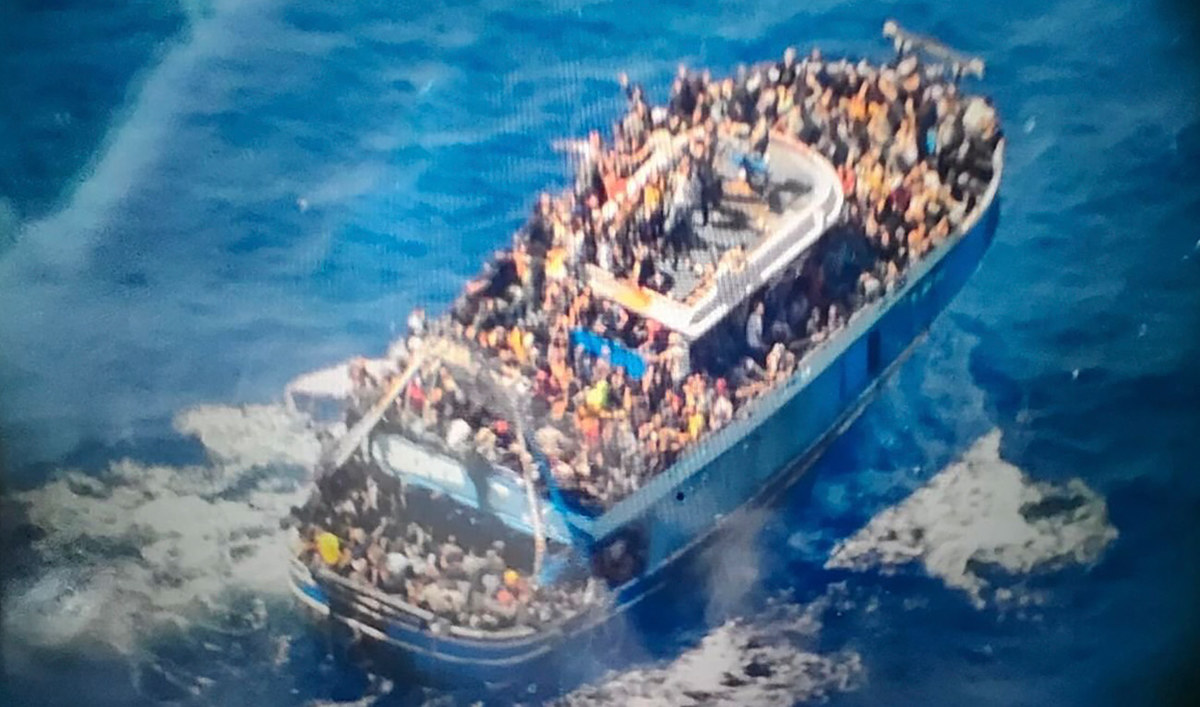
This undated handout image provided by Greece's coast guard on June 14, 2023, shows scores of people on a battered fishing boat that later capsized and sank off southern Greece. (AP/File)
By Aug. 7, around 40 of the recovered bodies were identified through a painstaking process combining DNA analysis, dental records, fingerprints and interviews with survivors and relatives, police Lt. Col. Pantelis Themelis, commander of Greece’s Disaster Victim Identification Team, told The Associated Press.
The task is complicated by a lack of information on who was on the boat, and by the fact that many were from countries where, due to war and civil turmoil, relatives are struggling to provide DNA samples.
For some, the lack of a body to bury means they hold out hope, however improbable, that their loved one is somehow still alive.
“In my heart I feel that my son is alive, by God’s grace, and I don’t believe even 1 percent that my son is dead,” said Mohamad Diab, whose 21-year-old son Abdulrahman has been missing since the trawler sank. “I don’t even think about this.”
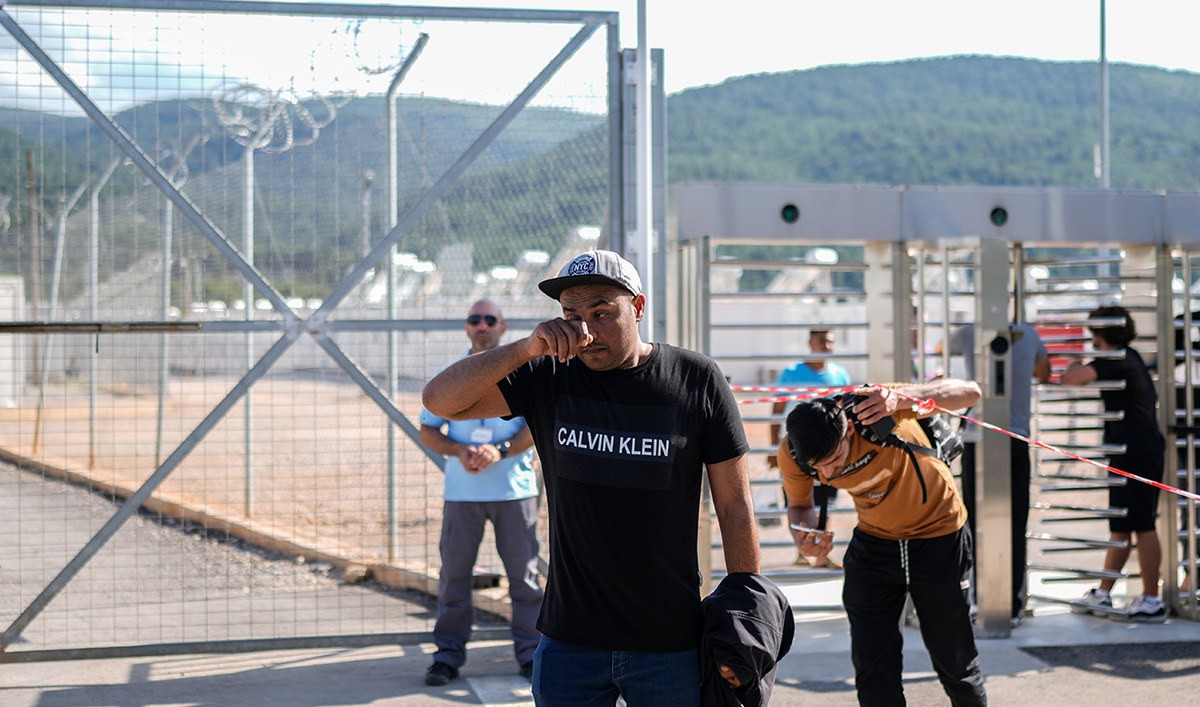
A man cries after speaking with survivors of a deadly migrant boat sinking at a migrant camp in Malakasa north of Athens, on June 19, 2023. (AP/File)
In his nearly two-month quest for his son, Diab has all but exhausted his options. He provided a DNA sample through the International Commission on Missing Persons, sent relatives to Greece, and spends hours on his phone, making calls and watching and re-watching videos of survivors on social media.
The housepainter from an impoverished Palestinian refugee camp in Lebanon on the outskirts of Beirut clings to a single, tenuous discovery: A brief moment in a video of the immediate aftermath of the sinking, when a man resembling his son is carried into a hospital in the southern Greek city of Kalamata.
Although inquiries at the hospital and with Greek authorities drew a blank, Diab insists his son might be in a coma, or imprisoned and unable to contact his family.
But all injured survivors have long since been released from hospital, and the nine survivors arrested as suspected smugglers are all Egyptians. Abdulrahman Diab’s name is not among them.
The thought of having lost his eldest son is unbearable. So Diab clings desperately to the hope that somehow, somewhere, Abdulrahman is out there, still breathing, still alive.
“My faith in God is great,” he said.
In Athens, the members of the Disaster Victim Identification Team continue the slow process of piecing together the identities of the bodies.
The team is still receiving DNA test results from prospective relatives abroad, Themelis said. And a telephone hotline in six languages set up after the disaster will remain operational for at least another two months, although calls now are few and far between.
An international mass-casualty event “requires a good investigative procedure that is time-consuming, with persistence and patience, to be able to collect information on missing people,” said Themelis. “This is fundamental. Who really were the people who might have been on the ship?”
His team, set up in 2018, draws on staff from a variety of services as needed, including the fire department, coroners, translators and the police. It was this team that was called in to identify the remains of more than 50 people killed in the Feb. 28 railway disaster in central Greece.
DVI work, Themelis said, is humanitarian. “It is separate from anything else and has no job other than the humanitarian work of the identification of disaster victims.”
Pakistan has already sent hundreds of DNA test results to help in the identification process, Themelis said. In countries where interviews with close relatives and DNA collection were problematic, that role was being carried out by the Red Cross and Red Crescent.
For Diab, a positive DNA match would mean all hope is lost for Abdulrahman, who grew up with his three younger brothers in Lebanon’s infamous Shatila camp for Palestinian refugees on the outskirts of Beirut, a cramped urban enclave with narrow alleys and crackling power lines overhead.
As a teenager he helped his father paint houses, but work dried up after Lebanon sank into a major financial crisis in 2019.
Relatives and friends, including Abdulrahman’s uncle who runs a supermarket in Germany, took the risk to travel to Europe. Eventually, he decided to follow them, arranging flights to Egypt and then Libya, and the risky voyage across the Mediterranean, using a network of smugglers and middlemen.
Mohamad Diab sold his belongings and borrowed money to raise the $7,000 in smuggling fees, hoping for a better future for his son. He never thought the journey could be fatal.
And for as long as he has no confirmation that it was, he can still cling to the belief that Abdulrahman will one day come home.
“I still have hope, I will not lose hope until I see his body,” Diab said. “I still have hope that I will see him and hear his voice.”


