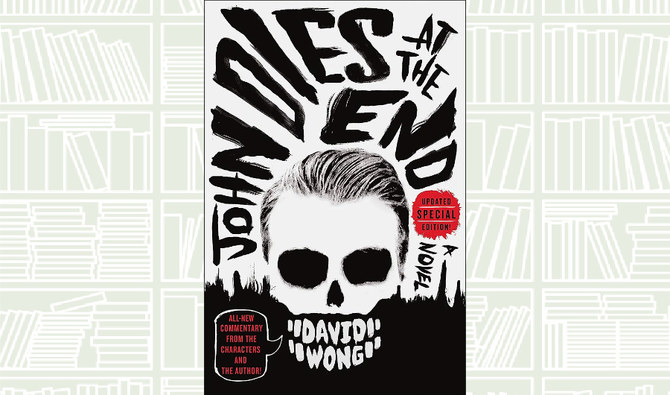
“John Dies at the End” is a horror-comedy novel by Jason Pargin.
It was first published as a web serial by Pargin, who writes under the pseudonym David Wong.
The story gained a cult following and was eventually adapted into a novel published in 2007.
The book follows David Wong, a young man who, along with his friend John, becomes embroiled in bizarre and terrifying events after taking a drug known as “soy sauce” that grants them strange abilities and allows them to see into other dimensions. David and John face various supernatural entities as the plot unfolds, including a monstrous creature known as Korrok, which seeks to conquer and enslave humanity.
They encounter a range of strange characters, including a dog that can speak through a computer, a journalist who is also a shape-shifting spider, and a psychic who may hold the key to defeating Korrok. Despite the dark and sometimes gruesome subject matter, the book is written in a humorous and irreverent style.
The book’s title is somewhat misleading, as John does not actually die at the end, but instead undergoes a transformation that establishes the possibility of a sequel. “John Dies at the End” is the first book of Pargin’s series.
The book combines horror, comedy, and science fiction elements and has been compared to the works of authors such as H.P. Lovecraft and Douglas Adams.
It also draws heavily from popular culture, including video games, movies, and comic books.
Pargin is an American writer and executive editor of the humor website Cracked.com. He has also written articles and essays on different topics for various publications.


![]()


Review: Web serial ‘John Dies at the End’ combines comedy and horror
Short Url
https://arab.news/wp8sv
Review: Web serial ‘John Dies at the End’ combines comedy and horror


What We Are Reading Today: ‘Novel Relations’ by Alicia Mireles Christoff
“Novel Relations” engages 20th-century post-Freudian British psychoanalysis in an unprecedented way: as literary theory.
Placing the writing of figures like D. W. Winnicott, W. R. Bion, Michael and Enid Balint, Joan Riviere, Paula Heimann, and Betty Joseph in conversation with canonical Victorian fiction, Alicia Christoff reveals just how much object relations can teach us about how and why we read.
These thinkers illustrate the ever-shifting impact our relations with others have on the psyche, and help us see how literary figures—characters, narrators, authors, and other readers—shape and structure us too.


Latest updates


© 2026 SAUDI RESEARCH & PUBLISHING COMPANY, All Rights Reserved And subject to Terms of Use Agreement.