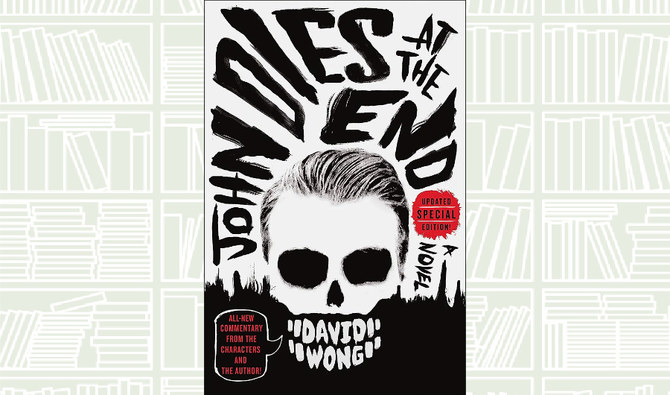
“John Dies at the End” is a horror-comedy novel by Jason Pargin.
It was first published as a web serial by Pargin, who writes under the pseudonym David Wong.
The story gained a cult following and was eventually adapted into a novel published in 2007.
The book follows David Wong, a young man who, along with his friend John, becomes embroiled in bizarre and terrifying events after taking a drug known as “soy sauce” that grants them strange abilities and allows them to see into other dimensions. David and John face various supernatural entities as the plot unfolds, including a monstrous creature known as Korrok, which seeks to conquer and enslave humanity.
They encounter a range of strange characters, including a dog that can speak through a computer, a journalist who is also a shape-shifting spider, and a psychic who may hold the key to defeating Korrok. Despite the dark and sometimes gruesome subject matter, the book is written in a humorous and irreverent style.
The book’s title is somewhat misleading, as John does not actually die at the end, but instead undergoes a transformation that establishes the possibility of a sequel. “John Dies at the End” is the first book of Pargin’s series.
The book combines horror, comedy, and science fiction elements and has been compared to the works of authors such as H.P. Lovecraft and Douglas Adams.
It also draws heavily from popular culture, including video games, movies, and comic books.
Pargin is an American writer and executive editor of the humor website Cracked.com. He has also written articles and essays on different topics for various publications.


Review: Web serial ‘John Dies at the End’ combines comedy and horror
https://arab.news/wp8sv
Review: Web serial ‘John Dies at the End’ combines comedy and horror


Book Review: ‘Winter Garden’ by Kristin Hannah
Kristin Hannah’s “Winter Garden” is a novel that gradually unfolds into something deeply emotional and haunting.
At its heart are two sisters who could not be more different. Meredith has stayed home, building a life around responsibility, family, and the demanding work of running the apple orchard.
Nina has done the opposite, chasing stories across the world as a celebrated photojournalist, avoiding roots and the weight they carry.
Reading “Winter Garden” feels like slowly peeling back layers of a family. The differences between the two sisters feel real, and so does the tension between them.
But what will really move you is their cold, unreachable mother Anya and the way her silence seems to freeze the entire house.
For most of the book readers will ask why she cannot show love. Why is everything so guarded? The only softness in her comes through the Russian fairytale she tells — and even that story is always unfinished.
When the sisters’ father becomes ill and asks that the story finally be told to its end, the novel shifts in a way that genuinely surprises. The fairytale slowly turns into truth. As Anya begins revealing her past in Leningrad — the hunger, the fear, the impossible choices — you feel your perception of her change page by page.
You will start judging her, pitying her, and finally understand that sometimes silence is just another way of surviving.
What makes the book feel personal is the reminder that our parents are not just parents: They are entire worlds of lost dreams, mistakes, heartbreaks, and secrets we may never fully uncover. And sometimes the distance we feel from them has nothing to do with us; it comes from wounds they never healed.
“Winter Garden” is not the kind of novel that grabs you right away. It is slow, heavy at times, and painful. But the emotional payoff is worth it. By the end you feel as though you have been invited into someone’s private grief.