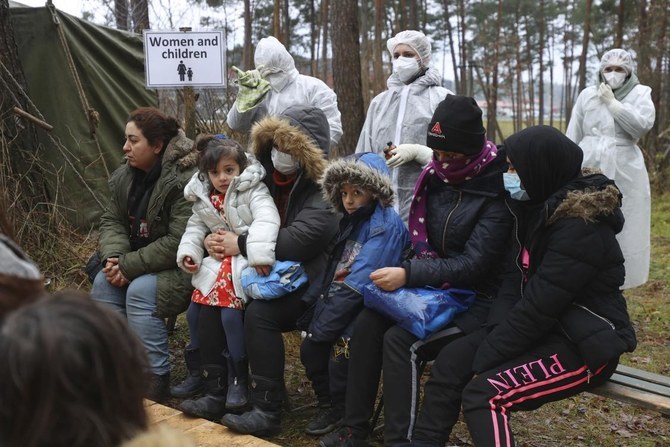
WARSAW: The Polish government announced Wednesday that it is planning to deploy an additional 2,000 troops to its border with Belarus, twice the number the Border Guard agency had requested, as fears of illegal migration rise.
In an interview with state news agency PAP, a deputy interior minister, Maciej Wasik announced the decision and accused the Belarusian authorities of organizing illegal migration.
He said migration pressure on the Polish-Belarusian border area is growing, although it cannot compare to the situation two years ago.
At the time, large numbers of migrants from the Middle East and Africa arrived at the border, their travel there facilitated by flights and visas provided by the Minsk government — something Warsaw considered to be a form of “hybrid warfare.”
“If we had real border guards on the other side and not a smuggling service, these crossings would not exist at all,” Wasik said.
Polish authorities retaliated by building a tall steel wall, which has reduced the numbers of migrants and refugees crossing the border, but did not stop them entirely.
The fallout from Russia’s war against Ukraine has brought other concerns, including the presence of Russia-linked Wagner group mercenaries in Belarus this summer after their short-lived mutiny in Russia.
Earlier this week Belarus also began military exercises near its border with Poland and Lithuania. And last week two Belarusian helicopters flew briefly into Polish air space in what was viewed by Warsaw as a deliberate provocation.
The new troops will be an addition to the 2,000 already at the border. They support the work of hundreds of police and Border Guard officers, according to PAP.
Wasik said the new troops would reach their destination within the coming two weeks.
Poland’s President Andrzej Duda announced Tuesday that Poland will hold its parliamentary election on Oct. 15. The ruling authorities that he is allied with have been trying to show voters that they are serious about security and defense as they seek a third term.

Poland to double troops number at border with Belarus, accuses it of organizing illegal migration
Short Url
https://arab.news/zcegb
Poland to double troops number at border with Belarus, accuses it of organizing illegal migration
- Deputy interior minister Maciej Wasik announced the decision and accused the Belarusian authorities of organizing illegal migration
- Polish authorities retaliated by building a tall steel wall, which has reduced the numbers of migrants and refugees crossing the border
Mexico and El Salvador make big cocaine seizures at sea as US continues lethal strikes
MEXICO CITY: The navies of El Salvador and Mexico announced drug seizures in the Pacific Ocean this week of more than 10 tons of cocaine, in contrast to deadly strikes by the US government that just this week left 11 people dead on three boats suspected of carrying drugs in Latin American waters.
The latest announcement came Thursday, when Mexico said it had seized nearly four tons of suspected drugs and detained three people from a semisubmersible craft, 250 nautical miles (463 kilometers) south of the port of Manzanillo.
Mexican Security Secretary Omar García Harfuch said via X that the seizure from the sleek, low-riding boat with three visible motors brought the weekly total to nearly 10 tons, but he did not provide detail on the other seizures.
Mexican authorities said the seizure was made with intelligence shared US Northern Command and the US Joint Interagency Task Force South.
On Sunday, El Salvador’s navy announced the largest drug seizure in the country’s history of 6.6 tons of cocaine. The navy had intercepted a 180-foot boat registered to Tanzania, 380 miles (611 kilometers) southwest of the coast. Navy divers found 330 packages of cocaine hidden in the boat’s ballast tanks. Ten men were arrested from Colombia, Nicaragua, Panama and Ecuador.
On Thursday, Salvadoran authorities gave access to the seized ship FMS Eagle, which had just arrived in the port of La Union. More than 200 wrapped bundles were lined up on the deck.
The Trump administration has pressured Mexico to make more drug seizures over the past year. The trafficking of drugs like fentanyl was the president’s justification for tariffs on Mexican imports.
Mexican President Claudia Sheinbaum has responded with a more aggressive stance toward drug cartels than her predecessor, that has included sending dozens of drug trafficking prisoners to the United States for prosecution.
Sheinbaum has also expressed her disagreement with strikes by the US military in the Caribbean Sea and Pacific Ocean against boats suspected of carrying drugs.
At least 145 people have been killed in those strikes since the US government began targeting those it calls “narcoterrorists” last September.
The US strikes this week included two vessels carrying four people each in the eastern Pacific Ocean and another boat in the Caribbean carrying three people. The administration provided images of the boats being destroyed, but not evidence they were carrying drugs.
The latest announcement came Thursday, when Mexico said it had seized nearly four tons of suspected drugs and detained three people from a semisubmersible craft, 250 nautical miles (463 kilometers) south of the port of Manzanillo.
Mexican Security Secretary Omar García Harfuch said via X that the seizure from the sleek, low-riding boat with three visible motors brought the weekly total to nearly 10 tons, but he did not provide detail on the other seizures.
Mexican authorities said the seizure was made with intelligence shared US Northern Command and the US Joint Interagency Task Force South.
On Sunday, El Salvador’s navy announced the largest drug seizure in the country’s history of 6.6 tons of cocaine. The navy had intercepted a 180-foot boat registered to Tanzania, 380 miles (611 kilometers) southwest of the coast. Navy divers found 330 packages of cocaine hidden in the boat’s ballast tanks. Ten men were arrested from Colombia, Nicaragua, Panama and Ecuador.
On Thursday, Salvadoran authorities gave access to the seized ship FMS Eagle, which had just arrived in the port of La Union. More than 200 wrapped bundles were lined up on the deck.
The Trump administration has pressured Mexico to make more drug seizures over the past year. The trafficking of drugs like fentanyl was the president’s justification for tariffs on Mexican imports.
Mexican President Claudia Sheinbaum has responded with a more aggressive stance toward drug cartels than her predecessor, that has included sending dozens of drug trafficking prisoners to the United States for prosecution.
Sheinbaum has also expressed her disagreement with strikes by the US military in the Caribbean Sea and Pacific Ocean against boats suspected of carrying drugs.
At least 145 people have been killed in those strikes since the US government began targeting those it calls “narcoterrorists” last September.
The US strikes this week included two vessels carrying four people each in the eastern Pacific Ocean and another boat in the Caribbean carrying three people. The administration provided images of the boats being destroyed, but not evidence they were carrying drugs.
© 2026 SAUDI RESEARCH & PUBLISHING COMPANY, All Rights Reserved And subject to Terms of Use Agreement.


