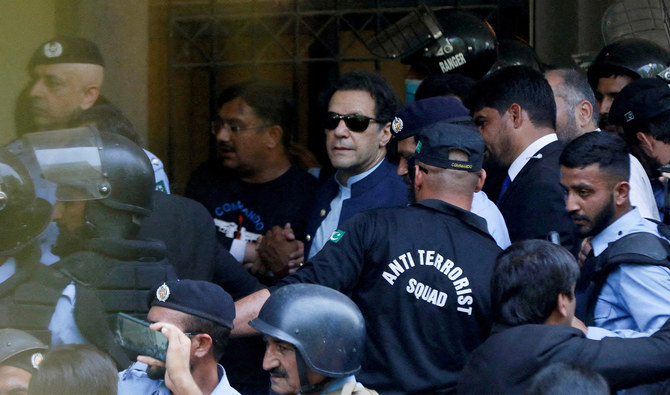

ISLAMABAD: Former prime minister Imran Khan’s lawyer met him in jail on Monday, saying his morale was high and a “core committee” would take decisions for his Pakistan Tehreek-e-Insaf (PTI) while its leader was imprisoned in a case involving the sale of state gifts.
Khan was arrested from his home in Lahore on Saturday and moved to a jail in Attock district, near Islamabad after he was sentenced to three years in jail by a lower court that declared him guilty of illegally selling state gifts and concealing the assets. Khan and his party have rejected the conviction as politically motivated, but it could likely end his chances of running in upcoming general elections, due in October or November.
“He is being kept in a lot of suffering in a class-C jail,” Khan’s lawyer Naeem Haider Panjutha told reporters after a nearly two-hour-long meeting with his client, referring to a cell with the least number of facilities under Pakistan Prison Rules 1978.
“But his morale is such that he was laughing and said it doesn’t matter.”
Panjotha said Khan’s cell had an “open washroom” and no shower and he was being fed pulses and spinach, but he was unfazed by the poor treatment.
Quoting Khan he said, “Tell everyone in front of the media that I will spend all my life in prison but never accept slavery.”
In Khan’s absence, he had empowered the PTI’s core committee to take important party decisions:
“No one person will take decisions,” the lawyer said, quoting Khan.
The PTI core committee comprises 33 members, though many of them have resigned since May when the party’s conflict with the military and the government intensified following violent street protests by Khan’s followers.
Indeed, Khan’s arrest is the latest in a series of blows that have weakened his political standing after he fell out with the powerful military and his party splintered.
Ever since his ouster in a parliamentary vote of no-trust last April, Khan has been campaigning for a snap election and organizing protests. His arrest in another graft case on May 9 led to significant violence, raising tensions with the military and the government of PM Shehbaz Sharif.
Khan accuses the military and his political opponents of plotting against him to block him from the upcoming election. The military, which has ruled Pakistan for about half its history, denies this.
PM Sharif is expected to call this week for the dissolution of parliament, ushering in a caretaker administration and paving the way for a general election by November.
Meanwhile, the PTI moved the Supreme Court against Saturday’s verdict by the trial court that landed the former cricket star in jail.
The PTI’s petition was filed under Article 184(2) of the Constitution and sought to have the case, popularly called the Toshakhana Case, heard again on the grounds that the PTI chief did not get a fair trial.
“A fundamental right under Article 10A, The Right to a Fair Trial, has been denied to Mr.Imran Khan the former Prime Minister of Pakistan in relation to his conviction in the Toshakhana case,” the PTI’s petition reads.
Article 184 confers original jurisdiction, the authority to hear a case at its initiation, often referred to as Public Interest Litigation, in the form of judicial review to Pakistan’s Supreme Court.
The petition argued that not only was the trial court’s judgment passed in haste, it was also announced in Khan’s absence and “in complete disregard” of the directions of the Islamabad High Court (IHC).
“That order of the Honourable Islamabad High Court dated 04.08.2023 distinctly remanded back the issue of maintainability to the learned Additional Sessions judge with the directions to decide it afresh … However, undermining this directive, the Learned judge bypassed any fresh decision-making and dismissed the application in violating haste and without objective evaluation of the case, subverting principles of natural justice,” the petition reads.