

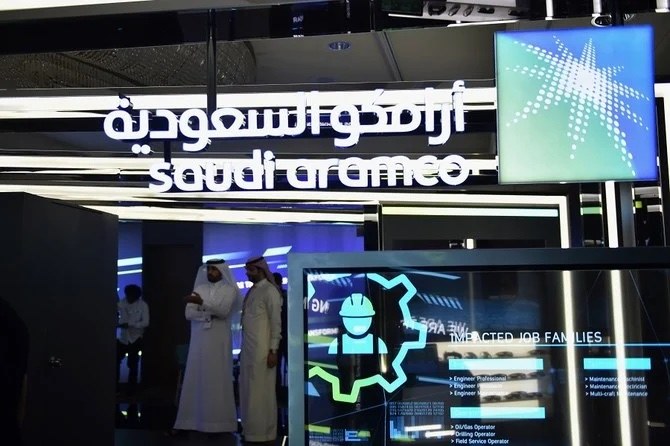
Saudi Aramco’s Q2 profit touches $30.07bn

Saudi Aramco’s net profit for the first half also dropped 29.52 percent to SR232.35 billion. (File)
Short Url
Updated 07 August 2023
Follow

Saudi Aramco’s Q2 profit touches $30.07bn

RIYADH: Global energy giant Saudi Arabian Oil Co. has posted a net profit of SR112.81 billion ($30.07 billion) in the second quarter of 2023, the company said in a bourse filing.   

In a statement to Tadawul, Saudi Aramco noted that the profit of the three months to the end of June was down 5.67 percent compared to the previous quarter when the company clocked a gain of SR119.54 billion.   

According to the statement, the drop in profit was due to lower crude oil prices and weakening refining and chemicals margins.   

Saudi Aramco’s net profit for the first half also dropped 29.52 percent to SR232.35 billion, compared to SR329.67 billion in the same period a year ago, the statement added.   

“Our strong results reflect our resilience and ability to adapt through market cycles. We continue to demonstrate our long-standing ability to meet the needs of customers around the world with high levels of reliability. For our shareholders, we intend to start distributing our first performance-linked dividend in the third quarter,” said Aramco’s President and CEO Amin Nasser in the statement.   

The bourse filing further noted that Saudi Aramco witnessed a 38 percent drop in net profit in the second quarter compared to the same period a year ago when the firm amassed a profit of SR181.64. 

After announcing the results, Saudi Aramco also declared a base dividend of $19.51 billion for the second quarter, roughly in line with its payout for the first three months of the year.

The oil company further noted that it would begin paying performance-linked dividends for six quarters, starting with a $9.9 billion payout in the third quarter.

In the press statement, Nasser added that the market will witness an economic recovery in the coming months of this year. 

“At Aramco, our mid to long-term view remains unchanged. With a recovery anticipated in the broader global economy and increased activity in the aviation sector, ongoing investments in energy projects will be necessary to safeguard energy security,” said Nasser. 

He added: “We are maintaining the largest capital spending program in our history, with the aim of increasing our oil and gas production capacity and expanding our downstream business — with petrochemicals projects, such as our $11 billion expansion of the SATORP refinery with TotalEnergies, essential to meet future demand.” 

Nasser also reiterated Saudi Aramco’s commitment toward sustainable goals and added that the company would work on future fuels like blue ammonia to meet net-zero goals. 

“We remain optimistic about the potential for new technologies to reduce our operational emissions, and our recent blue ammonia shipments to Asia highlight the growing market interest in the potential of alternative, lower-carbon energy solutions,” added Nasser. 

Saudi Aramco had set its net-zero target for 2050, 10 years earlier than Saudi Arabia’s 2060 goal to stop carbon emissions. 

As supply and demand issues elevated last year during Russia’s invasion of Ukraine, oil prices peaked and even touched $113 per barrel. However, this year, driven by an economic slowdown, oil prices started declining and top producers, including Saudi Arabia and Russia decided to reduce the output to stabilize the market. 

In April, the Organization of the Petroleum Exporting Countries and its allies, known as OPEC+, announced plans to reduce oil output by 1.2 million barrels per day. In those cuts, Saudi Arabia pledged to reduce production by 500,000 bpd.   

In June, Saudi Arabia also announced an additional cut of 1 million bpd for July and later to August.   

Earlier this month, Saudi Arabia extended its voluntary production cut of 1 million bpd to the end of September, adding that it could be extended beyond then or deepened. 


First EU–Saudi roundtable on critical raw materials reflects shared policy commitment

Updated 16 January 2026
Follow

First EU–Saudi roundtable on critical raw materials reflects shared policy commitment

RIYADH: The EU–Saudi Arabia Business and Investment Dialogue on Advancing Critical Raw Materials Value Chains, held in Riyadh as part of the Future Minerals Forum, brought together senior policymakers, industry leaders, and investors to advance strategic cooperation across critical raw materials value chains.

Organized under a Team Europe approach by the EU–GCC Cooperation on Green Transition Project, in coordination with the EU Delegation to Saudi Arabia, the European Chamber of Commerce in the Kingdom and in close cooperation with FMF, the dialogue provided a high-level platform to explore European actions under the EU Critical Raw Materials Act and ResourceEU alongside the Kingdom’s aspirations for minerals, industrial, and investment priorities.

This is in line with Saudi Vision 2030 and broader regional ambitions across the GCC, MENA, and Africa.

ResourceEU is the EU’s new strategic action plan, launched in late 2025, to secure a reliable supply of critical raw materials like lithium, rare earths, and cobalt, reducing dependency on single suppliers, such as China, by boosting domestic extraction, processing, recycling, stockpiling, and strategic partnerships with resource-rich nations.

The first ever EU–Saudi roundtable on critical raw materials was opened by the bloc’s Ambassador to the Kingdom, Christophe Farnaud, together with Saudi Deputy Minister for Mining Development Turki Al-Babtain, turning policy alignment into concrete cooperation.

Farnaud underlined the central role of international cooperation in the implementation of the EU’s critical raw materials policy framework.

“As the European Union advances the implementation of its Critical Raw Materials policy, international cooperation is indispensable to building secure, diversified, and sustainable value chains. Saudi Arabia is a key partner in this effort. This dialogue reflects our shared commitment to translate policy alignment into concrete business and investment cooperation that supports the green and digital transitions,” said the ambassador.

Discussions focused on strengthening resilient, diversified, and responsible CRM supply chains that are essential to the green and digital transitions.

Participants explored concrete opportunities for EU–Saudi cooperation across the full value chain, including exploration, mining, and processing and refining, as well as recycling, downstream manufacturing, and the mobilization of private investment and sustainable finance, underpinned by high environmental, social, and governance standards.

From the Saudi side, the dialogue was framed as a key contribution to the Kingdom’s industrial transformation and long-term economic diversification agenda under Vision 2030, with a strong focus on responsible resource development and global market integration.

“Developing globally competitive mineral hubs and sustainable value chains is a central pillar of Saudi Vision 2030 and the Kingdom’s industrial transformation. Our engagement with the European Union through this dialogue to strengthen upstream and downstream integration, attract high-quality investment, and advance responsible mining and processing. Enhanced cooperation with the EU, capitalizing on the demand dynamics of the EU Critical Raw Materials Act, will be key to delivering long-term value for both sides,” said Al-Babtain.

Valere Moutarlier, deputy director-general for European industry decarbonization, and directorate-general for the internal market, industry, entrepreneurship and SMEs at European Commission, said the EU Critical Raw Materials Act and ResourceEU provided a clear framework to strengthen Europe’s resilience while deepening its cooperation with international partners.

“Cooperation with Saudi Arabia is essential to advancing secure, sustainable, and diversified critical raw materials value chains. Dialogues such as this play a key role in translating policy ambitions into concrete industrial and investment cooperation,” she added.