

Philippines summons Chinese ambassador over South China Sea incident

The Philippine military condemned the Chinese coast guard ship’s ‘excessive and offensive’ use of a water cannon to block a Filipino supply boat to the Philippine-occupied Second Thomas Shoal in the disputed South China Sea. (Philippine Coast Guard via AP)
Short Url
Updated 07 August 2023
Follow

Philippines summons Chinese ambassador over South China Sea incident

  • The Philippines has filed over 400 diplomatic protests against China since 2020
  • China claims sovereignty over almost the entirety of the South China Sea

MANILA: The Philippines summoned on Monday Beijing’s ambassador to Manila to protest the China Coast Guard’s use of a water cannon against a Filipino supply boat in the disputed South China Sea.

The Philippine Coast Guard said on Sunday that its Chinese counterpart had fired a water cannon and used “dangerous” moves to block a chartered Philippine vessel that was on a routine troop rotation and resupply mission near the Second Thomas Shoal, which Manila calls Ayungin Shoal.

“A note verbale … was issued during the summon of the Chinese ambassador by Undersecretary (Theresa) Lazaro,” Department of Foreign Affairs spokesperson Teresita Daza said during a press conference in Manila, referring to a DFA official.

“Lazaro conveyed to the Chinese ambassador this morning the strong protest of the Philippine government … The Philippines demands that China immediately stop its illegal activities in our maritime zones.”

Manila’s ambassador in Beijing has also handed a protest note to the Chinese Foreign Ministry on Monday morning, Daza added.

The Philippines has filed over 400 diplomatic protests against China since 2020, and nearly three dozen were filed so far this year.
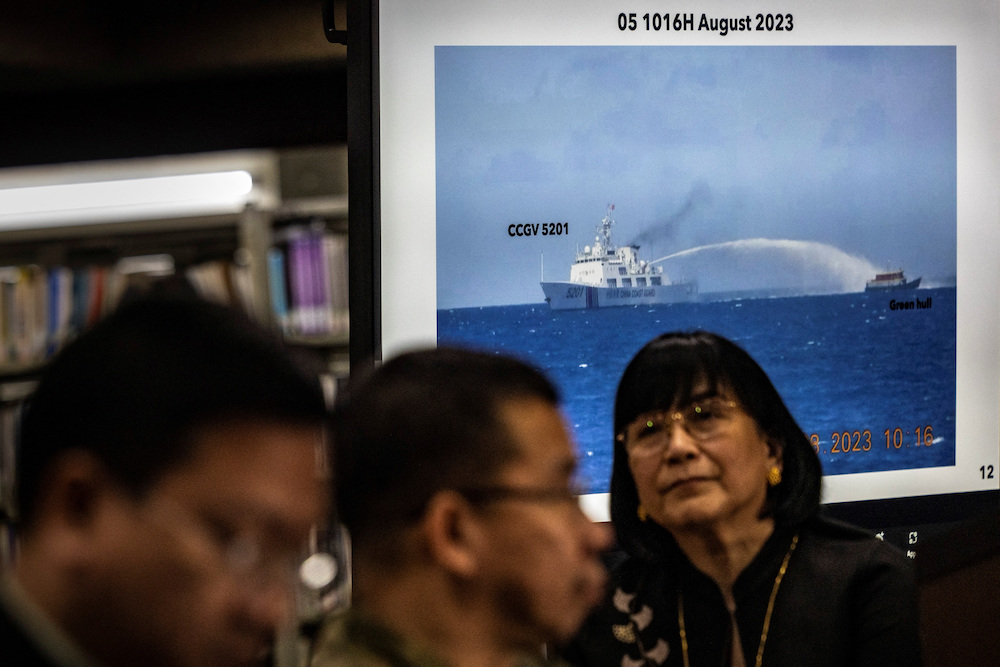


Philippines' foreign ministry holds a joint news conference on water cannon incident in the South China Sea on Aug. 7, 2023. (Supplied)

President Ferdinand Marcos Jr. said on Monday that the Philippines will continue “to assert our territorial rights in the face of all of these challenges and consistent with the international law.”

Last month, the Philippines stepped up patrols in its part of the South China Sea after recording dozens of “Chinese maritime militia” in the contested, resource-rich waterway.

China claims sovereignty over almost the entirety of the South China Sea based on its so-called “nine-dash line” stretching over 1,500 km off its mainland and cutting into the exclusive economic zones of several countries, including the Philippines.

Though an international tribunal in The Hague dismissed the expansive Chinese claim of the waters in 2016, Beijing does not recognize the ruling and has in recent years increased activities in the area, including developing its military presence by building artificial island bases.

“We will never abandon Ayungin Shoal,” said Jonathan Malaya, spokesperson for the National Task Force on the West Philippine Sea, or the Philippine part of the South China Sea.

“We are here precisely to assure the Filipino people that we are consistent with the president’s directive that we will not lose an inch of our territory.” 


Trump set to expand immigration crackdown in 2026 despite brewing backlash

Updated 7 sec ago
Follow

Trump set to expand immigration crackdown in 2026 despite brewing backlash

  • Trump plans to increase workplace raids despite political risks
  • ICE and Border Patrol to receive $170 billion funding boost
WASHINGTON: US President Donald Trump is preparing for a more aggressive immigration crackdown in 2026 with billions in new funding, including by raiding more workplaces — even as backlash builds ahead of next year’s midterm elections. Trump has already surged immigration agents into major US cities, where they swept through neighborhoods and clashed ​with residents. While federal agents this year conducted some high-profile raids on businesses, they largely avoided raiding farms, factories and other businesses that are economically important but known to employ immigrants without legal status. ICE and Border Patrol will get $170 billion in additional funds through September 2029 — a huge surge of funding over their existing annual budgets of about $19 billion after the Republican-controlled Congress passed a massive spending package in July. Administration officials say they plan to hire thousands more agents, open new detention centers, pick up more immigrants in local jails and partner with outside companies to track down people without legal status.
The expanded deportation plans come despite growing signs of political backlash ahead of next year’s midterm elections.
Miami, one of the cities most affected by Trump’s crackdown because of its large immigrant population, elected its first Democratic mayor in nearly three decades last week in what the mayor-elect said was, in part, a reaction to the president. Other local elections and polling ‌have suggested rising concern among ‌voters wary of aggressive immigration tactics. “People are beginning to see this not as an immigration question anymore ‌as ⁠much ​as it ‌is a violation of rights, a violation of due process and militarizing neighborhoods extraconstitutionally,” said Mike Madrid, a moderate Republican political strategist. “There is no question that is a problem for the president and Republicans.” Trump’s overall approval rating on immigration policy fell from 50 percent in March, before he launched crackdowns in several major US cities, to 41 percent in mid-December, for what had been his strongest issue. Rising public unease has focused on masked federal agents using aggressive tactics such as deploying tear gas in residential neighborhoods and detaining US citizens.

’NUMBERS WILL EXPLODE’
In addition to expanding enforcement actions, Trump has stripped hundreds of thousands of Haitian, Venezuelan and Afghan immigrants of temporary legal status, expanding the pool of people who could be deported as the president promises to remove 1 million immigrants each year – a goal he almost certainly will miss this year. So far, some 622,000 immigrants ⁠have been deported since Trump took office in January.
White House border czar Tom Homan told Reuters Trump had delivered on his promise of a historic deportation operation and removing criminals while shutting down illegal immigration across ‌the US-Mexico border. Homan said the number of arrests will increase sharply as ICE hires more ‍officers and expands detention capacity with the new funding.
“I think you’re going to ‍see the numbers explode greatly next year,” Homan said.
Homan said the plans “absolutely” include more enforcement actions at workplaces.
Sarah Pierce, director of social policy at the ‍center-left group Third Way, said US businesses have been reluctant to push back on Trump’s immigration crackdown in the past year but could be prompted to speak up if the focus turns to employers.
Pierce said it will be interesting to see “whether or not businesses finally stand up to this administration.”
Trump, a Republican, recaptured the White House promising record levels of deportations, saying it was needed after years of high levels of illegal immigration under his Democratic predecessor, Joe Biden. He kicked off a campaign that dispatched federal agents to ​US cities in search of possible immigration offenders, sparking protests and lawsuits over racial profiling and violent tactics.
Some businesses shut down to avoid raids or because of a lack of customers. Parents vulnerable to arrest kept their children home from school or had neighbors ⁠walk them. Some US citizens started carrying passports. Despite the focus on criminals in its public statements, government data shows that the Trump administration has been arresting more people who have not been charged with any crimes beyond their alleged immigration violations than previous administrations.
Some 41 percent of the roughly 54,000 people arrested by ICE and detained by late November had no criminal record beyond a suspected immigration violation, agency figures show. In the first few weeks in January, before Trump took office, just 6 percent of those arrested and detained by ICE were not facing charges for other crimes or previously convicted. The Trump administration has taken aim at legal immigrants as well. Agents have arrested spouses of US citizens at their green card interviews, pulled people from certain countries out of their naturalization ceremonies, moments before they were to become citizens, and revoked thousands of student visas.
PLANS TO TARGET EMPLOYERS
The administration’s planned focus on job sites in the coming year could generate many more arrests and affect the US economy and Republican-leaning business owners.
Replacing immigrants arrested during workplace raids could lead to higher labor costs, undermining Trump’s fight against inflation, which analysts expect to be a major issue in the closely watched November elections, determining control of Congress. Administration officials earlier this year exempted such businesses from enforcement on Trump’s orders, then quickly reversed, Reuters reported at the time.
Some immigration hard-liners have ‌called for more workplace enforcement.
“Eventually you’re going to have to go after these employers,” said Jessica Vaughan, policy director for the Center for Immigration Studies, which backs lower levels of immigration. “When that starts happening the employers will start cleaning up their acts on their own.”